
Come, Ask About My Loneliness — Terrill Welch by herself - issue #63
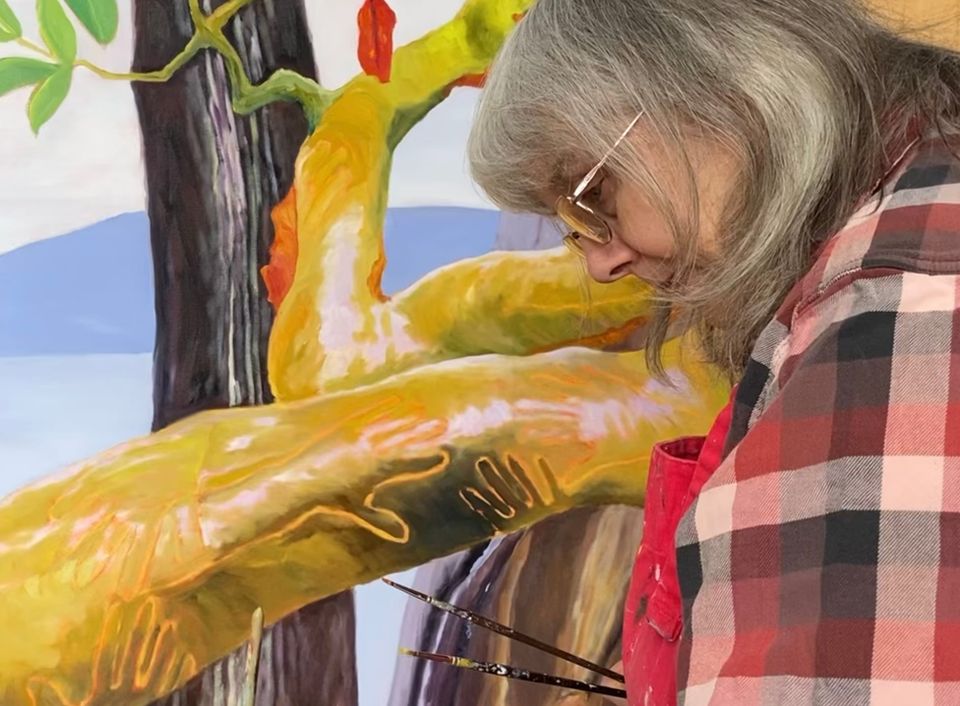
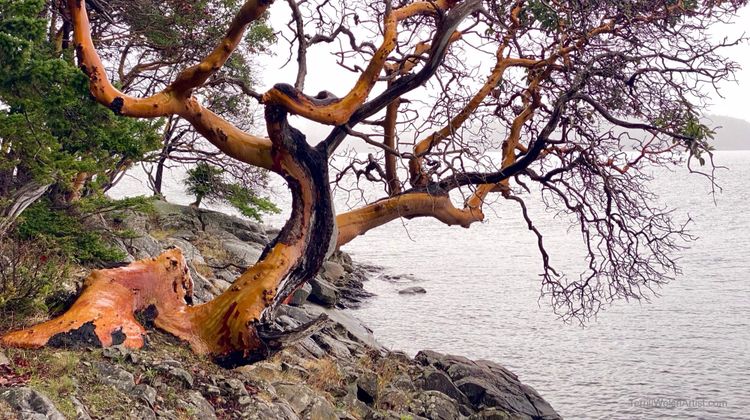
The answer came slowly and didn’t emerge until about halfway through my hike when I came across a lone arbutus tree between two older fir trees near the Navy Channel side of a trail in Saint John Point Park on Mayne Island in British Columbia. I had just finished videoing part of the trail with the sound of the rain. I paused to look around and listen before continuing on the trail. My question on this day when I went out to gather references for this painting was — what is this forest asking of me?
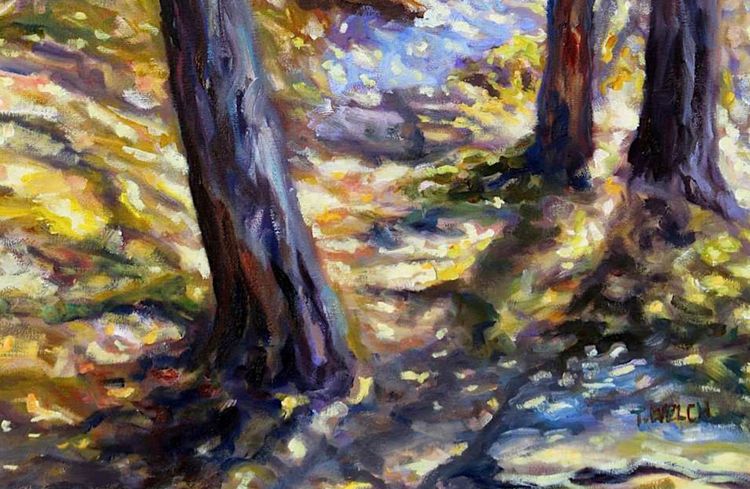
You will remember these reference images from an earlier issue that can be revisited at:
https://terrill-welch.ghost.io/something-that-arises-of-itself-terrill-welch-by-herself-issue-61/
I have placed them in a collage here for quick review.
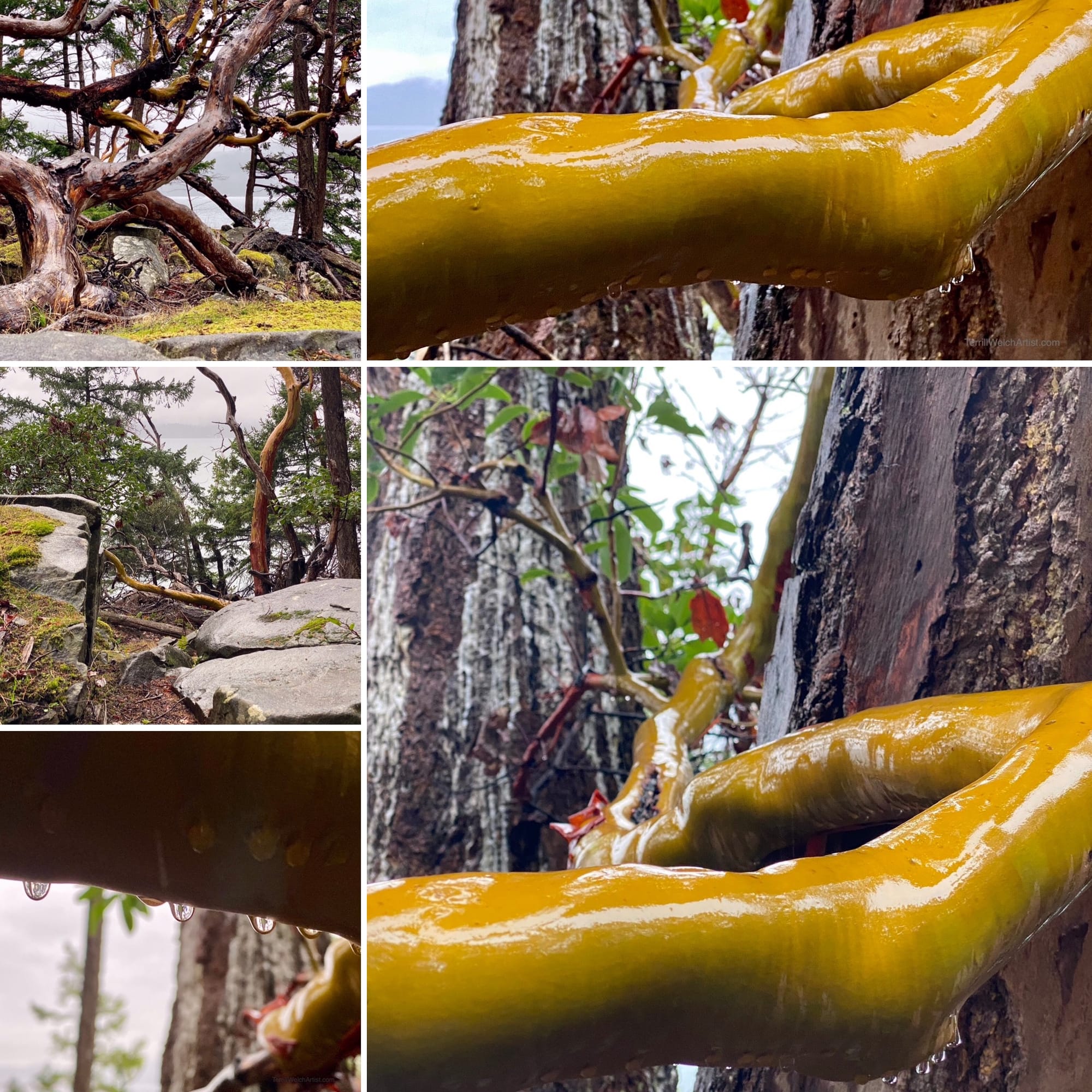
The sensations ran through my hand resting on this cool, smooth trunk and right through my body where it flowed deep down into the forest floor. No words were adequate or necessary.
Making Process:
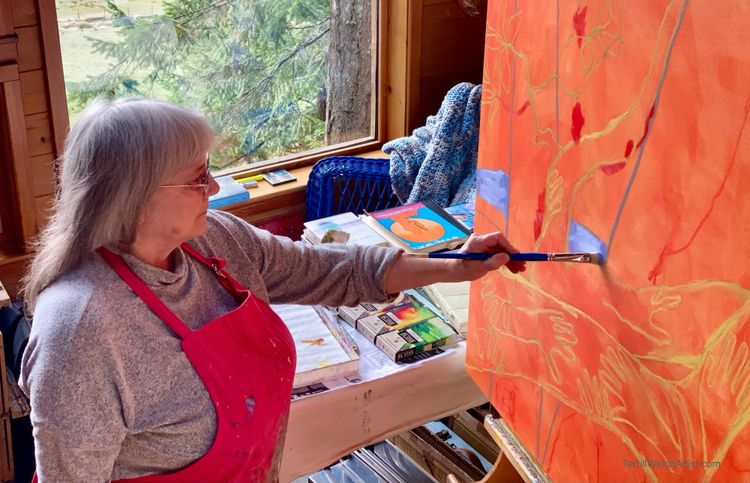
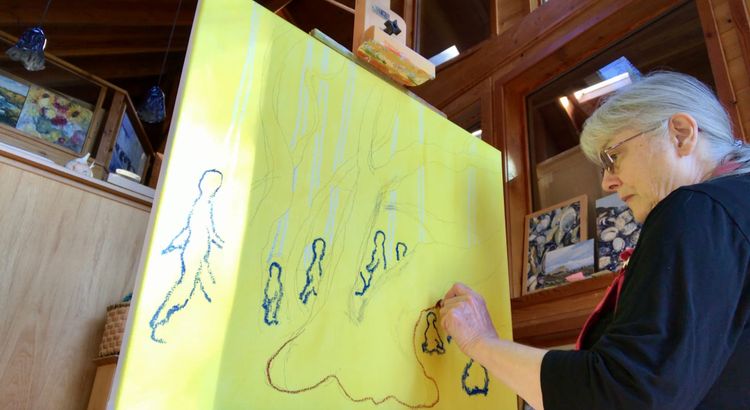
When I returned to the studio and for several days following, I mused about what I wanted to paint and how I wanted it to feel. The canvas already had an orange acrylic ground and a hanging wire. I put it up on the easel and grabbed a pencil to make some early marks for consideration. I changed my question from my field exploration from — “what is this forest asking of me?” to — “what is this canvas asking of me?”
What will I leave out? How can I imagine my conversation with this arbutus tree and our shared connection? I didn’t have answers so I began working with just the questions and my usual response — we shall see.
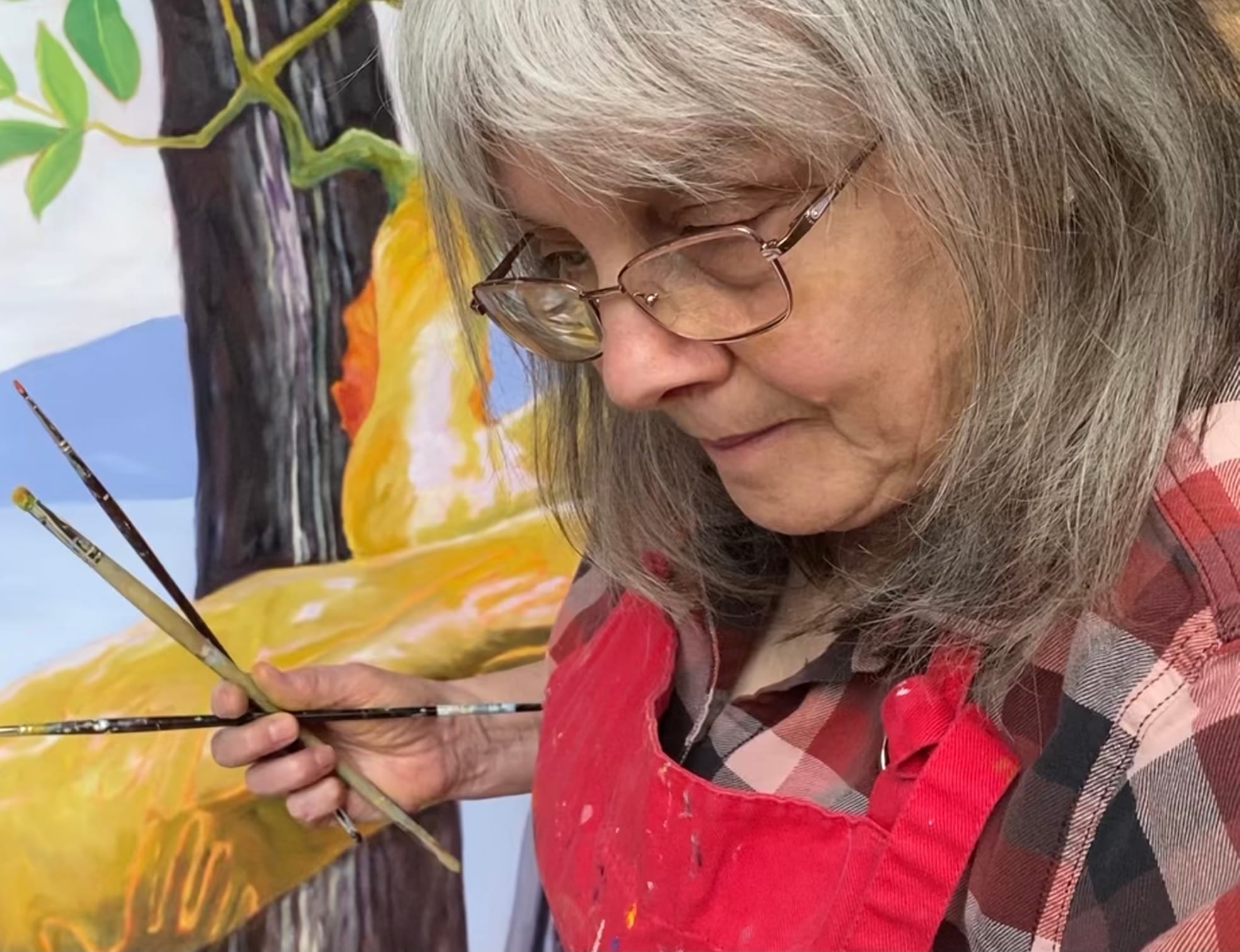
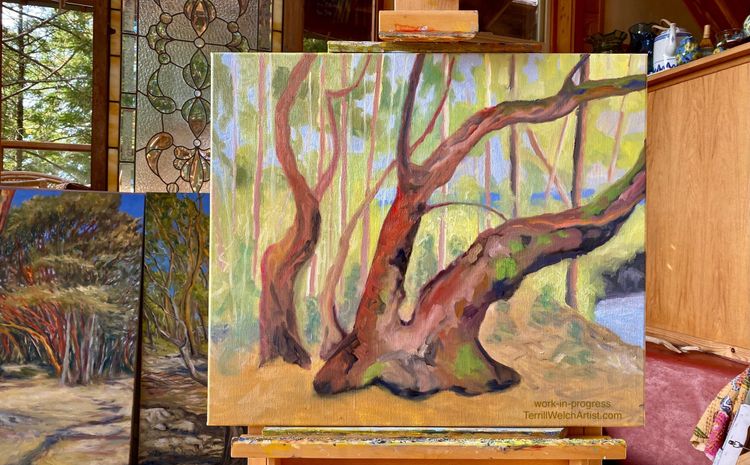
I worked for several days first with the pencil to get the composition portions and then with oil sticks so I could see where I was going. Finally, I began painting back to front with Lukas Berlin water mixable oils because they dry the quickest of my oil paints. I do not use them very often anymore and they are stiff and require a firm hand on the brush that is pushed hard onto the canvas. I then moved on to the vibrant Michael Harding oil and warmer M.Graham oils. It is still an “oil on canvas” painting but more intricately rendered than the description implies.
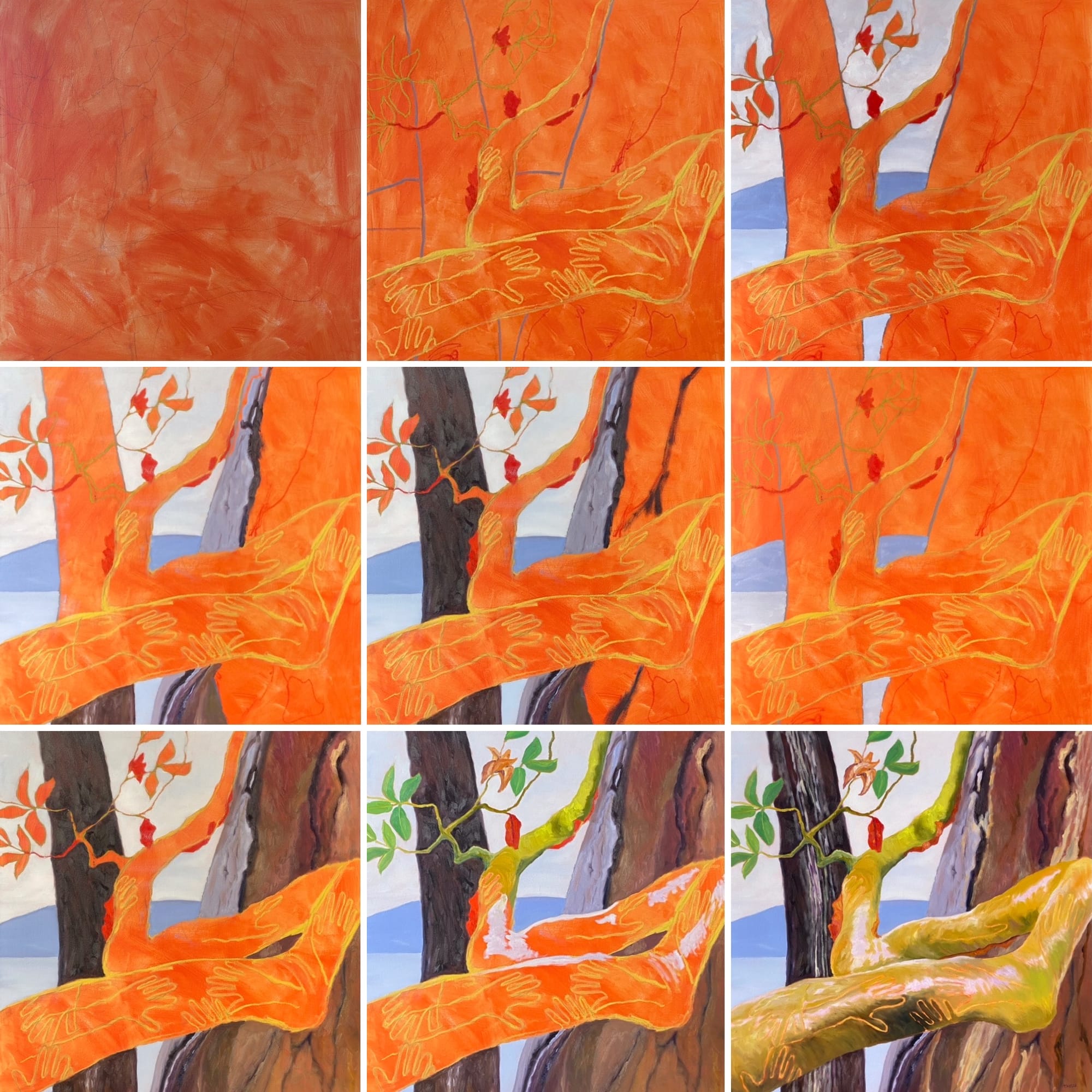
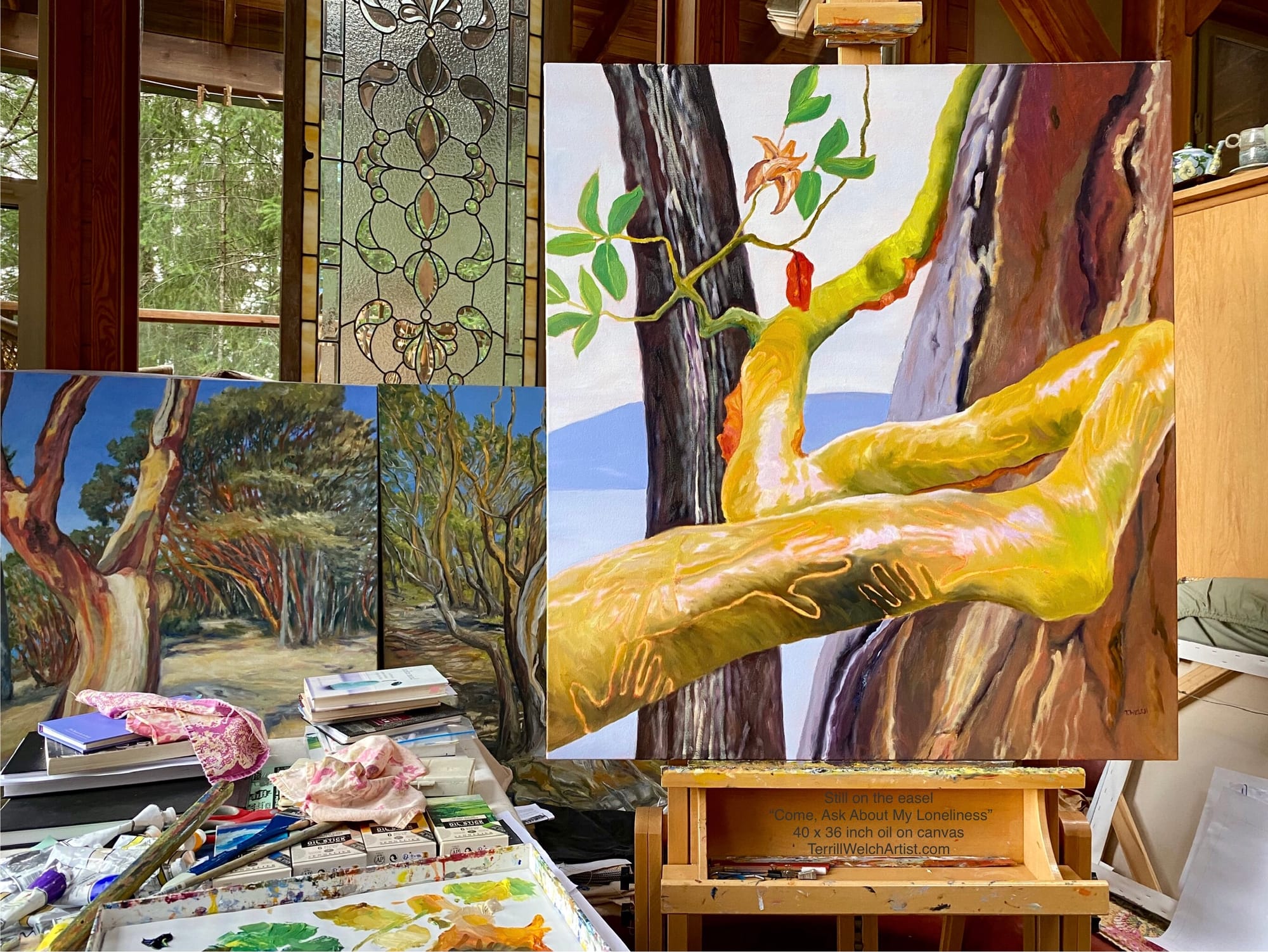
I traced my hands onto the trunk of the arbutus tree as a way to symbolize our connection and shared exchange. At first I was unsure if they would remain visible on the surface of the painting and if so, how would I get it to work? I again stayed with the question and kept working. Eventually, as it was the last thing I painted, it came together. The handprints are there with the yellow oil stick showing and some of the orange ground around it. It works!
Finished Painting:
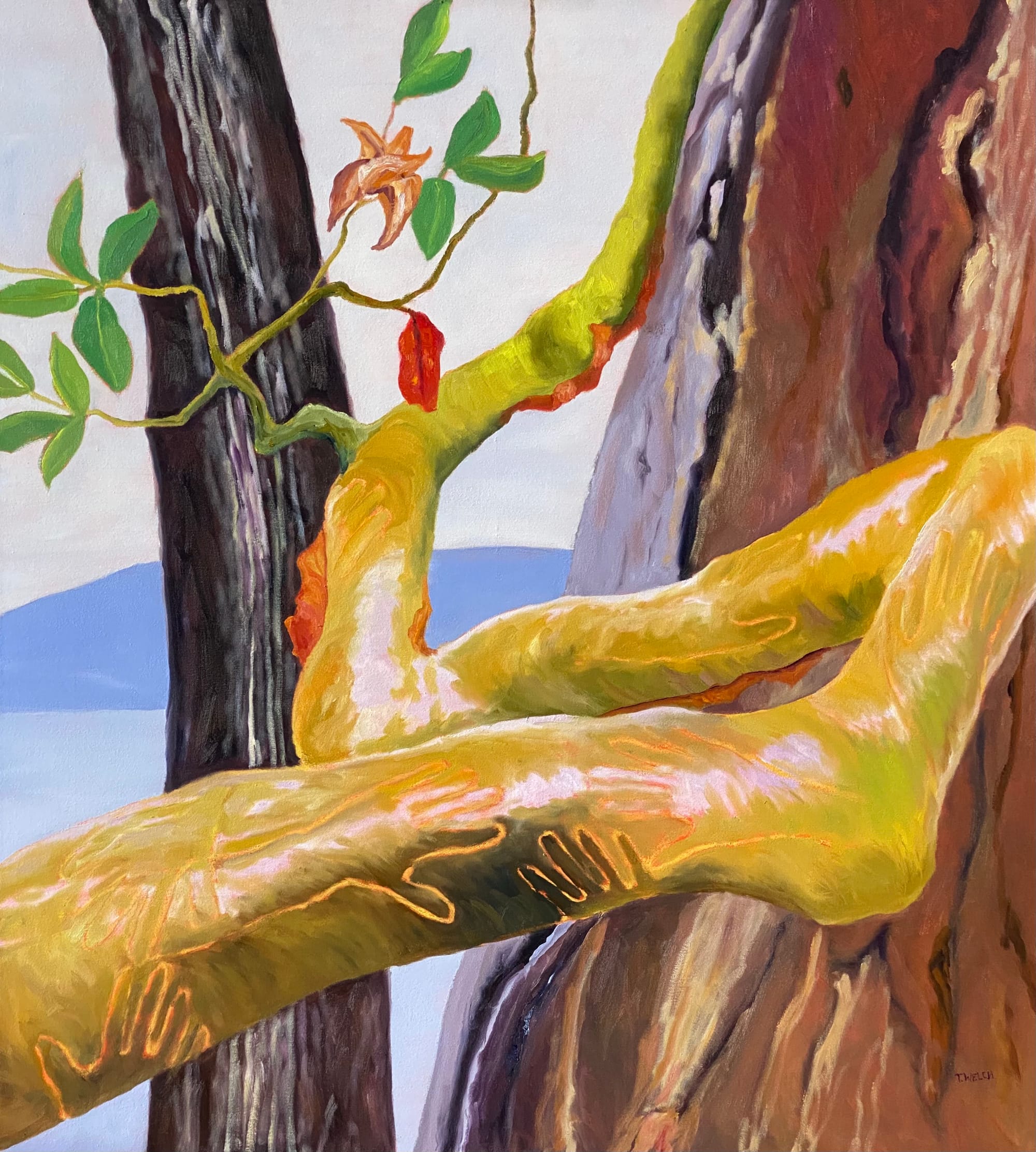
Artist notes: The late autumn rains are heavy as a lightly bruised opaque sky drops to earth and wraps itself around a lone arbutus snaking between a couple of old fir trees at the edge of the trail. I stop and then reach out to rest my hands on the smooth, cool, freshly peeled bark. I feel the lament of the tree as if it could read my own thoughts - come, ask about my loneliness. Did I dare inquire as I stood there damp on a rare afternoon to myself? If I did, would we, the tree and I, weep uncontrollably? Or would it be a comforting embrace of simply knowing what is hard to comprehend in words? I take a chance knowing that both would likely be true at the same time. I also understand that deep wells of loneliness are often glimpses into great losses. For the arbutus tree, it is the absence of kin caused by a ravaged forest floor from an invasive and starving deer species and conditions that have been exacerbated by a series of summer droughts. For me, it is the unrelenting progression of my partner’s dementia as I care, monitor, coax, prompt, guide and observe. Neither the arbutus tree nor I can fix our circumstances. We are here, bearing witness and loving our way through our loneliness. Today and this moment are enough. The handprints on the trunk of the arbutus tree are tracings of my own hands on the canvas that I then outlined using a yellow oil stick over the orange acrylic ground. No arbutus tree was carved or harmed in the making of this painting.
Here it is still resting in the easel.
And here it is in a digital viewing room without so many distraction.
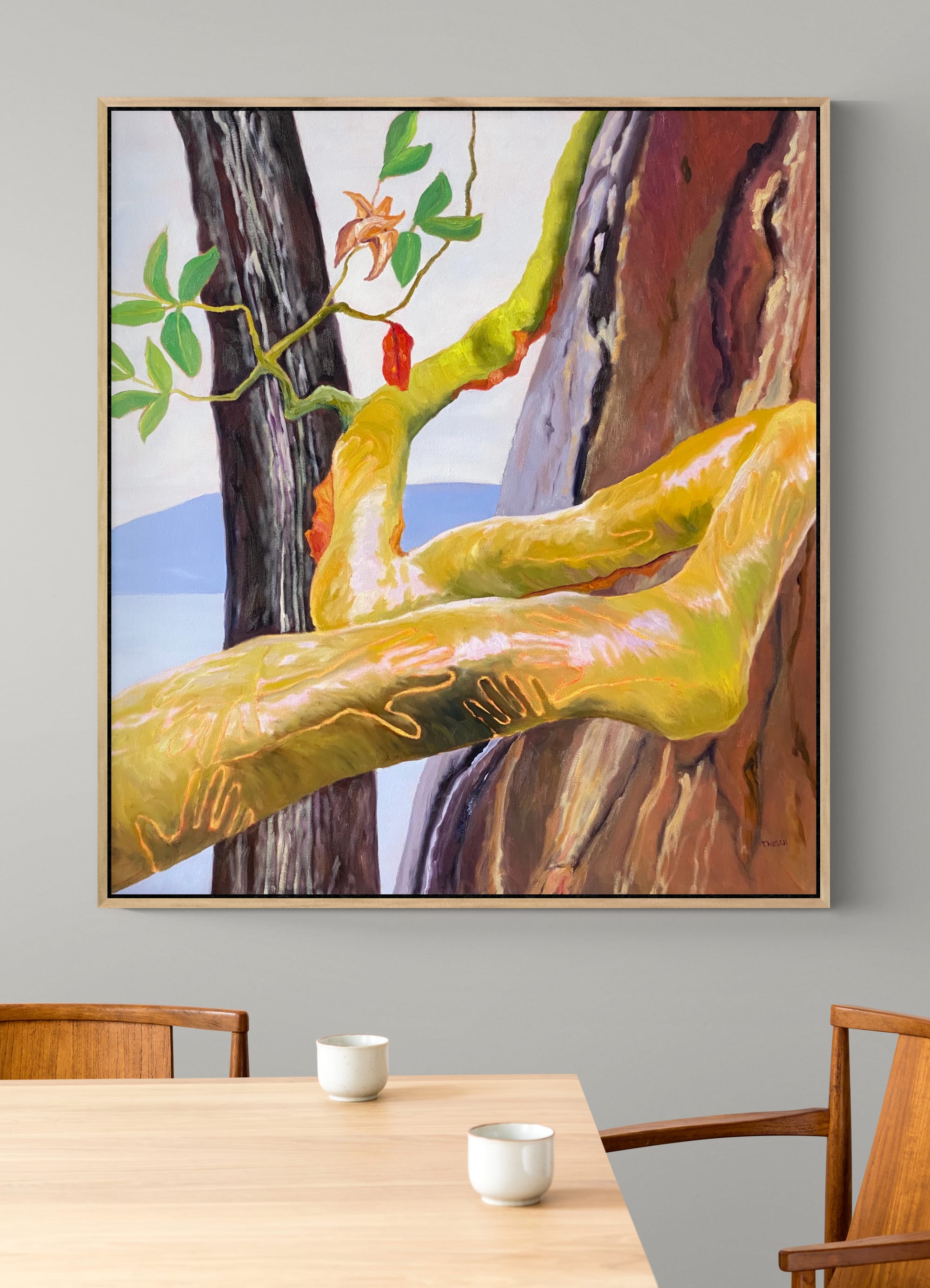
This painting is not yet released from its “resting” status. However, you are welcome to inquire about purchasing it if you are interested in adding it to your art collection.
Reflective Analysis:
The title “Come, Ask About My Loneliness” of this painting is important to placing my first viewer’s presence within the work. I didn’t write about the painting until it was finished. Then the words came easily. I wanted to make space for loneliness in a way that required no fixing. I wanted space for acknowledgment and generosity of kindness without pity or indifferent dismissiveness. It is a hard task to find a way to invite someone to stand beside you in your loneliness and expect only that they can feel it as well. We are not used to remaining this uncomfortable with each other. But trees are skilled in this way. If I put my hand on a tree, it effortlessly bears witness with me in a shared compassionate exchange that so often challenges my fellow humans. This is part of my mono no aware practice. Mono no aware is Japanese and means allowing yourself to feel the full weight of a moment - the joy and the sadness simultaneously - without trying to hold on to it or push it away:
It means being present with the people you love, knowing that your time together is precious precisely because it is limited. It means finding beauty in things that are worn, weathered, and imperfect - in the falling petals, the fading seasons, the quiet endings that are as much a part of life as the beginnings. Mono no aware does not ask us to be sad; it asks us to be awake - to the beauty that is always here, always passing, always worthy of our attention and our gratitude.(Hanabira, 2026)
I want to be able to live fully with my loneliness and acknowledge its essential beauty. This is what I am sharing with the viewer, with you, in this painting.
Reflexive Analysis:
Every once in a while someone says something that resonates with me like what Joshua Smith, PhD, shared in his latest newsletter — “Making things well often feels less like imposing a plan and more like keeping up one half of a conversation.” This is what it is like when I am making with nature. Smith was explaining the small sounds a Japanese listener makes when someone is speaking and how this provides a space for the speaker to know they are heard and to encourage them to lean into their conversation. Then he went on to describe how our subjects and materials are one half of a conversation and the artist, potter or photographer is the other. In my work, sometimes I am the listener and other times I am the speaker while I hold an intention for an idea in my nature-centric, reparative painting practice. The Shizan Style (shizan means nature, natural, and spontaneous): something that arises of itself, feels as “Close to Home” as I can get in my making practice. It is the place from within which this painting arises.
This painting is influenced by my study of komorebi and mono no aware, borrowed Japanese words for a congruent and harmonious life within nature. Sometimes we need to reach across cultures to find the words because the concept of noticing what we are observing was so important to them that they created a perfect word for it. I will leave a references for you below to explore further if you wish.
Key Findings:
I can now see a path forward into this next body of work using the same close up intimacy that emerged in my Seafloor series.
Anything else:
I am returning to an earlier exploration with The Zen of Creativity: Cultivating Your Artistic Life by John Daido Loori, 2005 and I will now add in a study practice six week workshop “The Japanese Art of Intentional Living” drawn from Japanese aesthetics and philosophy by Joshua Smith as a source of continuing my professional artist practice development. I had wanted to go in this direction during my MA Fine Art degree but was encouraged to stay within western art theory and research. I am now returning to this vein of inquiry as it seems to be the most fruitful foundation for my nature-centric, restorative painting practice. I want to spend my time over the next while studying concepts such as the Japanese word mono no aware https://hanabira.org/japanology/mono-no-aware to determine what it can offer my lived experiences and painting practice on the southwest coast of Canada in a western culture.
Reference:
Hanabira (2026). Mono no aware: The bittersweet awareness of impermanence and the gentle sadness of passing things. [online] Hanabira. Available at: https://hanabira.org/japanology/mono-no-aware [Accessed 19 Nov. 2026].
UNTIL NEXT TIME
You may have noticed that this issue takes its structure from my data collection for this painting. I felt it is important to share snippets from this material because it profoundly influences the direction of my current “Close to Home” series and body of work. That bittersweet tension between sadness and beauty is often present in my work but it is something I take for granted rather than as a vein of inquiry for deep investigation. My current work seems to be taking on this rigorous exploration with renewed commitment.
There are just four days left in the November Special Savings offer. The specifics for the 10% and 20% savings can be found in the first November issue at:
Thank you to everyone who has considered this opportunity and to those of you that have shared it with others. This is the final special offer for 2026 and I am looking forward to what the next year has in store.
We have had family visiting most of this past week and so this is about all there is to share at the moment.
I wish you each all the best for the week ahead and I look forward to connecting again next Friday!
Warm regards as always,
Terrill 👩🎨❤️🎨
Member discussion