Terrill Welch by herself - issue #40 Traveling Through Time in a Clamshell
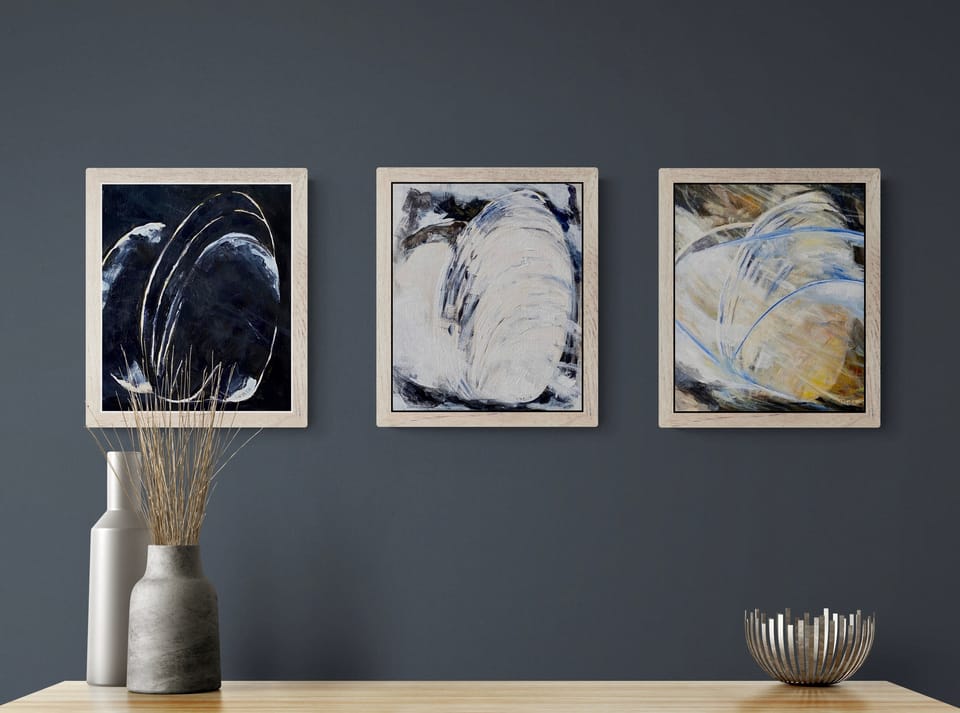
Longer days in March have arrived with new paintings completed, brief introductions to fellow artists and a Spring Studio Tour in early April to announce. Please come into my world of painting, research and exploration! The bulk of this issue will be about five new paintings, though three are a triptych so that brings the number down to three I suppose. Either way, this is a sharing of practice this time from excerpts recorded in my art journal and a few extra bits thrown in for good measure. Shall we!?
Quick housekeeping note before we begin: Sometimes my newsletters are long enough that they get cut off in the email version before the end (this will likely be one of those newsletters). To avoid missing out and to get the best viewing and reading experience, click ‘View in Browser’ that will be underlined and between the date of the issue above and the top of the image in your email. This is a common challenge that most of you will have figure out but I was reminded of it when someone said they couldn’t see my Japanese Garden images in the previous issue.
Now let’s get started from the beginning with the triptych ‘Clamshell Travel’
HOW LITTLE IS NECESSARY TO CAPTURE THE FULLNESS OF MY EXPERIENCE?
Wednesday, 18 February 2026
My studio space is occupied by a painting with its edges drying on my work table at the moment. This happens sometimes if I am painting edges on several paintings at a time and it is the only flat surface left besides our kitchen table.
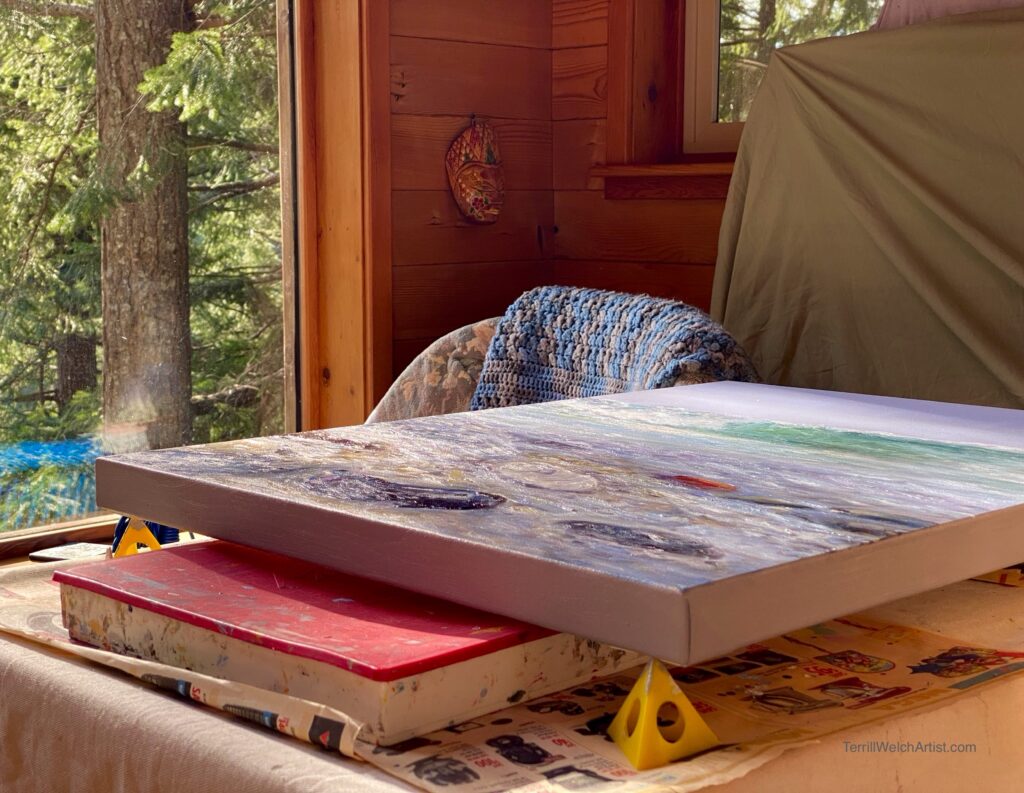
So I decided to resort to digital tools to explore a question - How little is necessary to capture the fullness of my experience? Basically, is there one mark or line that can stand in for many others? I have toyed with this before with the notion of simplifying without diluting so that the end result is stronger than where the inspiration began.
The cropped photograph from which I begin.
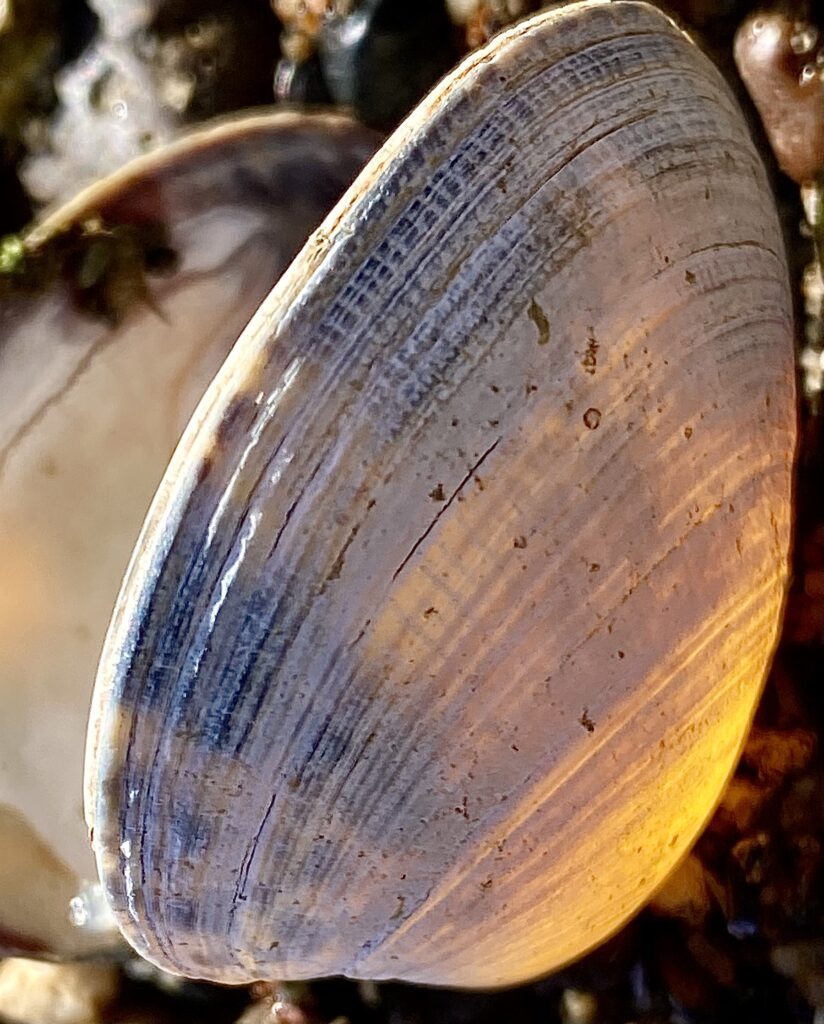
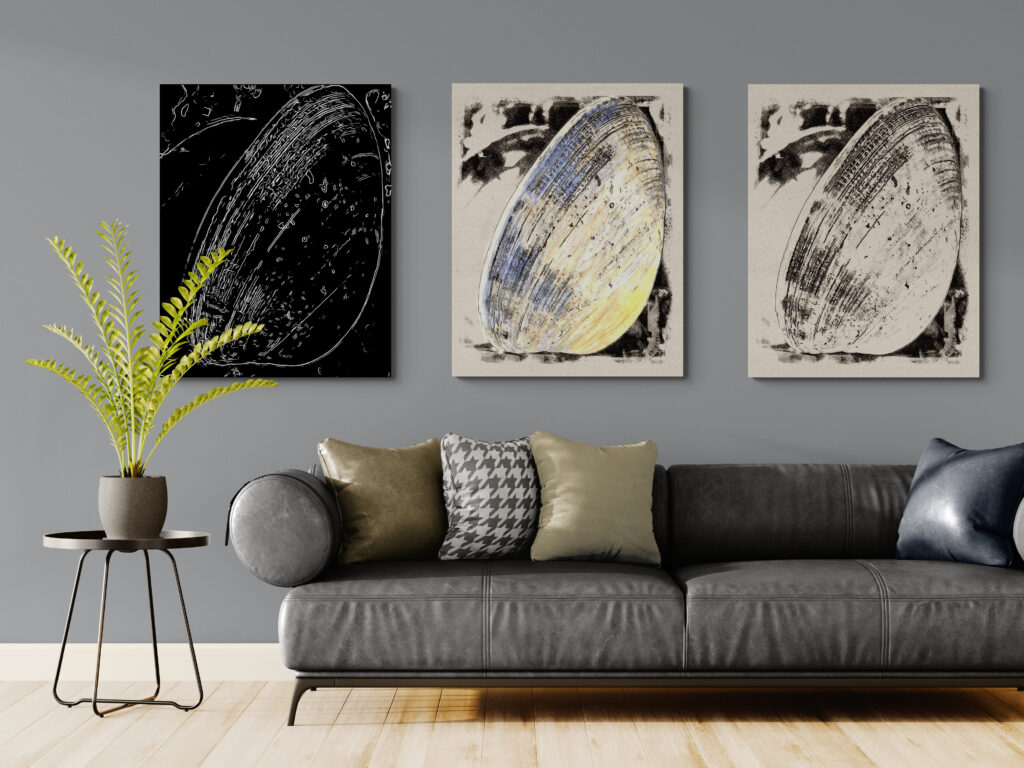
It is usually an exercise in taking away and then adding back that takes place between sketches and then paint. In this instance, the sketches are three different digital renderings.
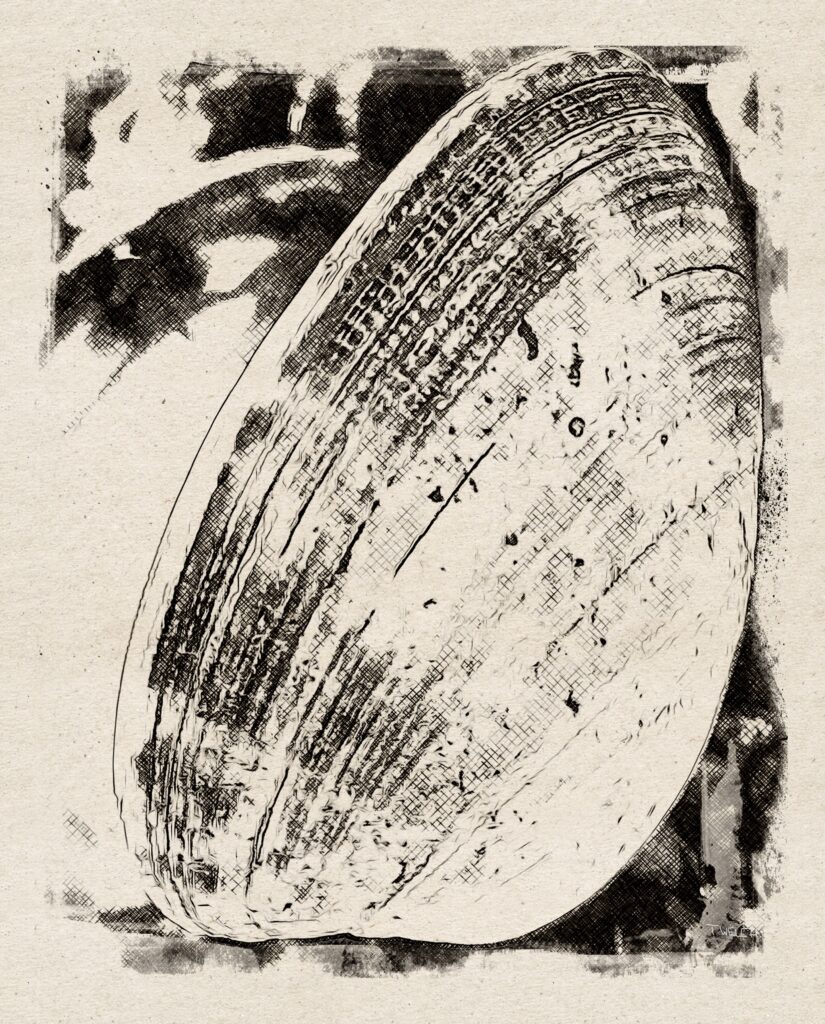
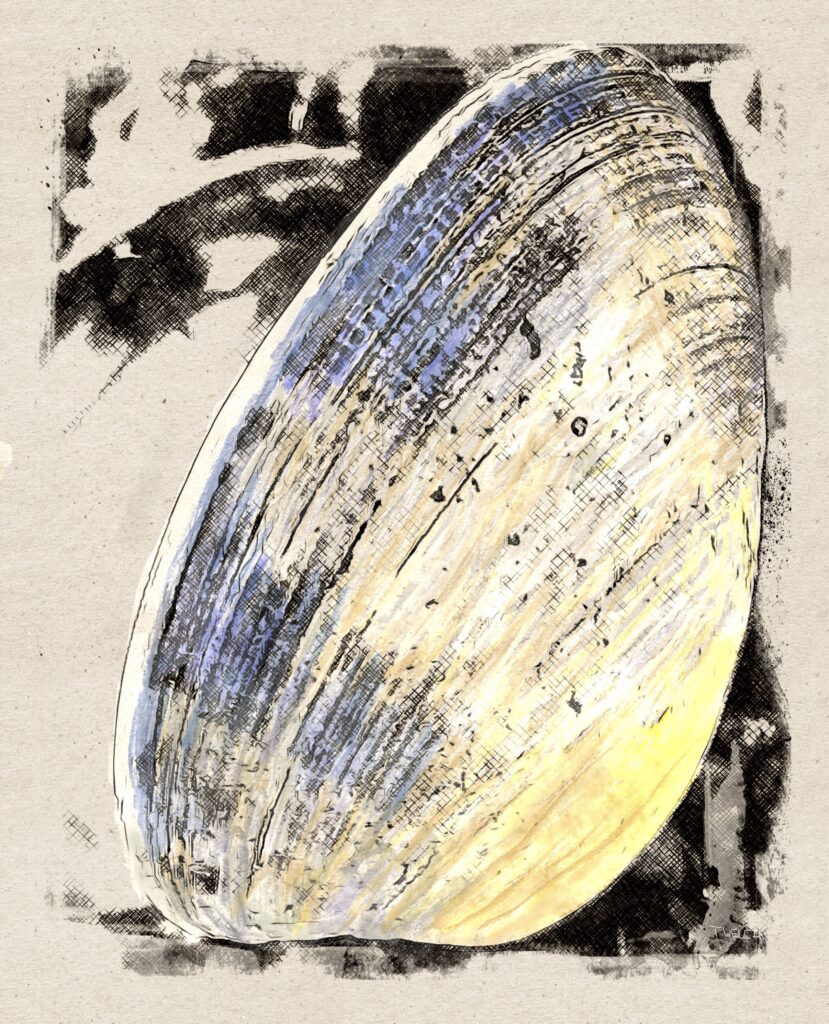
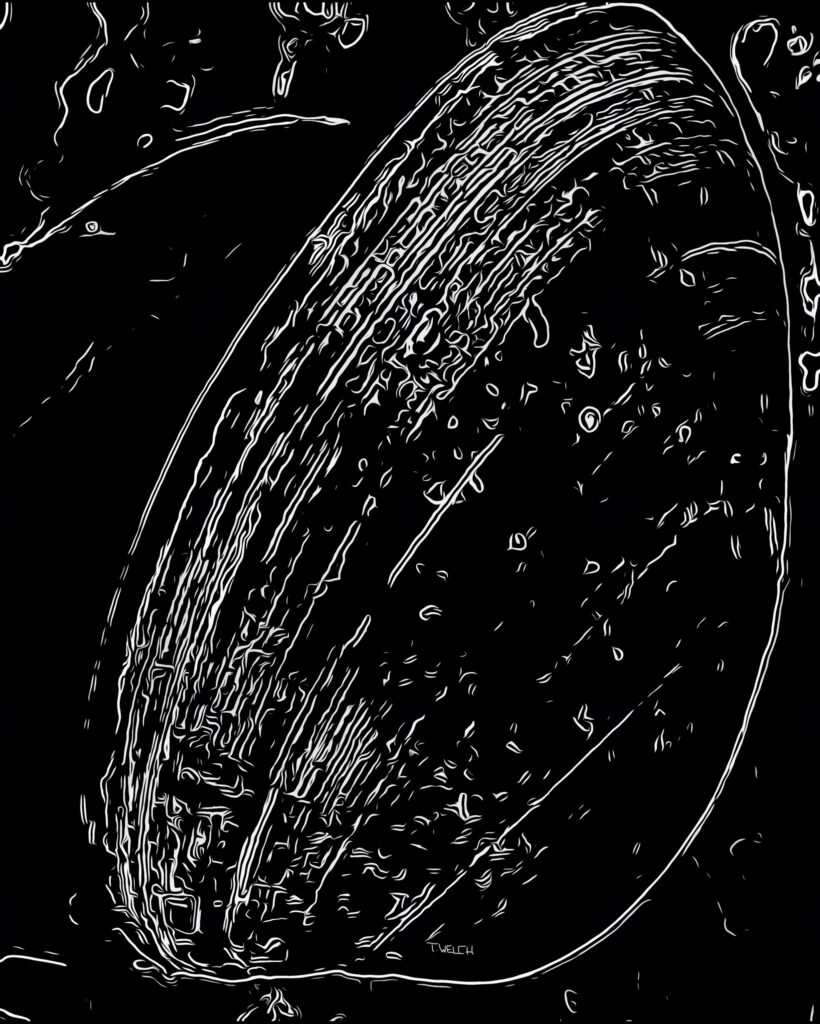
I then placed them in a digital viewing room to get a better feel for them. At first, I made the works too large at 48 x 40 inches and then settled for 38 x 30 inches which could easily be painted on a Canadian standard 40 x 30 inch canvas. However, this room view provides an estimate of the works at 38 x 30 inches each.
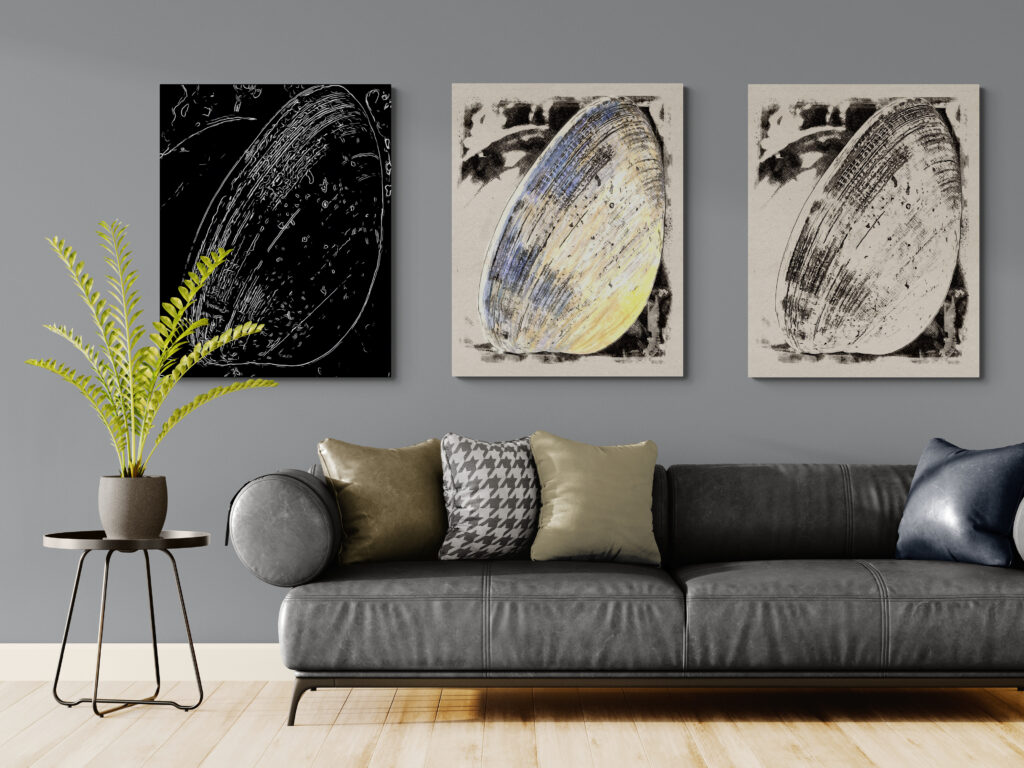
I also used Layout app to explore what it would be like to compose these three images together in a 40 inch square and then put them into the same room view.
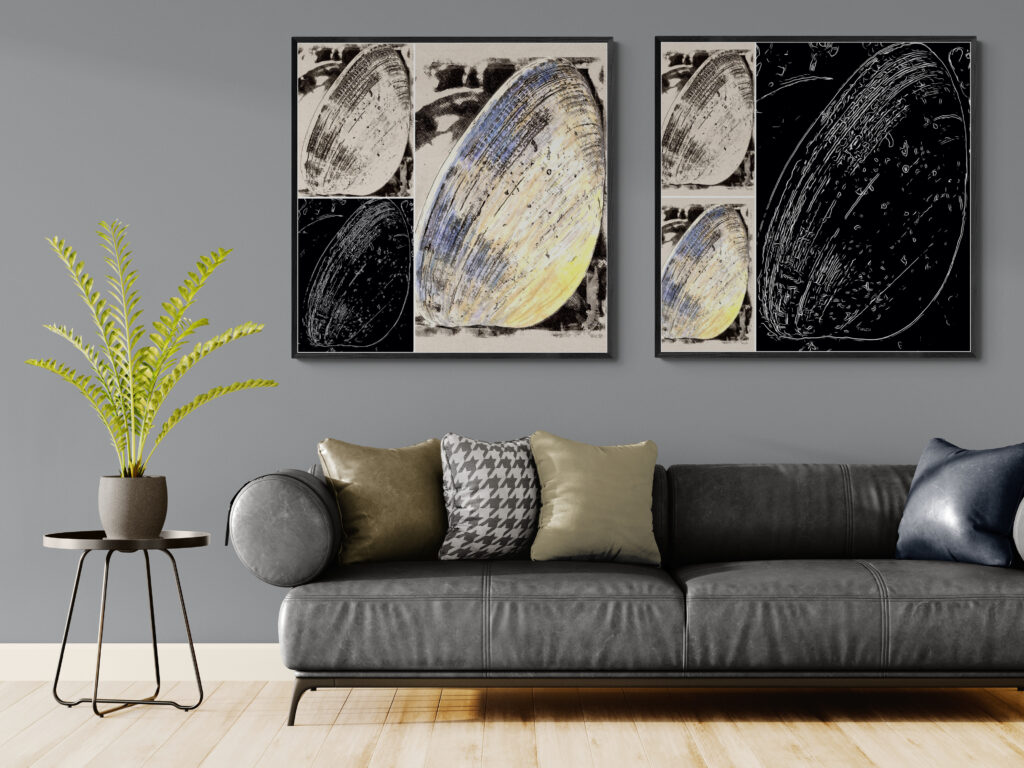
The lines in these digital renderings do not have the life that fully original handwork will offer but they are useful as part of a process of minimizing the marks as a way of considering how worthwhile they can be as a beginning point for paint.
I tend not to work with line directly but rather use paint to almost sculpt or find my way into my subject. Even with this as a starting point, I am already thinking about various greys instead of the black and white and more colour in the line and watercolour work and darker and more variation of colour in white and black rendering. My question is, will it hold my interest and in the end have the delicate power of less-is-more I am seeking/exploring? I could try three smaller studies as a starting point - three smaller studies that I could do on my portable easel while I am waiting for the edges to dry on the larger painting that is pushing me out of the studio. I have a hunch that this is an exercise that might be able to move further into the figurative to abstract mark making.
I do not always follow through with paintings when exploring these ideas anymore than I paint all the potentially useful references I gather. However, I find it is often worth making a few notes because sometimes these are the beginnings of shifts in my practice that don’t show up until months or even years later. So no commitment, just a record of possibilities.
BY THE LIGHT OF THE MOON PAINTING DATA COLLECTION
Saturday, 21 February 2026
Reference Gathering:
The primary field reference for this painting is a photograph of the clamshell that was then worked through using various digital tools (BeCasso and Art Set Aps) before being enlarged to a 30 x 38 inch scale and placed in a digital viewing room.
Making Process:
The making process proceeded in a 47 minute focused session. Using acrylic paints allowed for a fluid process of adding and taking away and adding again.
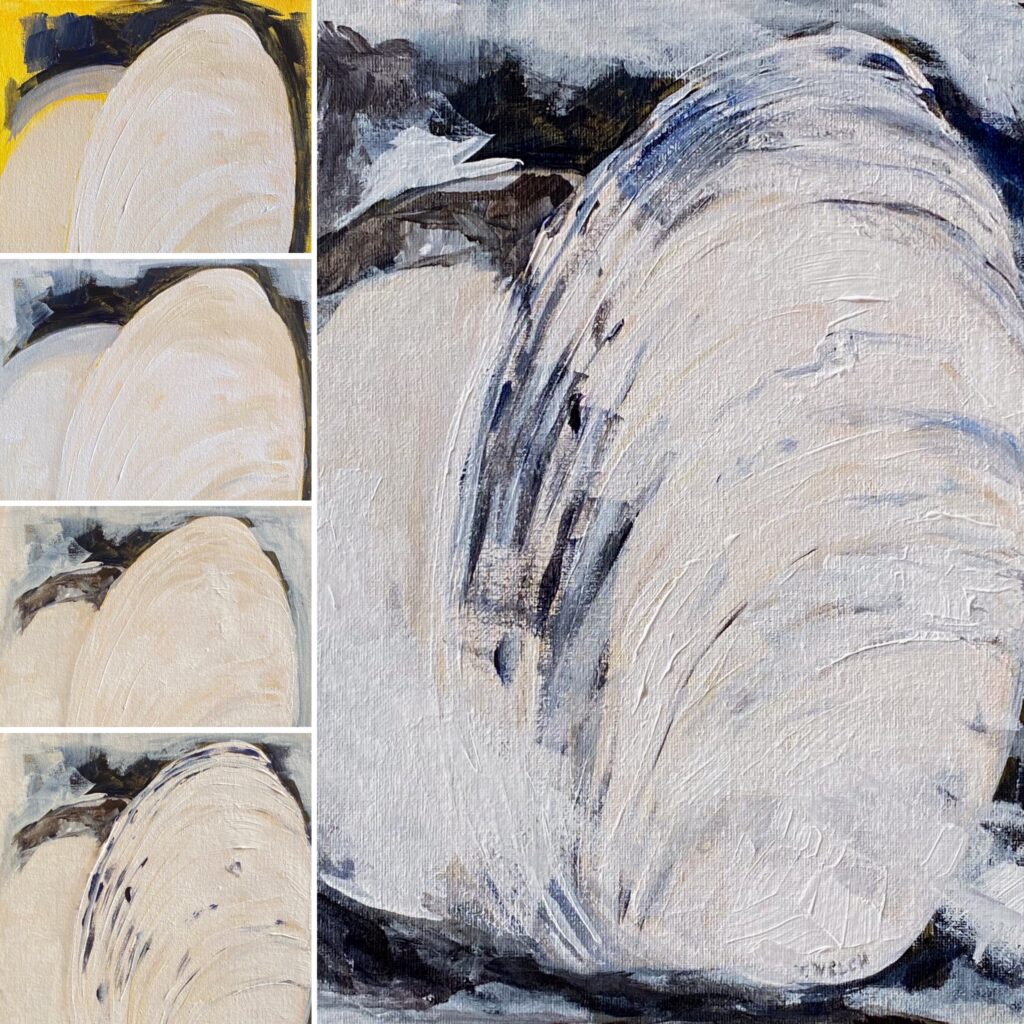
The limited palette was a deliberate choice to heighten my awareness of shape, line, mass and movement. Marks were considered, made and then left or reconsidered, made and then left. This leaves behind a visible history of mark making that I can now trace as snatches of memory that were remembered and now remembered again.
Finished Painting:
Making Notes:
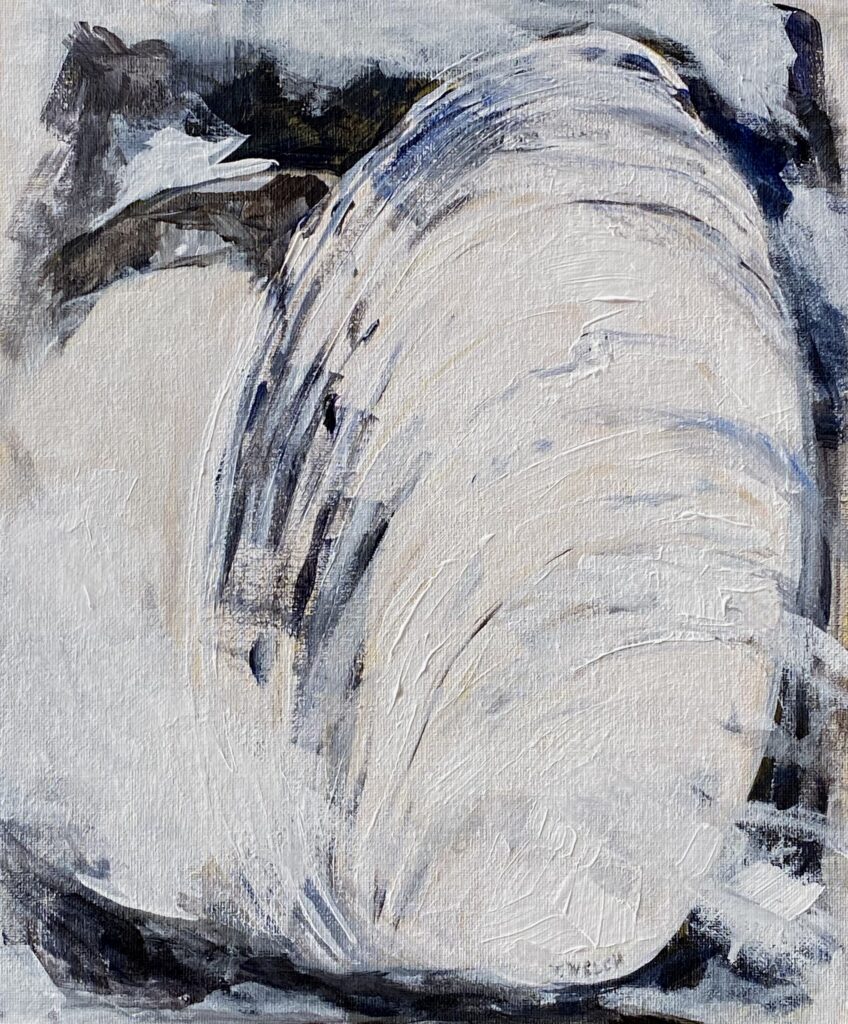
A clamshell is thrust high on the sands by the light of the moon where the tide rushes in rearranging everything in its path. As if in prayer, it seems to wait for my morning arrival. I find myself in the spaces between what might be next.
Reflective Analysis:
I have been down to Reef Bay by moonlight. It has usually been for a full moon rise or sometimes just before dawn to catch the sunrise. But this rendering is imagined as I haven’t yet been down to the shore to gather night references for a ‘landscape of the small’. I do have reasonably good night vision but I suspect this is because I rely on my other senses to create a visual image for me, particularly the information coming from the soles of my feet and what I can hear.
Reflexive Analysis:
This painting is intended to be one of three. The second painting is complete and I will do the data collection records directly after completing this one. The third painting is still being considered. I want to leave most of my reflexive analysis until I have completed all three. However, my primary concern is having the results become too decorative or lacking in emotional depth and strength… possibly a residue of having been contrived rather than an experience that can be shared. I don’t feel this as the first viewer but I need more time with the work to be sure. Even to write this data collection report, I have propped the work up on the table in front of me to squint at it slightly as I write.
Key Findings:
The mark making of the clamshell shape is visceral in its impact on my being as the brush is moving across the surface. Each ridge is a year in the life of the butter clam. In reviewing the biology of these clams, they start reproducing at 3 years old and can live to be roughly 20 years old but are generally 8-10 years old in this area (Caldwell, 2021). I will never have clam chowder made with the small butter clams again without thinking about how many years of life I am chewing up in each bite.
Anything else:
I have read more about the history of clams and was surprised to hear that some species in the Arctic have been found to live up to around 400 years old:
When this animal was a juvenile, King James I replaced Queen Elizabeth I as English monarch, Shakespeare was writing his greatest plays Hamlet, Othello, King Lear and Macbeth and Giordano Bruno was burnt at the stake for espousing the view that the Sun rather than the Earth was the centre of the universe (Bangor University, 2007).
Our human history in relation to clams is complex and spans millennia:
Researchers focused on clams in the Salish Sea in British Columbia in Canada. They started out looking at populations of butter clams—small, tasty marine mollusks—that lived about 11,500 years ago before the arrival of permanent human settlers. These early clams were relatively small—about 80% the size of today's butter clams—but they got bigger and lived longer as sea levels stabilized and glaciers receded after the end of the last ice age, leaving rocky sea floors in their wake. By 10,900 to 9500 years ago, the clams were much larger (Fredrick, 2019).
Mayne Island is located in the Salish Sea in British Columbia and we have middens visible on some of our eroding shores. Starting about 5,500 years ago Indigenous people began cultivating clam gardens (Fredrick, 2019). This practice continued until around the arrival of Europeans in the late 1700’s when it declined. There is no evidence I can see of clam gardens at Reef Bay on Mayne Island. However, the reefs may have made natural beds that could have been tended easily enough.
Reference List:
Bangor University (2007). Longest Living Animal? Clam -- 400 Years Old -- Found In Icelandic Waters. [online] ScienceDaily. Available at: https://www.sciencedaily.com/releases/2007/10/071028100032.htm#google_vignette [Accessed 21 Feb. 2026].
Caldwell, L. (2021). Butter Clams. [online] Interpretivecenter.org. Available at: https://www.interpretivecenter.org/news/butter-clams [Accessed 21 Feb. 2026].
Frederick, E. (2019). People and clams have a more complex history than you might think. Science. doi:https://doi.org/10.1126/science.aaz8284.
IN THE DARK OF MOON PAINTING DATA COLLECTION
Saturday, 21 February 2026
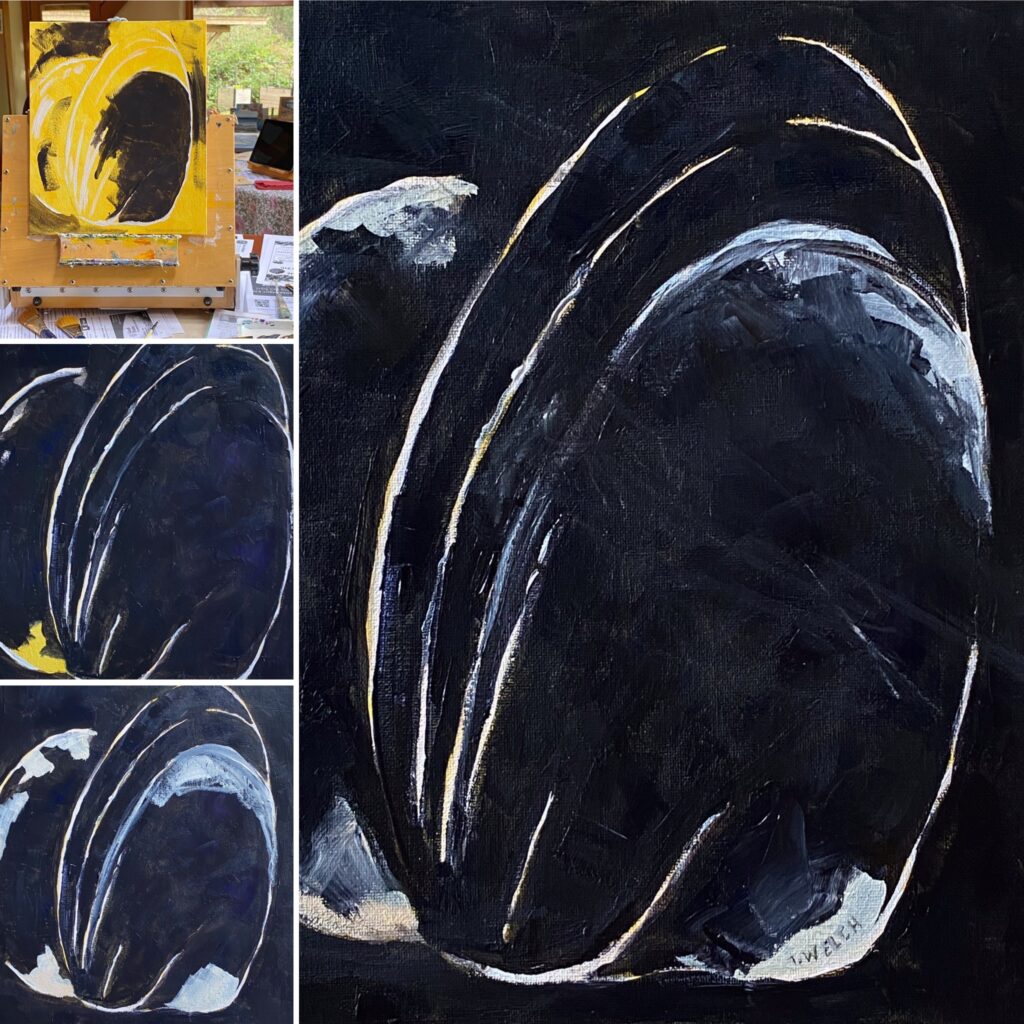
Unlike the sister painting ‘By the Light of the Moon’ to this one, it does not have as much of an abstract quality. Yes, if taking in 4-6 inch square parts of this 12 x 10 inch painting, the figurative reference is lost. However, it feels more like not being able to see enough of the painting at one time rather than abstract expressive marks. The lines are decidedly strong with wisps of disruption that do not rock the overall subject matter. The painting is finished in my first viewer experience, just with a narrow band of mark making that has faint echoes of Matisse and Picasso.
Reference Gathering:
The reference gathering for this painting is getting farther away from the primary source image and now carries primary references to the digital sketch works from past exploration and the previous painting ‘By the Light of the Moon’ that was completed in the hour before this painting study.
Making Process:
During a 43 minute painting session, this 12 x 10 inch on canvas board study developed and came to a pause that defied my ability to find a way to take it further. It was as if the painting was saying ‘I am good. Leave me be.’ So I did, all the while thinking maybe the next day a path would open up. But it didn’t. The clamshell just rocked ever so slightly in the stillness and whispered ‘It is all good’.
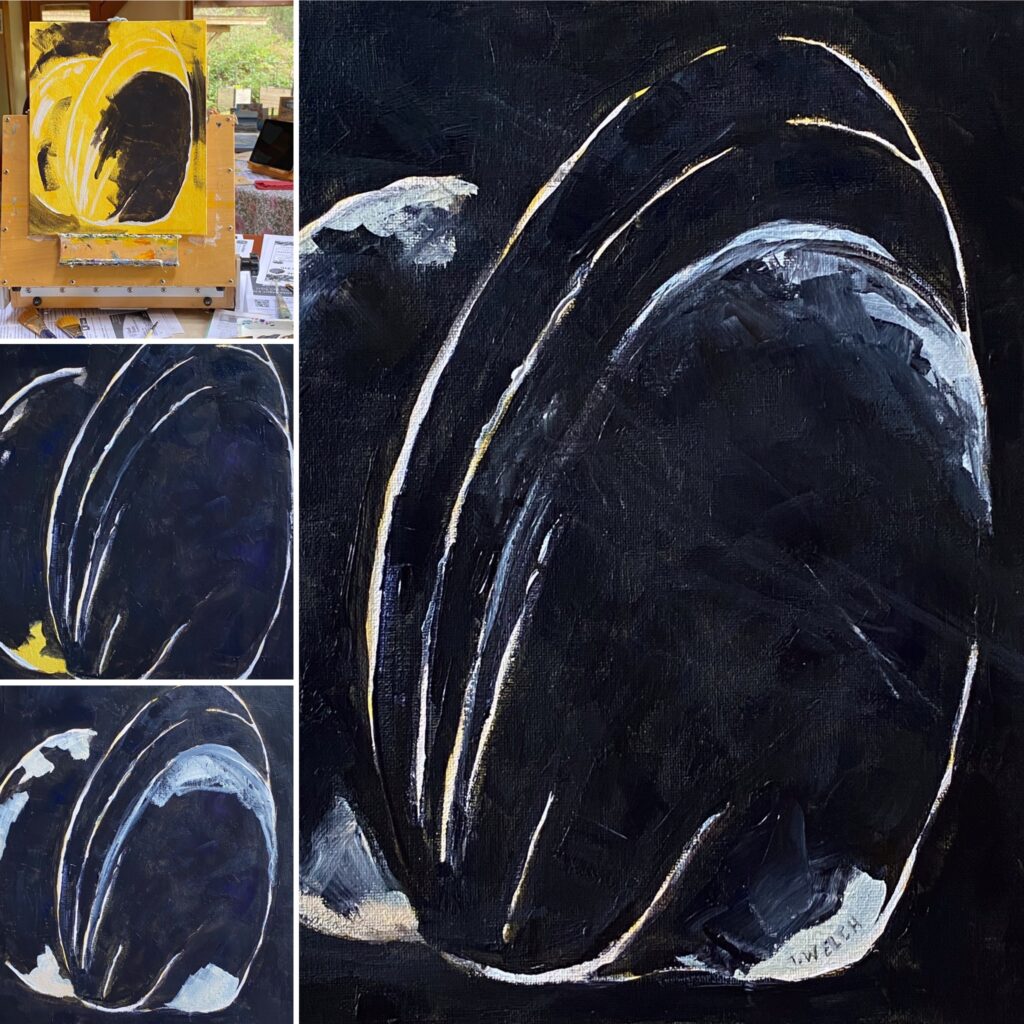
Finished Painting:
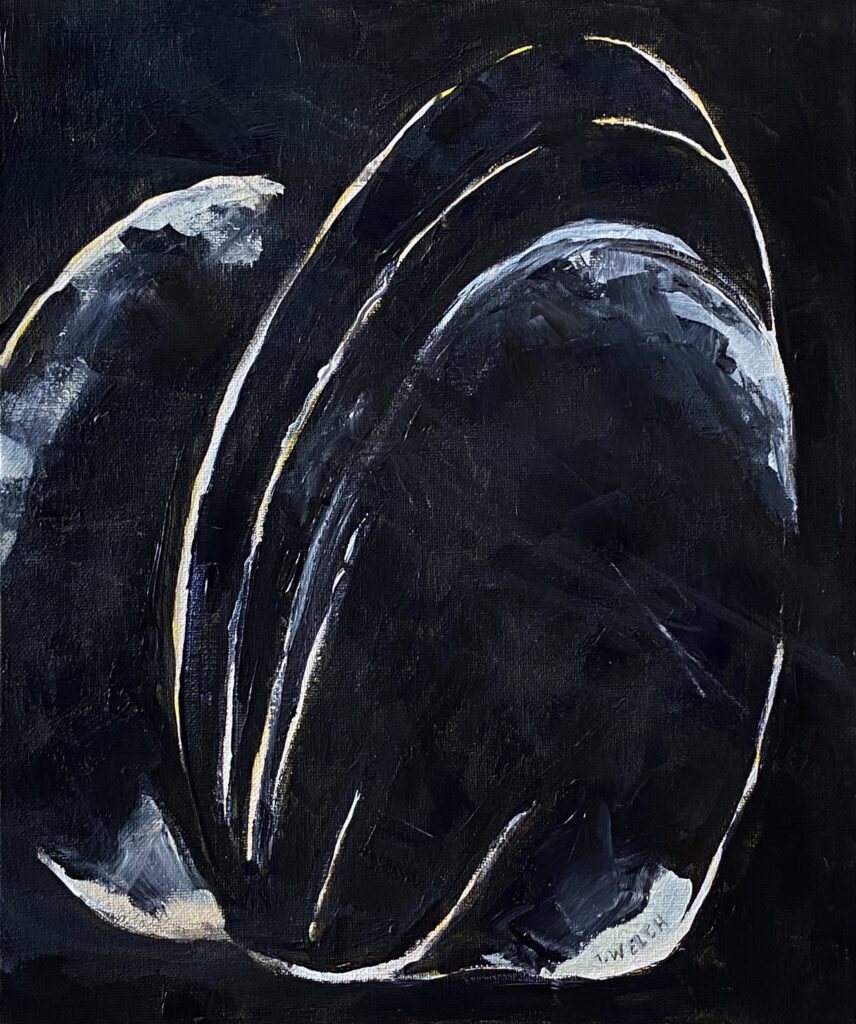
Making Notes:
Imagine the sound of the sea washing ashore in the dark of the moon. There is a web of history running over each clamshell that is measured in millions of years of ancestors. To think of knowing a place so thoroughly as this?
Reflective Analysis:
I wanted more for this painting. I am not sure what but more. The painting said otherwise. I place it next to its sister study thinking it might release its conviction.
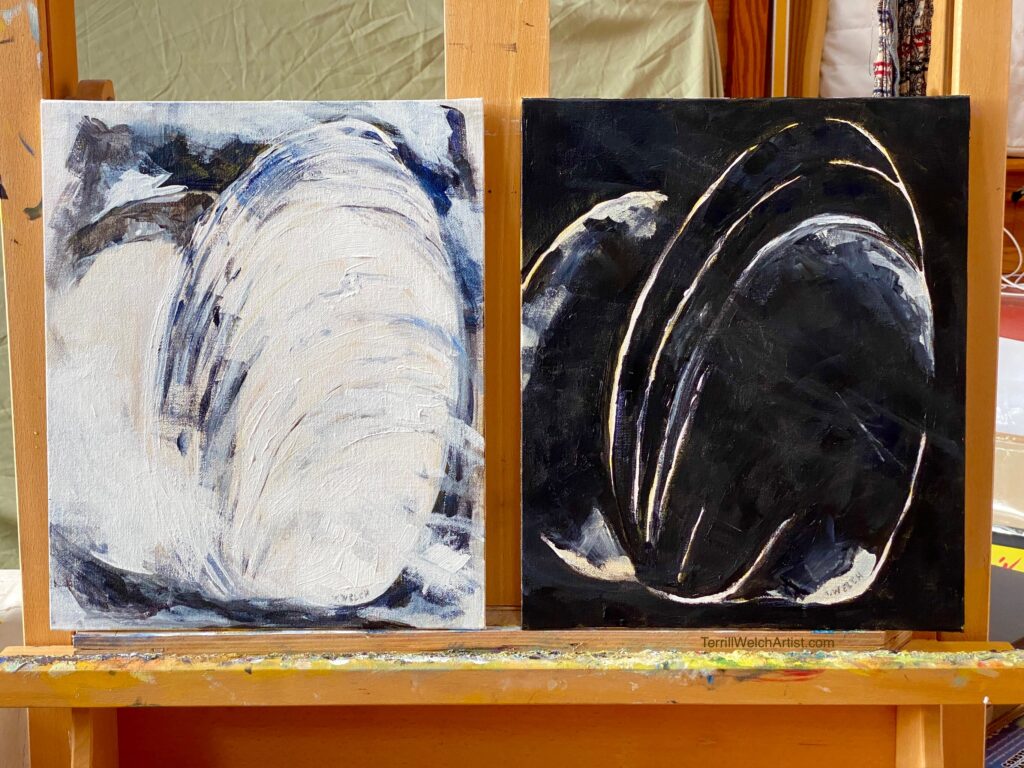
But the painting was even more stubbornly entrenched. So for now, I leave it to wallow in its half erased blackboard complexion. These two paintings and the third yet to be done are parts of a whole. At least, this is my tentative conclusion.
Reflexive Analysis:
In my nature-centric reparative painting practice I am again taken with the curvature of the clamshell ridges. They require interrogation to follow and then render on a surface. Like any skeletal structure they are deceptively complex. It is this observation and focus that stills and releases my mind and body as I work. That residue of experience remains for me as the first viewer. It remains and carries its honesty even when the painting is resisting my further intervention.
Key Findings:
I have a trust in the value of honouring the process without attachment. In wanting more, I will carry this forward to the next painting and likely several more after that.
Anything else:
Not at this time.
TRAVELLING THROUGH TIME PAINTING DATA COLLECTION
Sunday, 1 March 2026
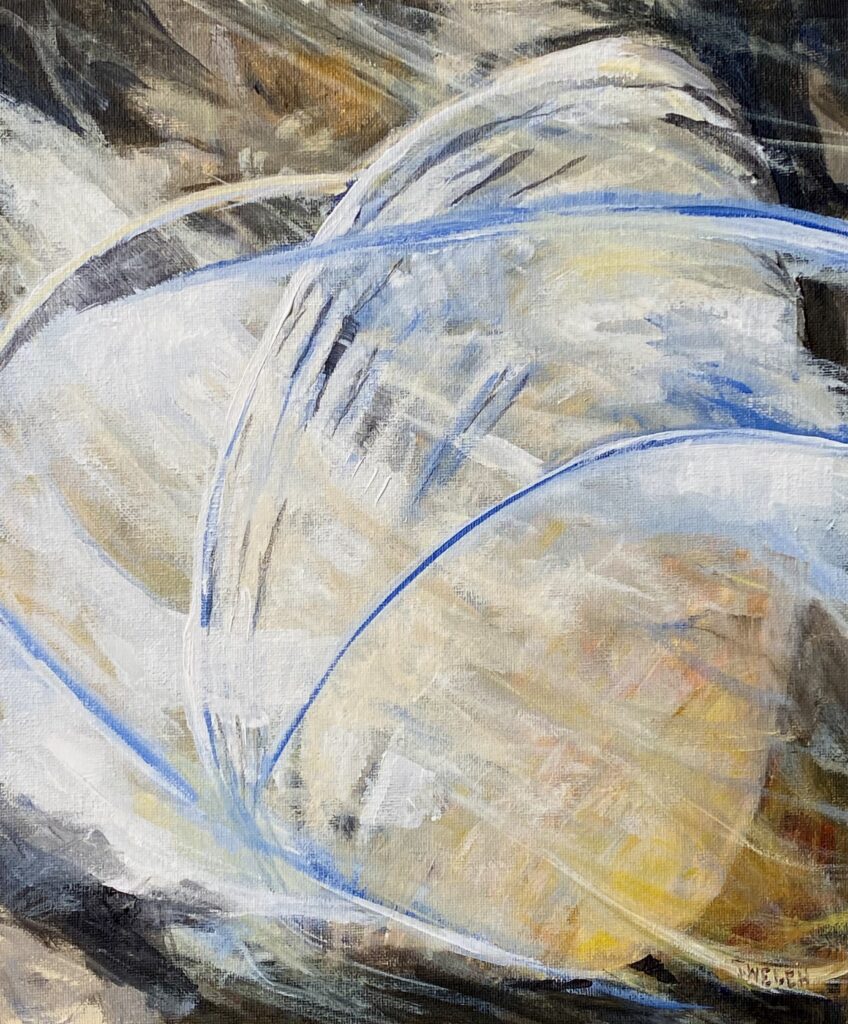
I found this painting’s mark making challenging to assess. The overall expression of the clamshell brought to mind Rackstraw Downes (Art21, 2026) who I have identified as “4” on my continuum. However, if one was not perhaps already thinking about clamshells, then the overall abstract character of the work might leave it unidentifiable and assessed at a “10”. One thing is for sure, there is a fluid sense of movement in the work that blurs and reveals and then blurs the primary shape again.
Reference Gathering:
For this work I went back to my original experience and the primary photographic reference and combined it with my knowledge of the painting process from the previous two paintings.
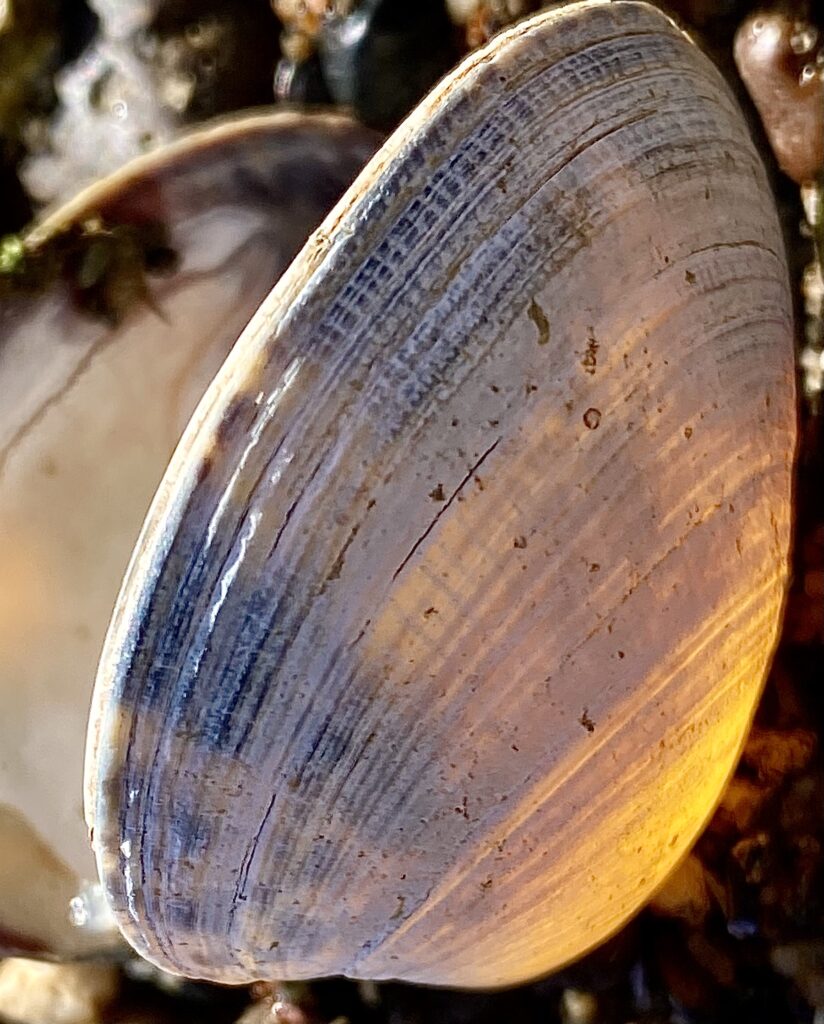
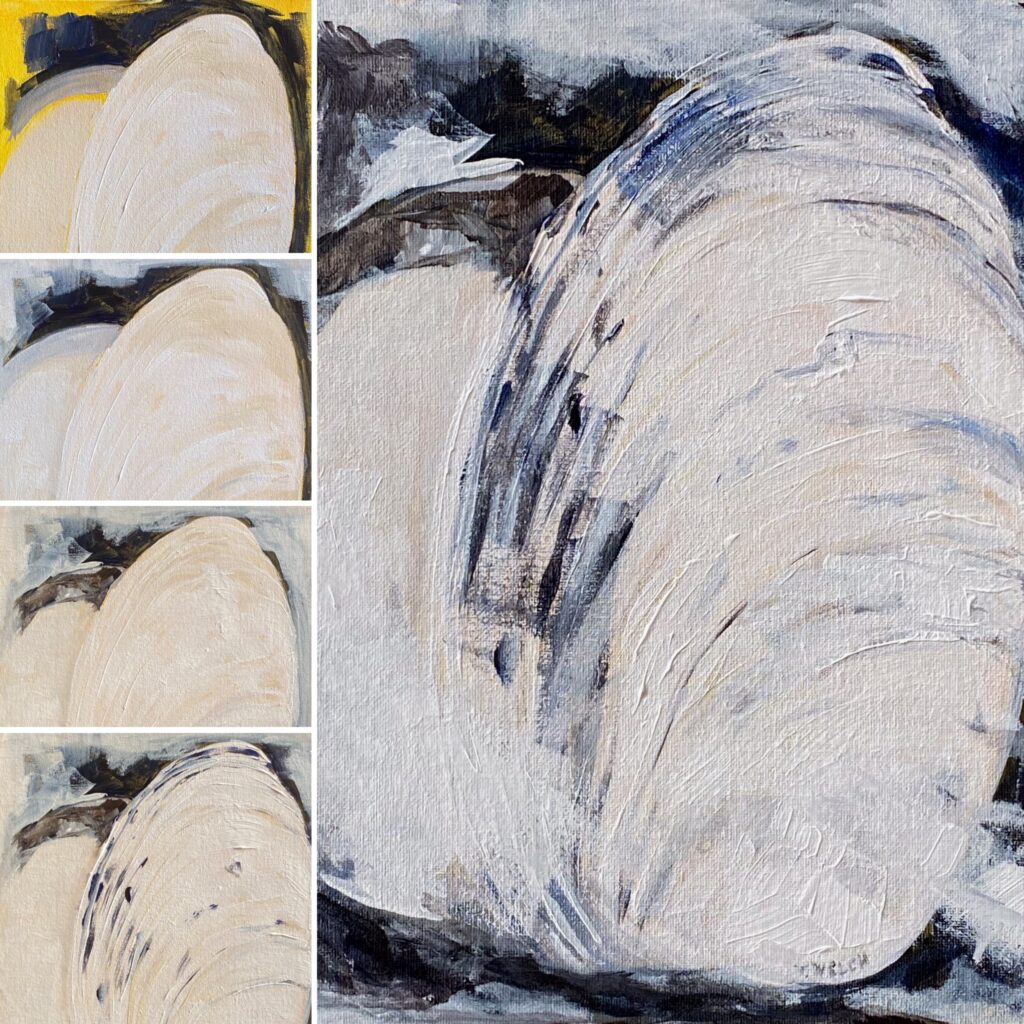
I didn’t return to the first digital renderings as my memory and imagination were strongest in these aspects of the process.
Making Process:
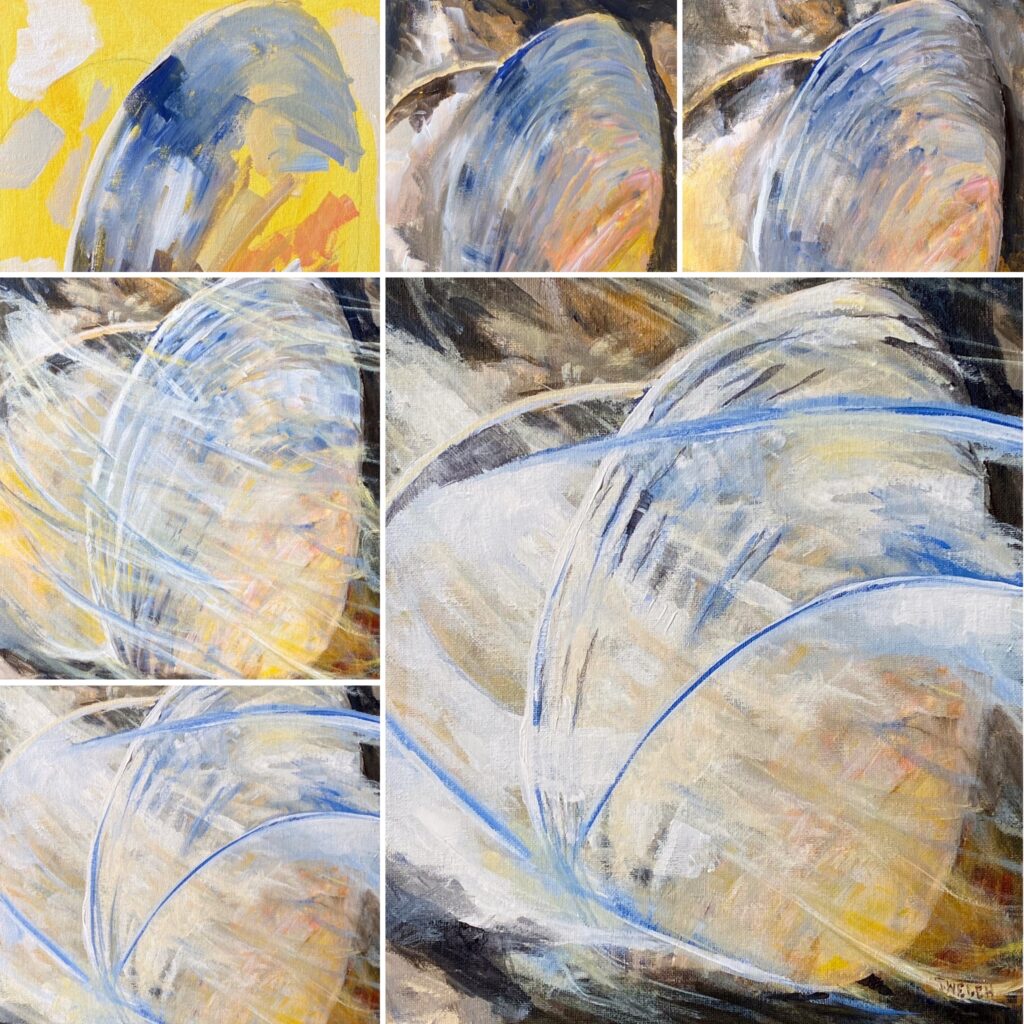
Finished Painting:
Making Notes:
Travelling through time is the third in a series of clamshell paintings. The three together convey how everything changes but nothing is lost in the web and wash of the shoreline. Though this painting can stand alone, it is more when sharing space with the other two studies. The concept of thousands of years is mostly lost to me. But sitting with a small butter clamshell that is weather and worn, it is almost possible to grasp.
Reflective Analysis:
The history of the clams and the weathered shells that are left behind on this beach offers me a sense of continuity. They are so plentiful and embedded in my daily life that it would be easy to overlook their presence. I know them almost as much by their feel between my fingers as I do by their visual shape. I wanted to somehow find a way to articulate this in paint on a surface.
Reflexive Analysis:
In contemporary society we are frequently separated from the life growing and harvesting of the critters that we eat and whose lives are impacted by our manipulation of their environments. This painting and the previous two paintings in the triptych are my way of bringing me closer to these embedded and interconnected relationships, a relationship that exists even if one never eats a clam or steps on a shell-covered beach. It is a shared history for many thousands of years. We could say that we evolved together along the shores of seas and rivers. Yet, clamshells do not feature strongly in contemporary art. However, this is not true of west coast Indigenous art.
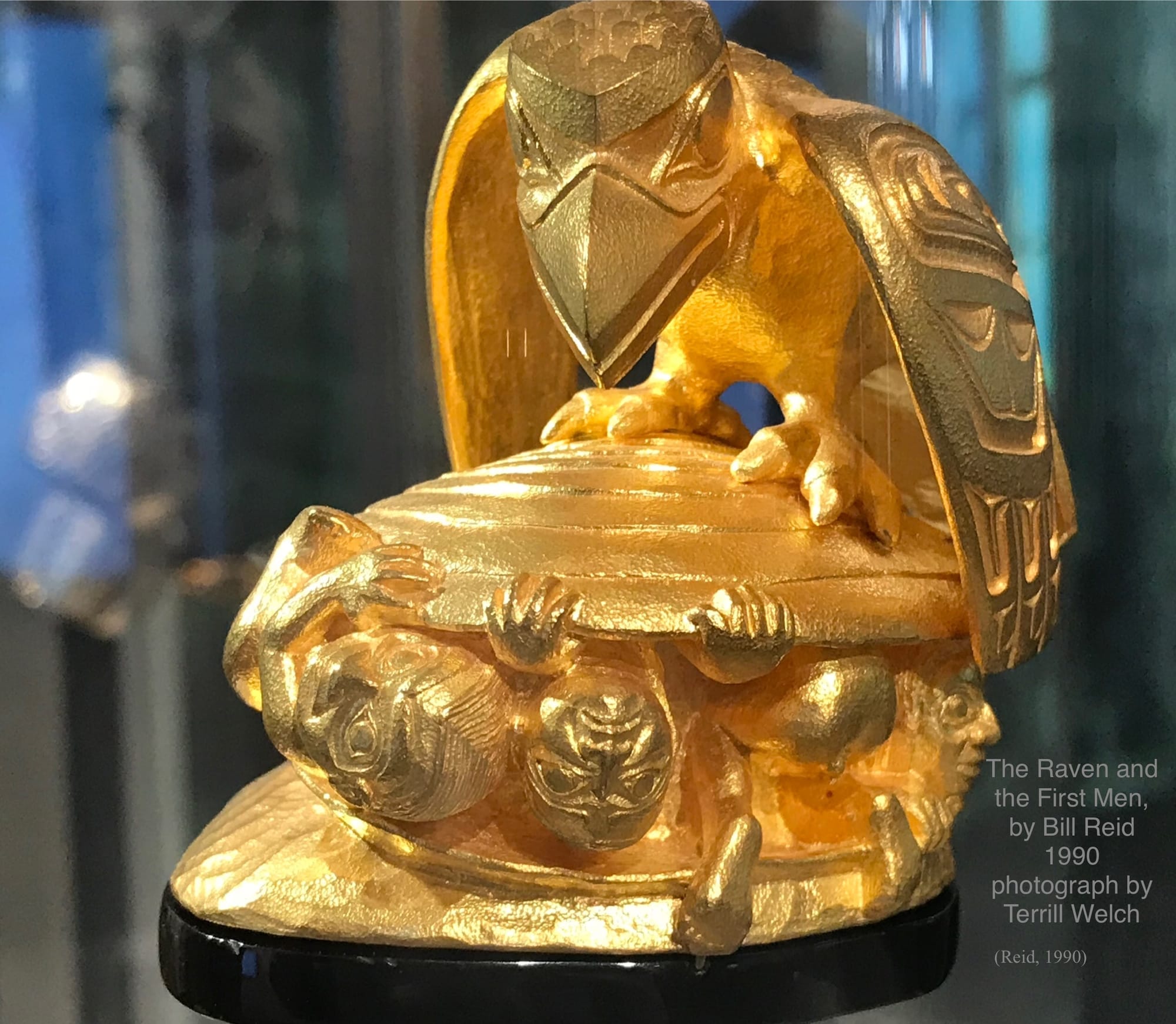
This is likely the most famous of all Bill Reid’s sculptures and has been created large in yellow cedar and other editions as well this small gold sculpture edition and depicts part of an origin story that is not mine to retell. This work was also featured in the Canadian twenty dollar bill issued in September 2004 (Bank of Canada Museum, n.d.)
That hint of gold light shining through the bottom of the right side of the clamshell did bring me back to this memory of seeing this sculpture in The Bill Reid Gallery when I visited back in the spring of 2019. Bill Reid has a strong and revered influence on my experience of West Coast contemporary art.
Key Findings:
When I spend time with a seafloor object such as this one clamshell, the past, present and future become meaningfully connected and fluid. The tides seem to easily push against the notion within these spaces that everything changes but nothing is lost. Admittedly, this is a very difficult picture to paint!
Anything else:
There is one more thing, I am dedicating these three paintings to my four colleagues and classmates in the MA in Fine Art programme. I will expand on this in the next section.
Reference list:
Art21 (2026). Rackstraw Downes. [online] Art21. Available at: https://art21.org/artist/rackstraw-downes [Accessed 1 Mar. 2026].
Bank of Canada Museum (n.d.). Canadian Journey Series $20 Note. [online] www.bankofcanadamuseum.ca. Available at: https://www.bankofcanadamuseum.ca/complete-bank-note-series/2001-2006-canadian-journey-series/canadian-journey-series-20-note/ [Accessed 1 Mar. 2026].
Reid, B. (1990). The Raven and the First Men. [22kt gold cast].
UNDER THE INFLUENCE IN MY PAINTING PRACTICE
Monday, 2 March 2026
My reference to being under the influence has nothing to do with ingested substance but rather that sponge-like creative juice that I absorb within my creative process. Sometimes it is long standing artistic shoulders that I precariously balance atop. Other times, it is more subtle and unpredictable and unintended hints that show up without invitation or fanfare. This last situation was what surfaced in my most recent triptych ‘Clamshell Travel’ that includes three 12 x 10 inch ( 30.48 x 25.4 cm) acrylic on canvas board paintings.
Therefore, these three paintings or triptych are dedicated to my four colleagues and fellow students in our MA in Fine Art programme. The unintended hints of influence surfaced slowly, revealing themselves to me in the third and final painting. Let’s place all three together in a viewing room before I continue.
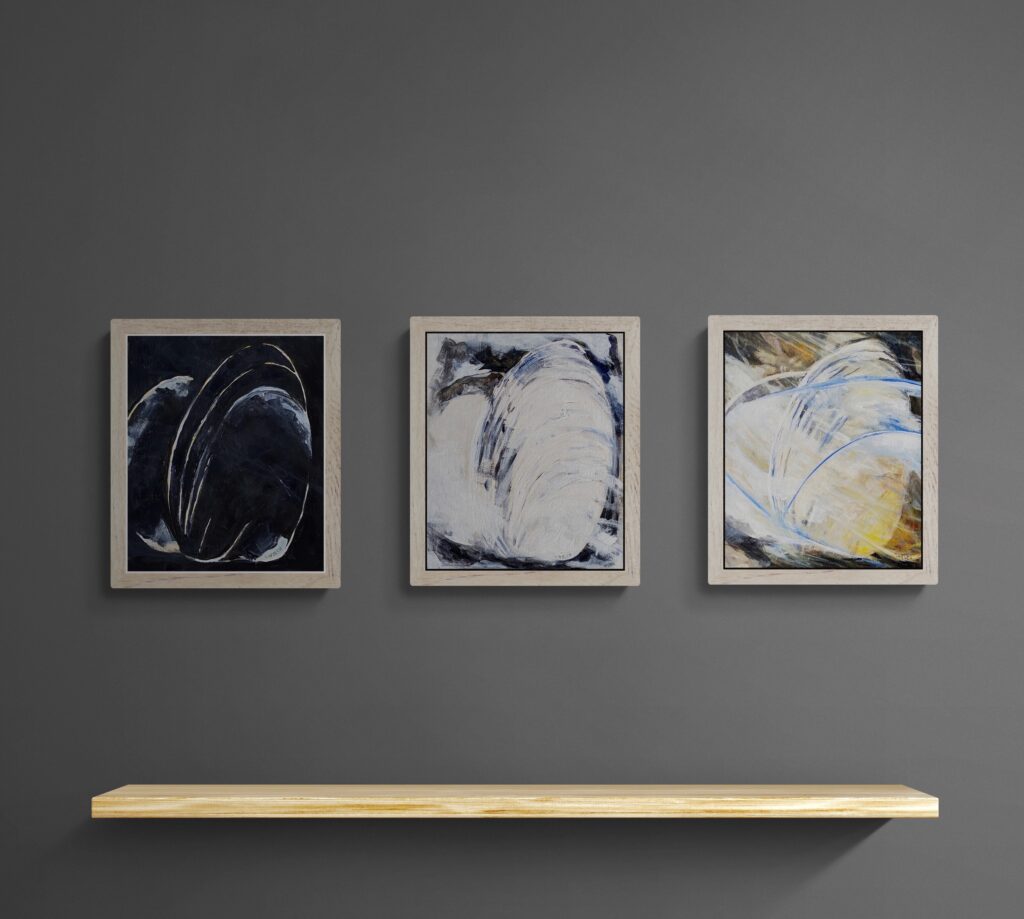
The title of the painting on the left is ‘By the Dark of the Moon’ and is dedicated to David Crawford who in his creative practice brings to our attention the dark and shadow side of human experience. A full moon might find him out in the night air, photographing or painting with fluorescent paint producing other worldly and haunting results. Humour is never far beneath the surface of his presentation even within these darker moments.
The title of the middle painting is ‘In the Light of the Moon’ and is dedicated to Maggie Taylor who in her ongoing exploration of the Humber Estuary excels in the compelling use of monochrome and line spanning a continuum of representation to abstract expression. With scant detail, these paintings fill me with emotion that feels private and privileged.
The title of the third and final painting is ‘Travelling Through Time” and is dedicated to both Murray Hamilton and Kate Aimson. Though these two artists approach their work from vastly different perspectives and media, the importance of the passage of time is explicit in both their processes and the completed artwork. Murray uses various starting points for his scanography that explores spirituality in a manner that often leaves the source material completely transformed into a visual representation of spiritual references. Kate’s fabric art has a deep and long history into folklore and traditions that she brings forward into her contemporary art interpretations without losing this meaningful connection.
Learn more about these England artists by clicking on the links for their websites below:
Maggie Taylor: www.maggie-taylor-art.co.uk
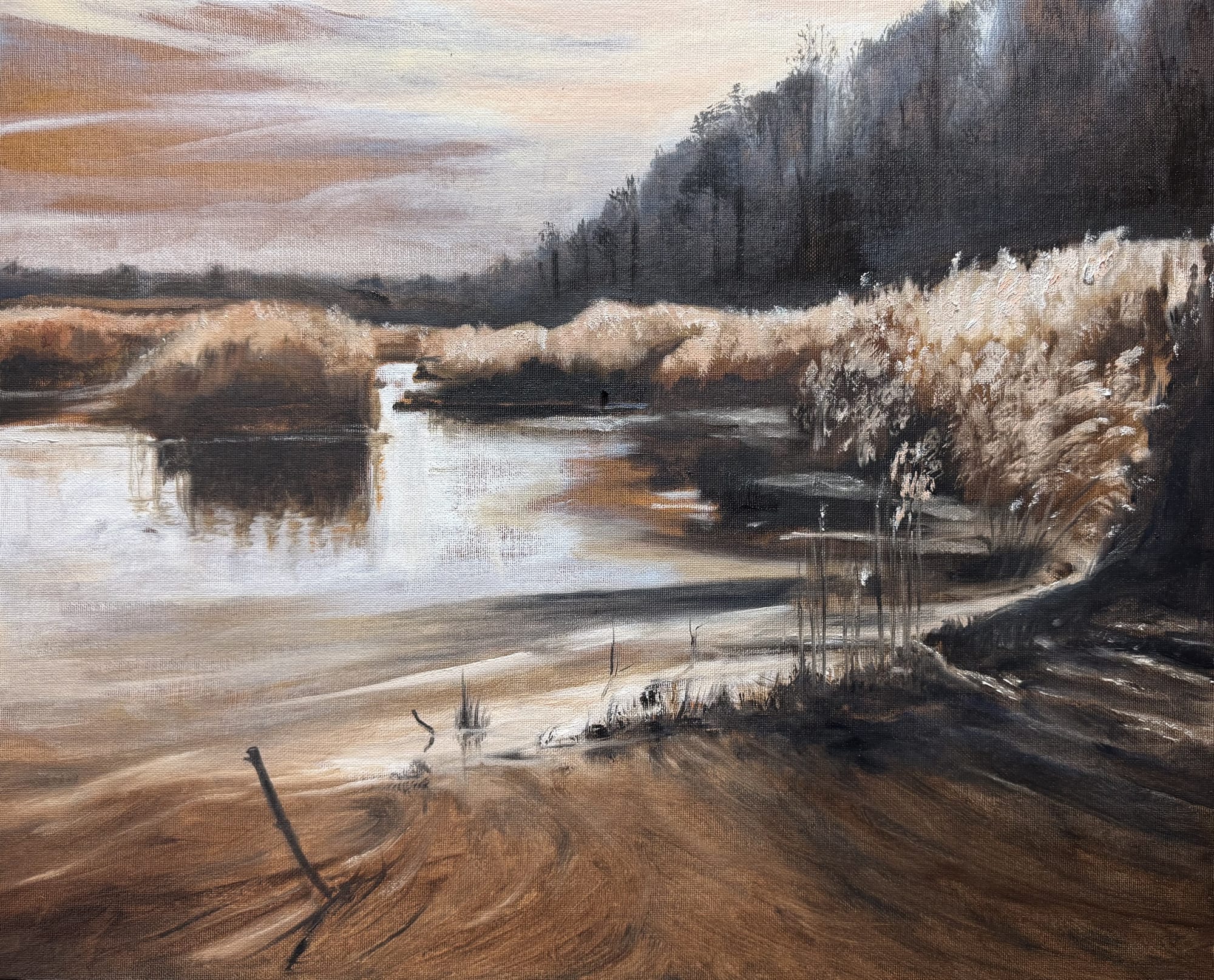
David Crawford: https://www.photographerlight.com/welcome
Kate Aimson: website is under construction however, she has offered to share one of her artworks.
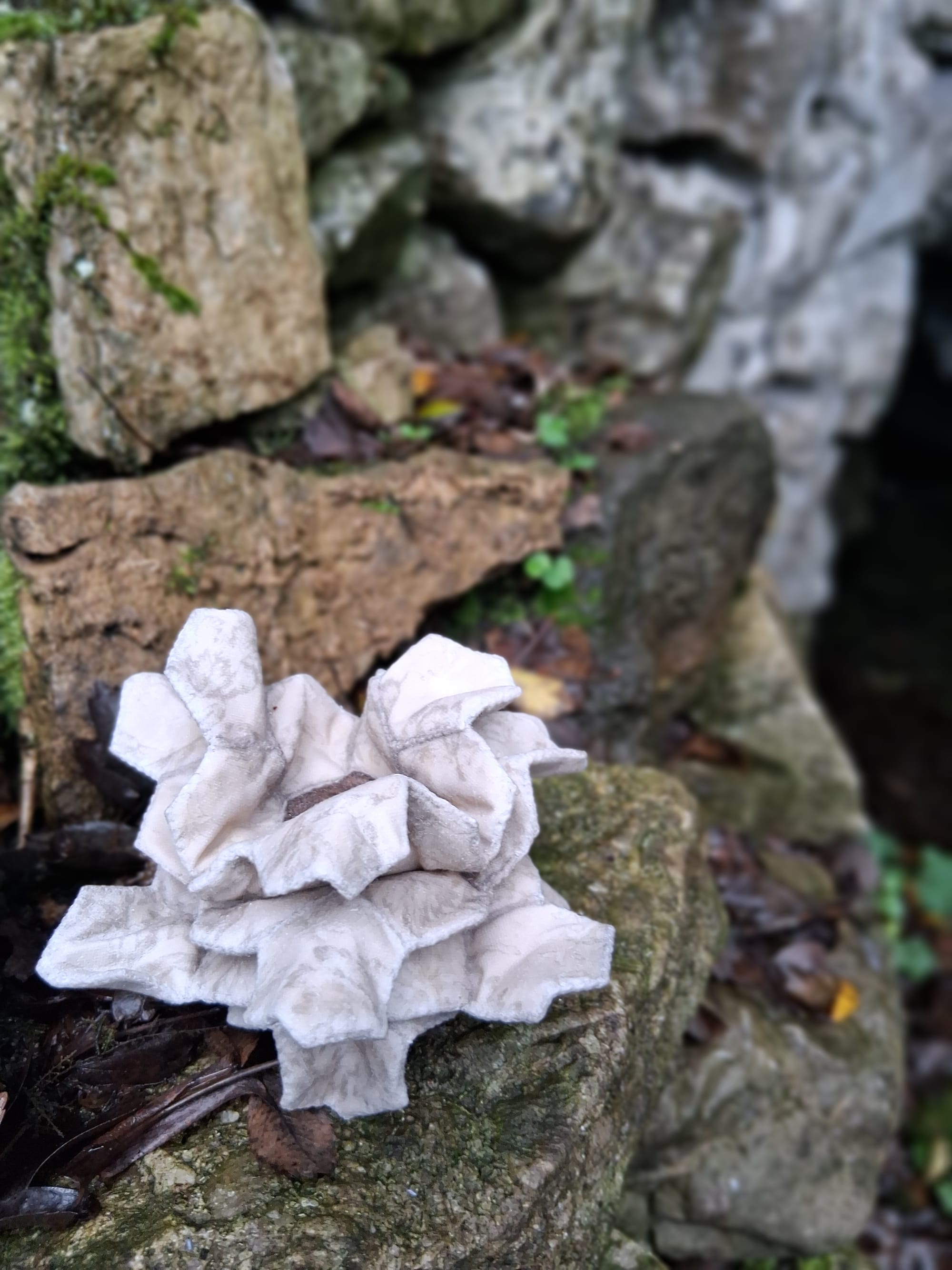
And, Murray Hamilton: https://scanarttherapy.wixsite.com/murrayhamilton
Note: Permission via email to share in my newsletter, along with a couple of artworks in some instances, has been granted by all four colleagues and artists.
This is the conclusion of the triptych. However, there are two more new paintings to share… if you are up to it?
WEB AND WASH PAINTING DATA COLLECTION
Friday, 6 March 2026
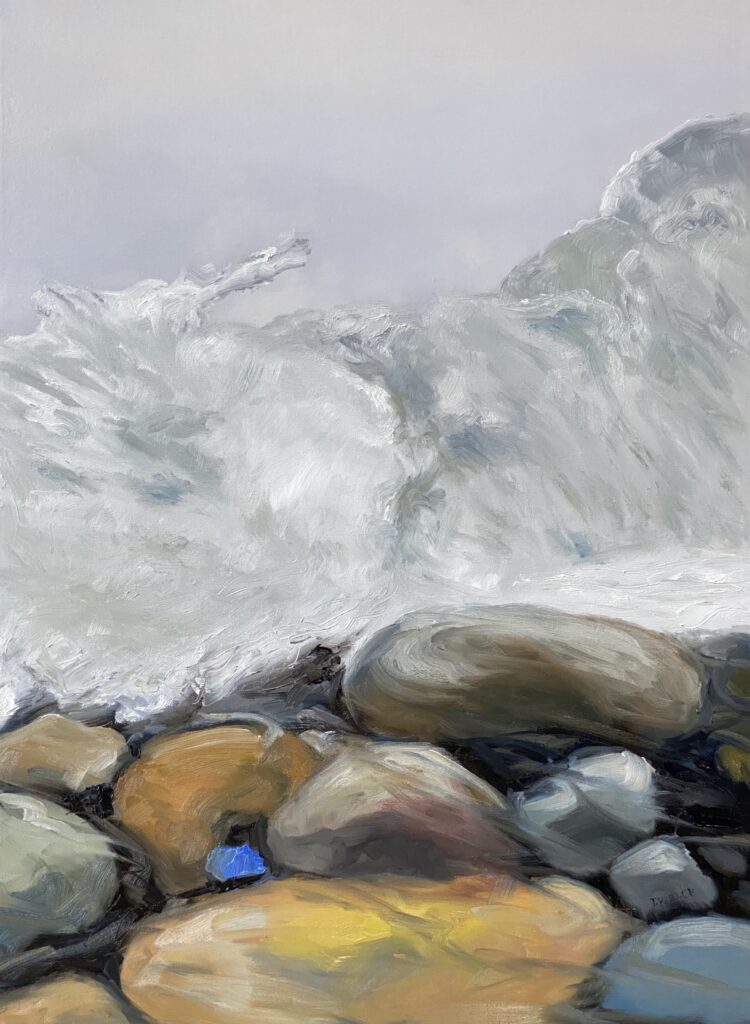
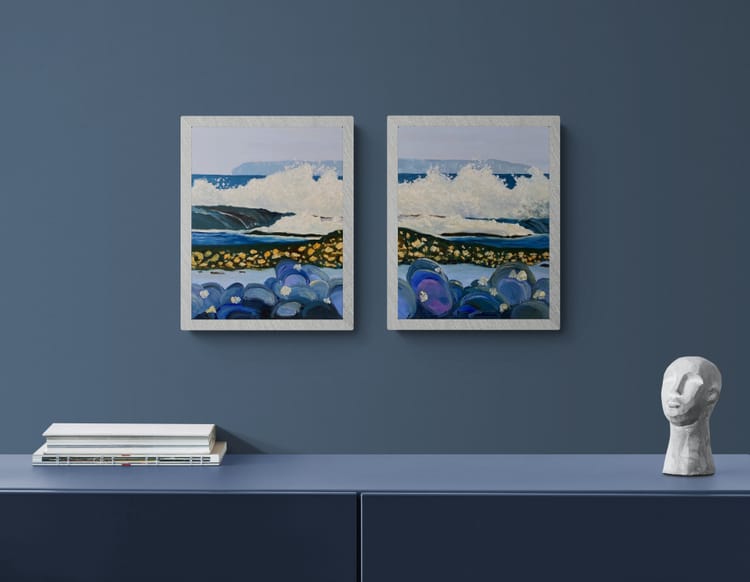
Though this painting has descriptive elements, it is full of movement that is imagined and would be challenging to view with my naked eye. Think of the painters Wanda Coop, Gerhard Richter or Patterson Ewen. The inspiration has an earthly anchor that is abstractly explored in a detail like the patch of blue.
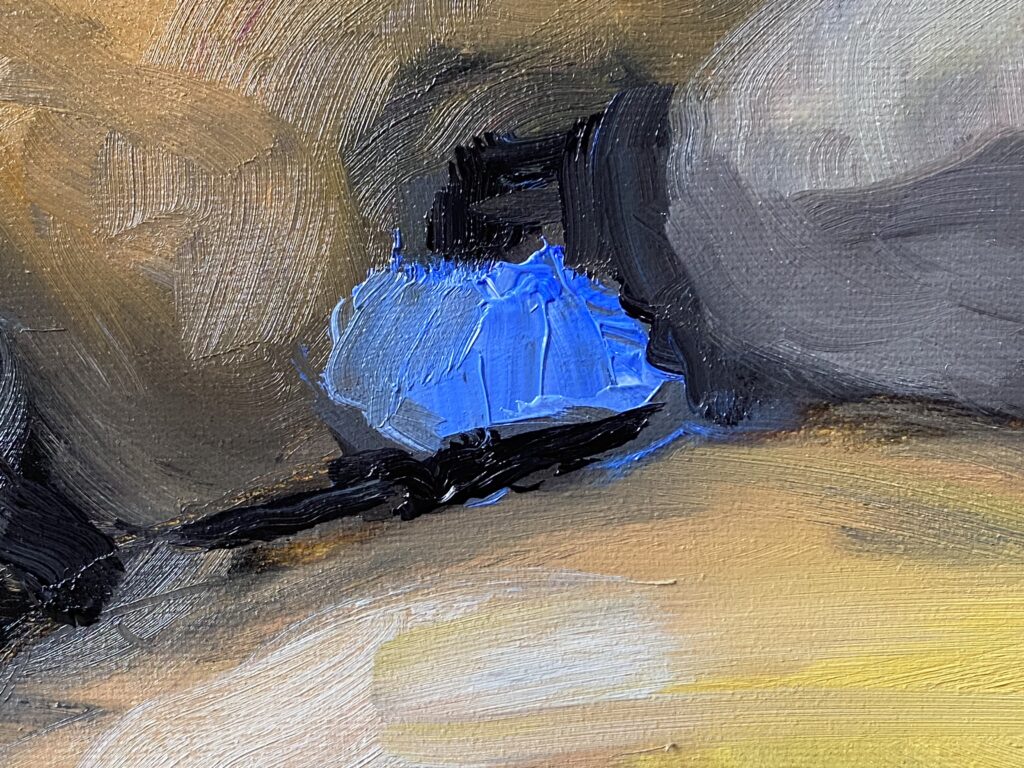
Or a part of the wave that resembles a great splash but is simply a loose stroke of white and blue/grey paint that demonstrates the expressive application over rendering figurative marks.
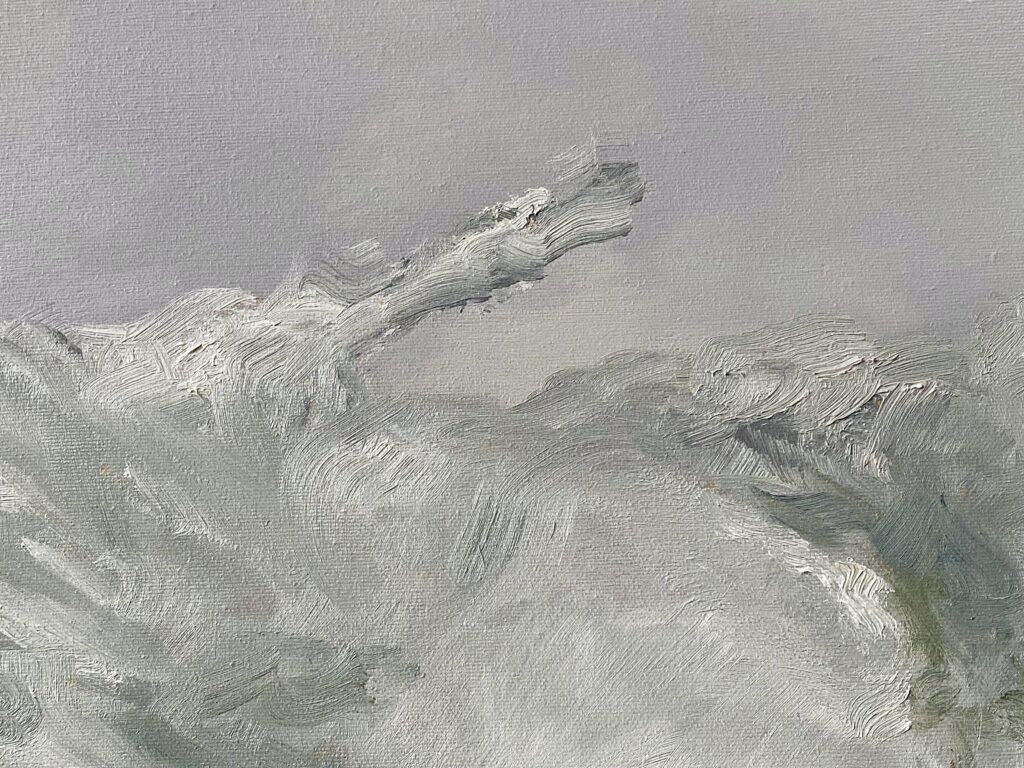
However, when viewing the whole work, its original inspiration comes through to my first viewer’s eyes easily.
Reference Gathering:
The reference for this painting came from a number of video stills with this one being used as a primary reference.
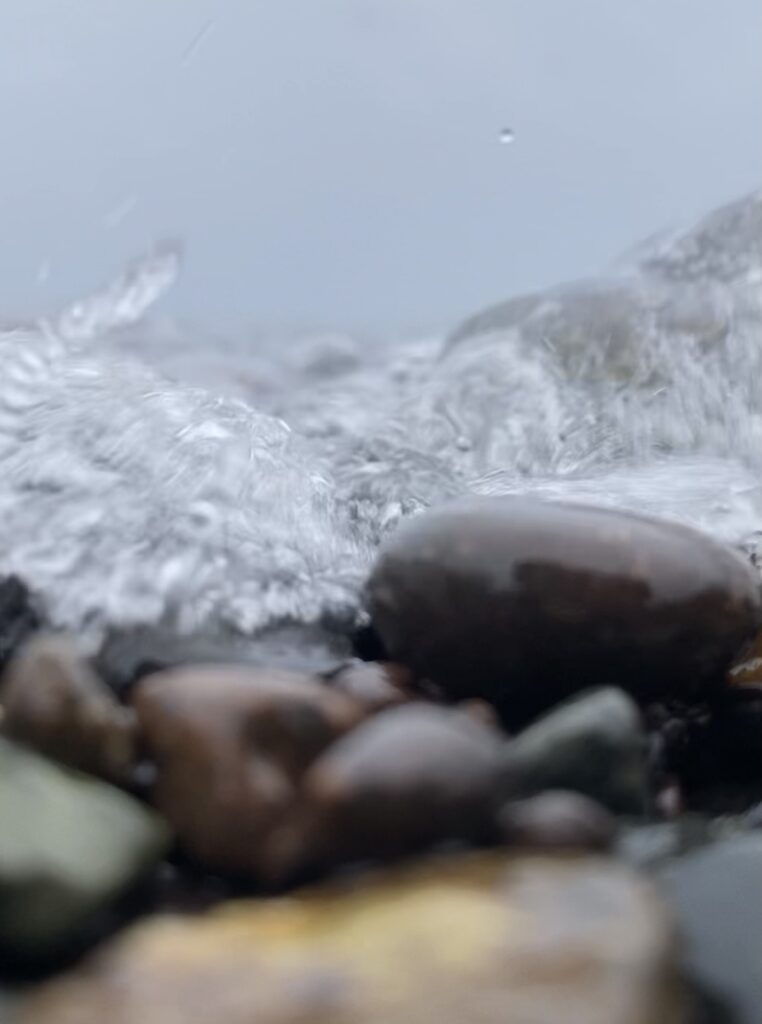
There was no attempt to replicate but rather to use the strength of the composition that I then adjusted and anchored with my memory of the moment which ended up with a submerged and washed in seawater iPhone camera lens. Not something I would recommend but resulted in great reference material.
Making Process:
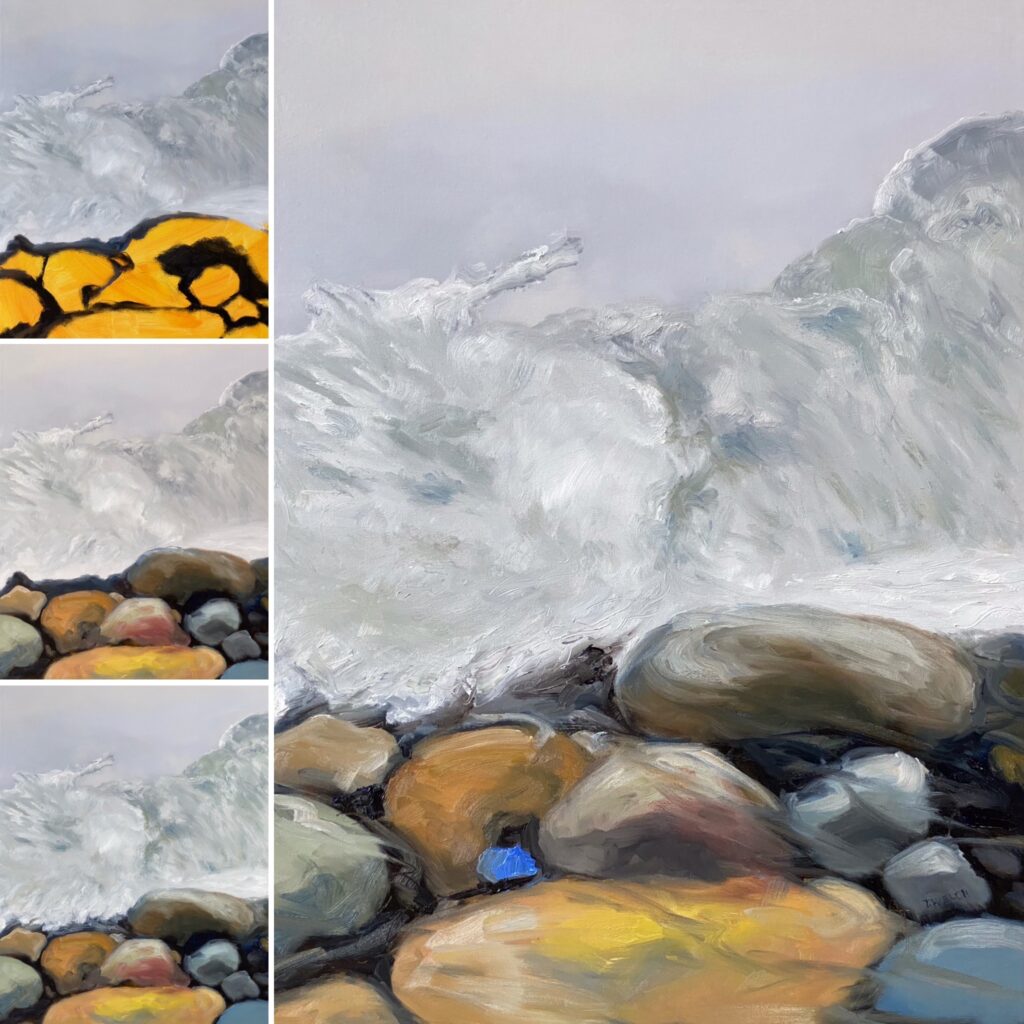
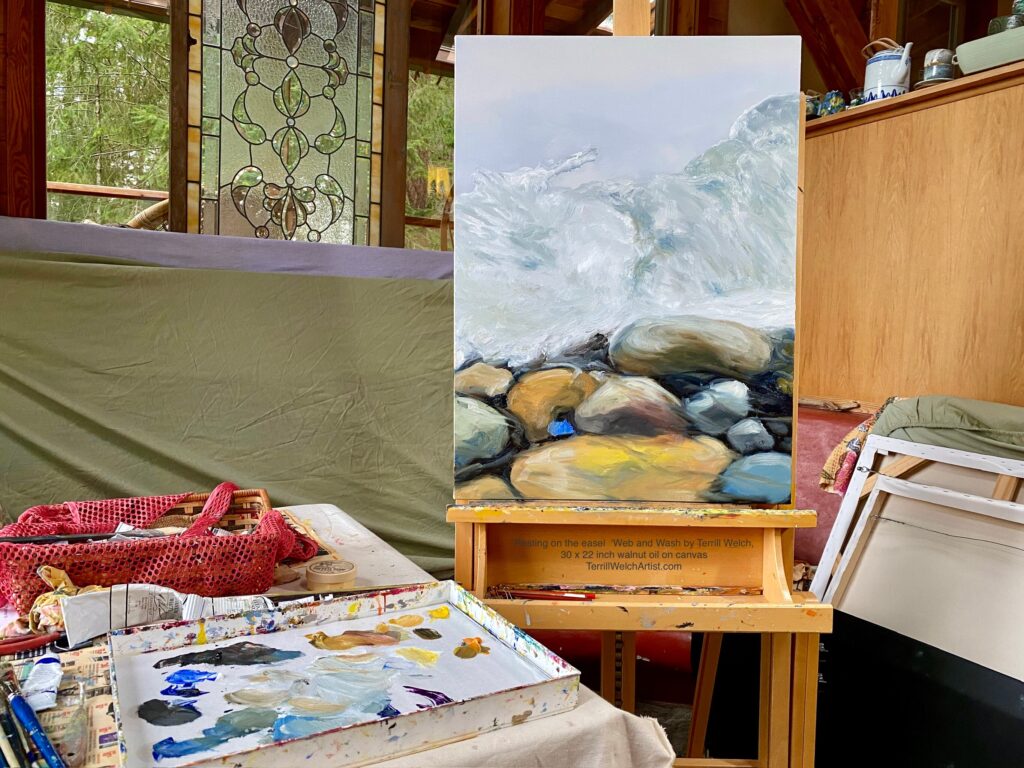
The painting process for this painting happened over a period of two days but was about two hours in total of time standing at the easel.
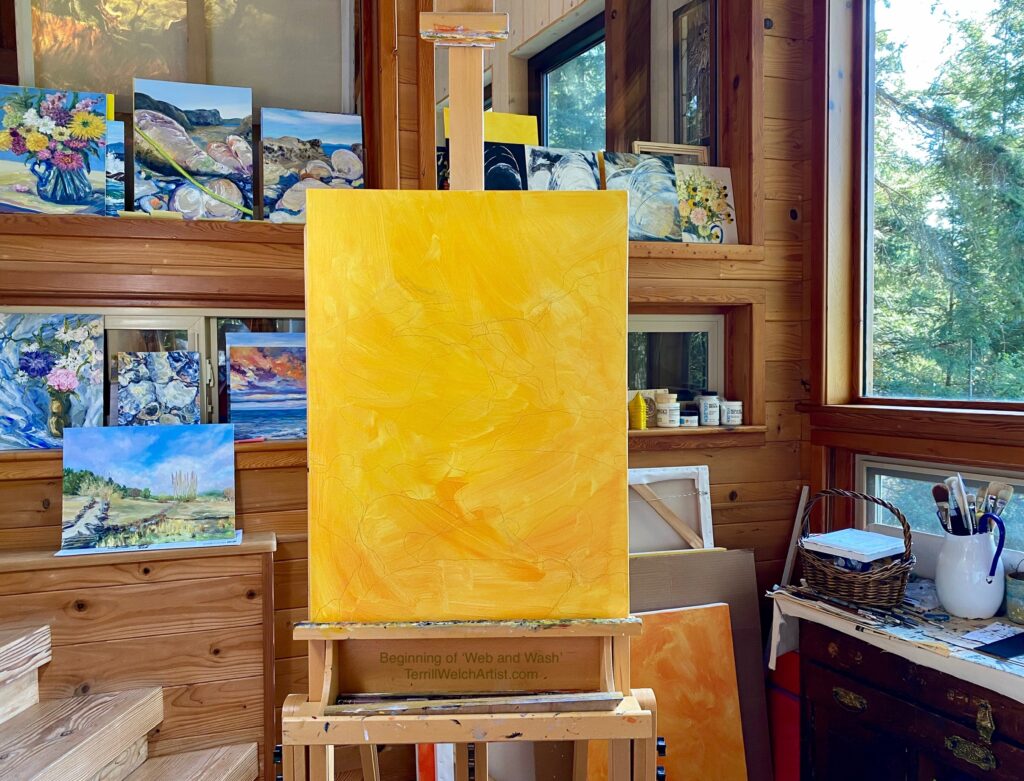
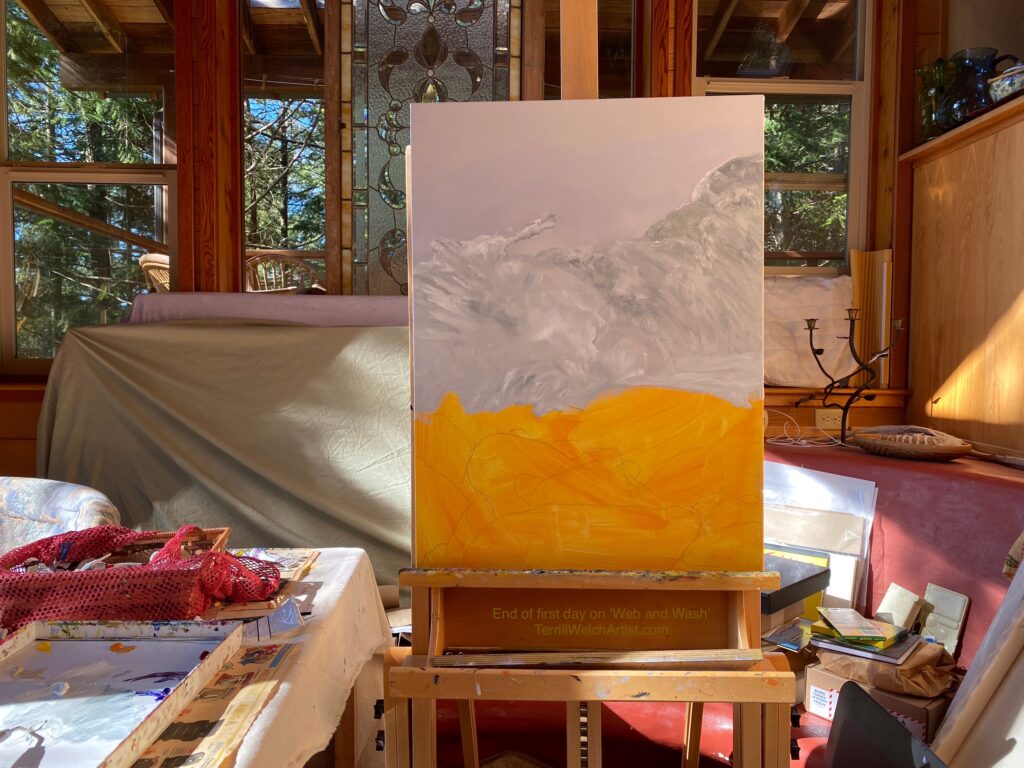
On the second day, the process went quickly and smoothly as if the painting had already painted itself ahead of time and my hand just needed to listen to the instructions coming from an invisible muse.
Finished Painting:
Making Notes:
With certainty, resting in a web of stones on the seafloor is to expect a wash of sea on an incoming tide. Not even the heavy fog can slow this predictable procession. In this moment, the viewer is a seashell on the seafloor as the water rolls in at the shoreline. The bright blue patch is either a piece of a mussel shell or plastic. Mostly it is blue paint leaving evidence of the artist’s brush.
Reflective Analysis:
The flow of the painting process was a long pause from when I gathered the reference to when I got started, followed by a short painting session and a break overnight and another short painting session. I toyed with mental ideas during the pauses and then the paint just went on the canvas without further questioning. The blue paint mark went in very last and though I took a deep breath before spreading it on with a palette knife, I knew it needed to be there.
Reflexive Analysis:
Assessing a painting as fitting into a range of contemporary artworks is seldom simple for me. This work was no exception. Is it that bright blue paint mark that makes it contemporary? Is it the chosen subject matter that uses video stills of movement that contributes to its contemporary feel? Or is it the reparative, autoethnographic nature-centric theoretical framework that places it squarely within a contemporary creative practice? Finally, does it even matter?
I shall start with the last question first. The work's contemporary stature matters to me because I want to continue to develop an investigative research focused practice. To do this means critically examining my process and the results. The reparative, autoethnographic nature-centric theoretical framework is cumbersome to say but accurately underpins the core concepts explored in my painting practice. But it doesn’t show us consistent processes or steps in the development of the work. This is because I allow the subject and my intention to lead the work's development. There is no attempt to squish the idea for the subject into the process. Instead, the process must serve the idea. This leaves me with maximum flexibility to explore a figurative/abstract mark making continuum. The small purposeful bright blue swath of paint definitely speaks to the ambiguity, almost as a sassy exclamation mark to contemporary art.
Key Findings:
I am starting to relax and open up into a new kind of observation and flow with these latest works. It is like I have some new skills solidly added to my practice that I can call on as needed to do the work I want to do.
Anything else:
Not at this time.
SEAFLOOR FRAGMENTS PAINTING DATA COLLECTION
Wednesday, 11 March 2026
This is a fully abstract painting in whole or part.
Reference Gathering:
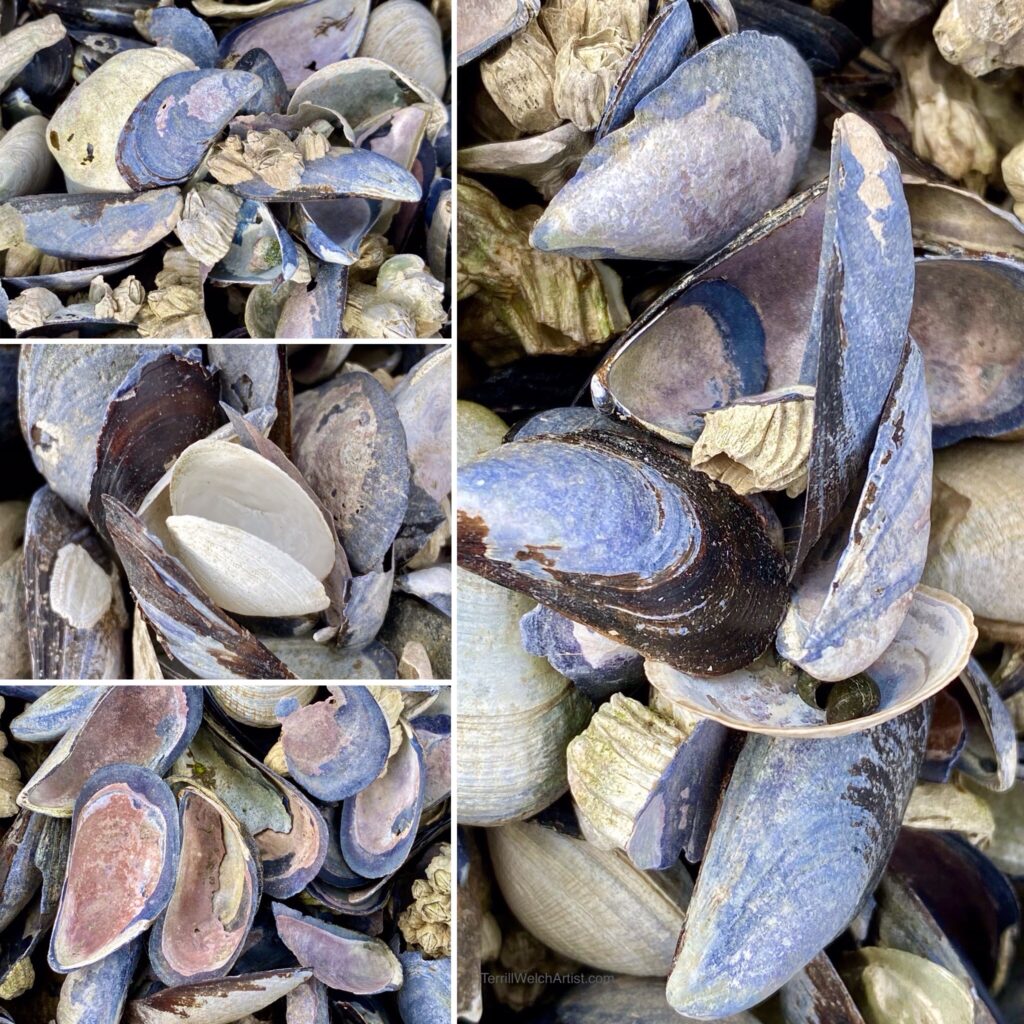
There are references for this painting that were taken the day before but they were not directly used during the painting process but rather the seafloor is imagined and remembered. That said, here is a collage of images that capture what was remembered.
Making Process:
The making process for this painting has a different starting point than usual. I reused an old surface.
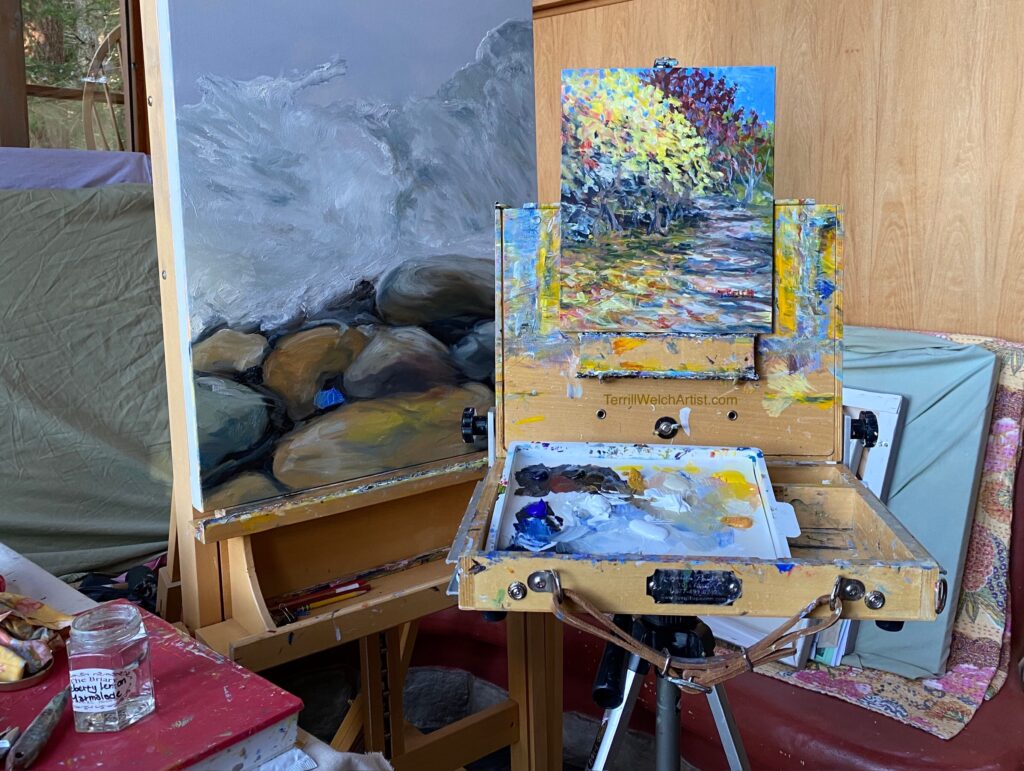
The painting came together without any pre-planning or direct reference material.
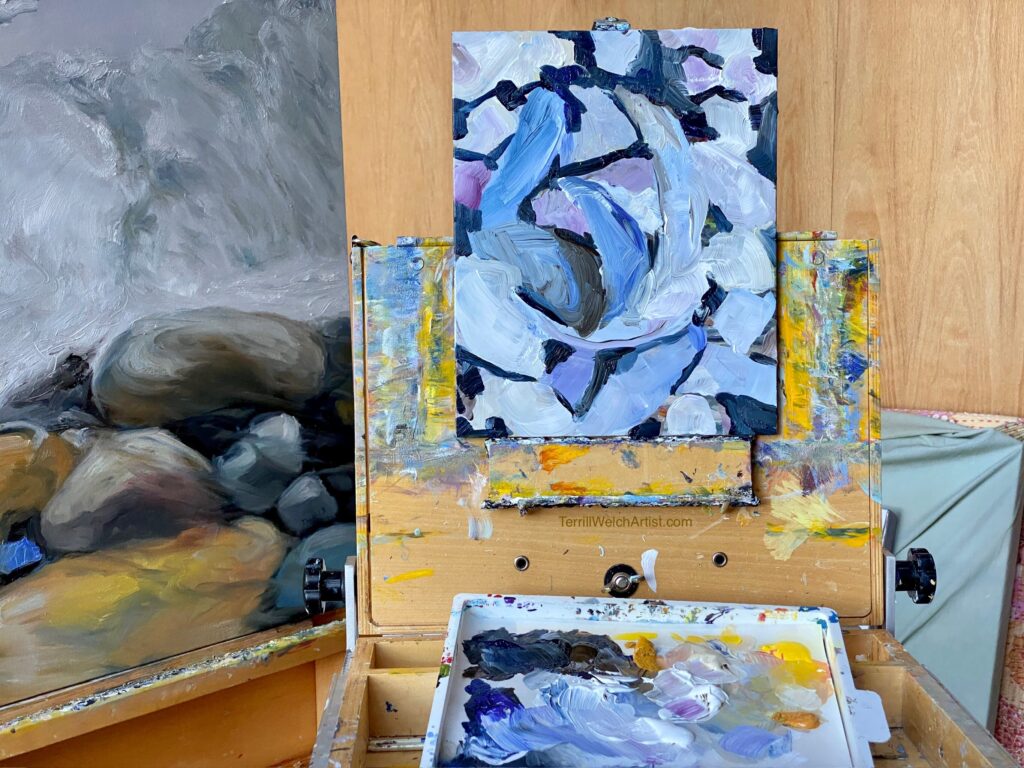
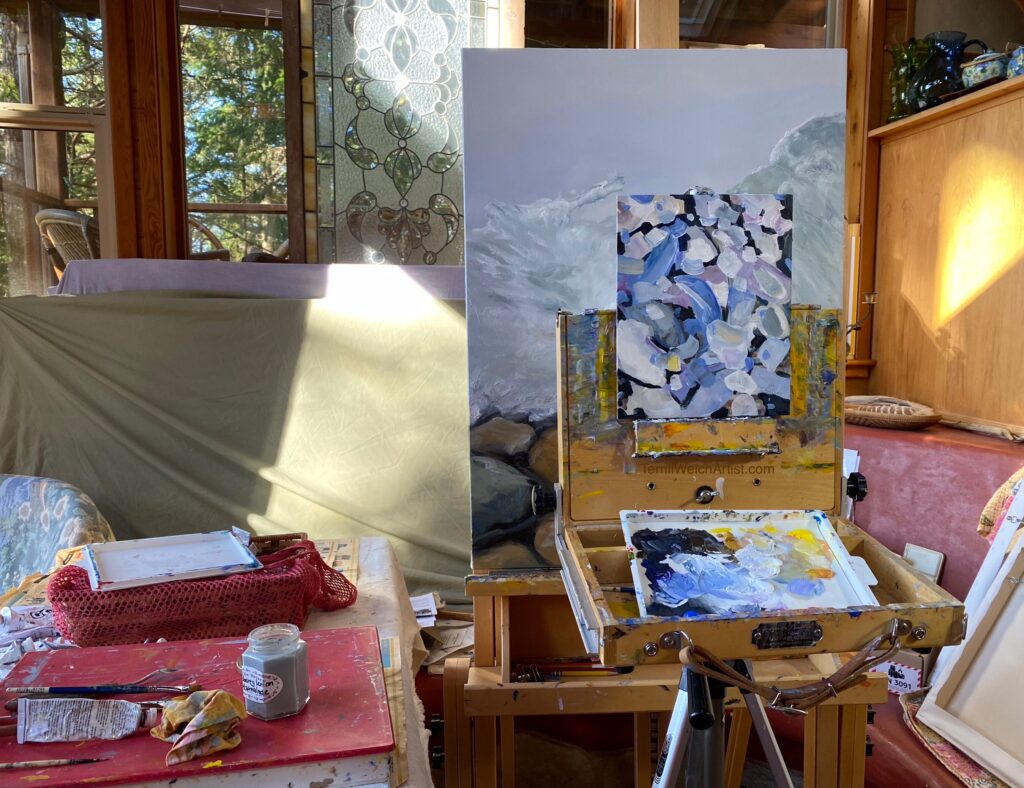
The brush marks layered up as I moved back and forth over the whole canvas During the 45 minute painting session.
Finished Painting:
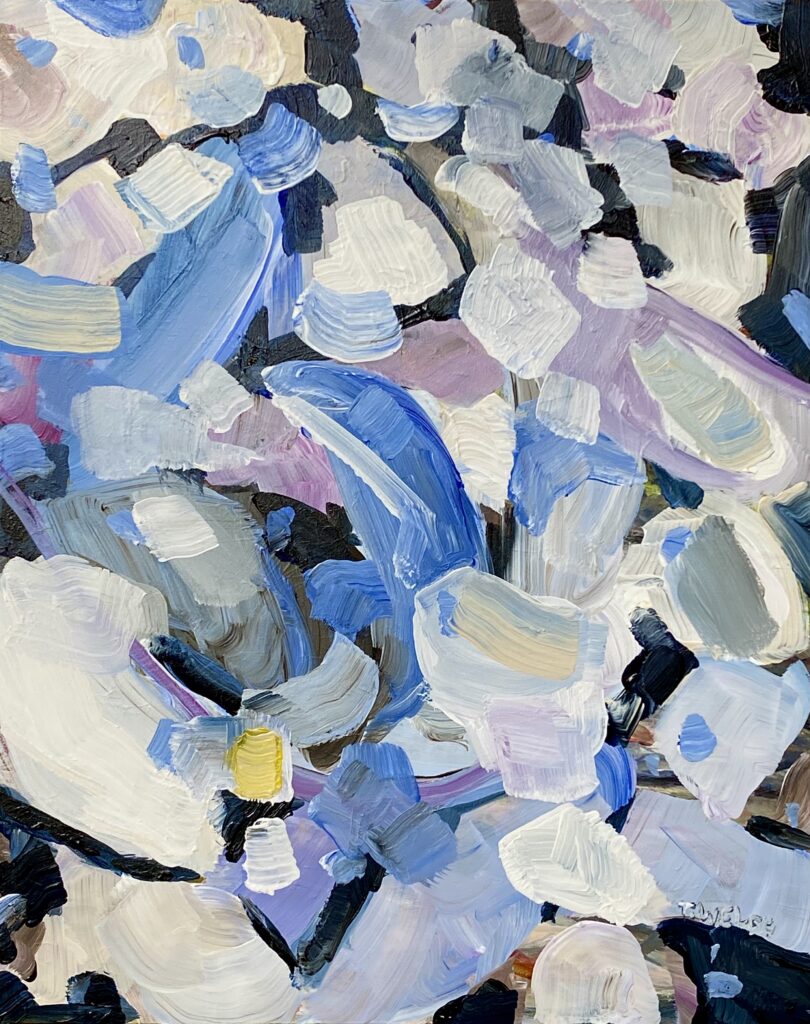
Making Notes:
Kneeling close to the seafloor with no reason to name, I feel my way into and across the shapes, textures and patterns remembered. Leisurely, layered, abstract mark making meanders onto the painting surface with consideration that is devoid of expectation. Then, a purposeful addition of a bit of soft sun yellow. I find myself rhythmically letting go and reclaiming in a way that is similar to the movement of tides.
Reflective Analysis:
This is the third fully abstract rendering I have done of the seafloor over the past 18 months. All three are small 10 x 8 inch studies with the first two completed at the shoreline en plein air. When I completed the two plein air, I wasn’t sure I had accomplished my primary intention of bringing my first viewer experience of the place to the paintings. However, the paintings have grown on me and seem to strongly hold the experience of each day of painting. This third studio abstract work also keeps my sense of the place front and centre. So much so that I wanted to set the painting side by side with the initial references gathered the day before just to see how they felt together.
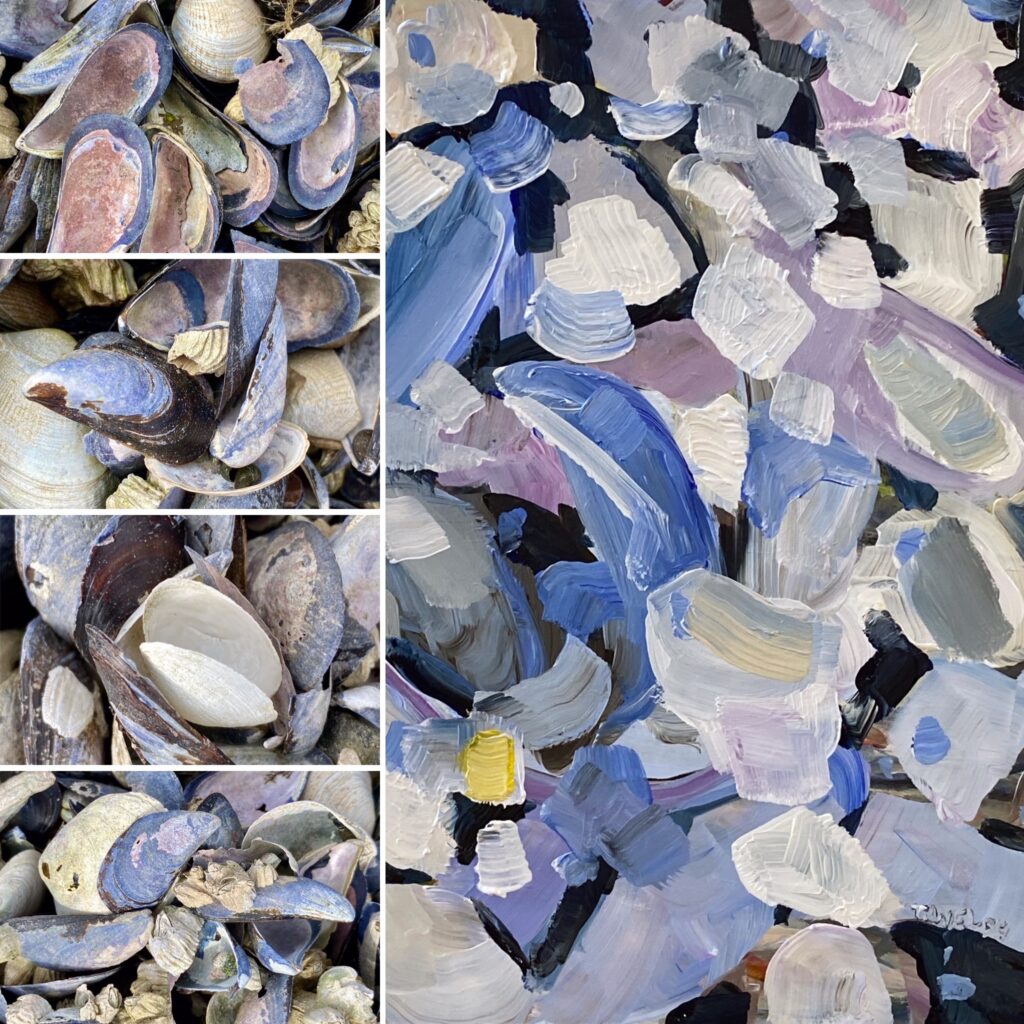
The palette similarities surprised me as well as the rough shapes of the all over abstract painting that speak to how my brain first grapples with what I am seeing before it has filtered through an identification and naming process. It is only a split second but that abstract space offers something valuable to me. I can feel my body relax and open up as I take in ‘Seafloor Fragments’ and my sensory system fully embraces its reparative powers. I say to myself - ‘this is just what I needed’.
Reflexive Analysis:
Abstract painting has had a small and not particularly well received roll in my painting practice by either me or the majority of my art collectors. Why is this? The approach is not new nor cutting edge. Abstract painting has been around almost as long as impressionist painting. Is it simply a matter of personal taste or is it the critique of what is unceremoniously called ‘zombie abstract’ that is intended to enhance a designer or architect’s room, often large but holding a decorative accent value rather than a deeply integrated rendering of a creative process that is to be ‘sat with’ and carefully considered for its own value? I don’t have an answer to these questions yet but it is something that I want to investigate further.
Key Findings:
Abstract painting is not something I have readily embraced in my practice as it didn’t seem to have a use or offer something that I valued. Now I am reconsidering this. I am not ready to embrace full abstract as a way forward in my painting practice but take it on board as a valuable tool to strengthen my nature-centric landscape painting practice similar to the way I use my nude figure drawing studies, not as an end but as a way of strengthening my landscape painting. It is like building various painting muscles to stay fit and explorative over all.
Anything else:
I see more full abstract explorative studies in my future. Possibly in a similar way to my figure drawing that is not part of the main body of my work but a supporting actor to strengthen the rest of the work.
Well, if you are still with me, this is the conclusion of the new paintings. Thank you for coming out in the field and back to the studio with me for these many hours of painting and study.
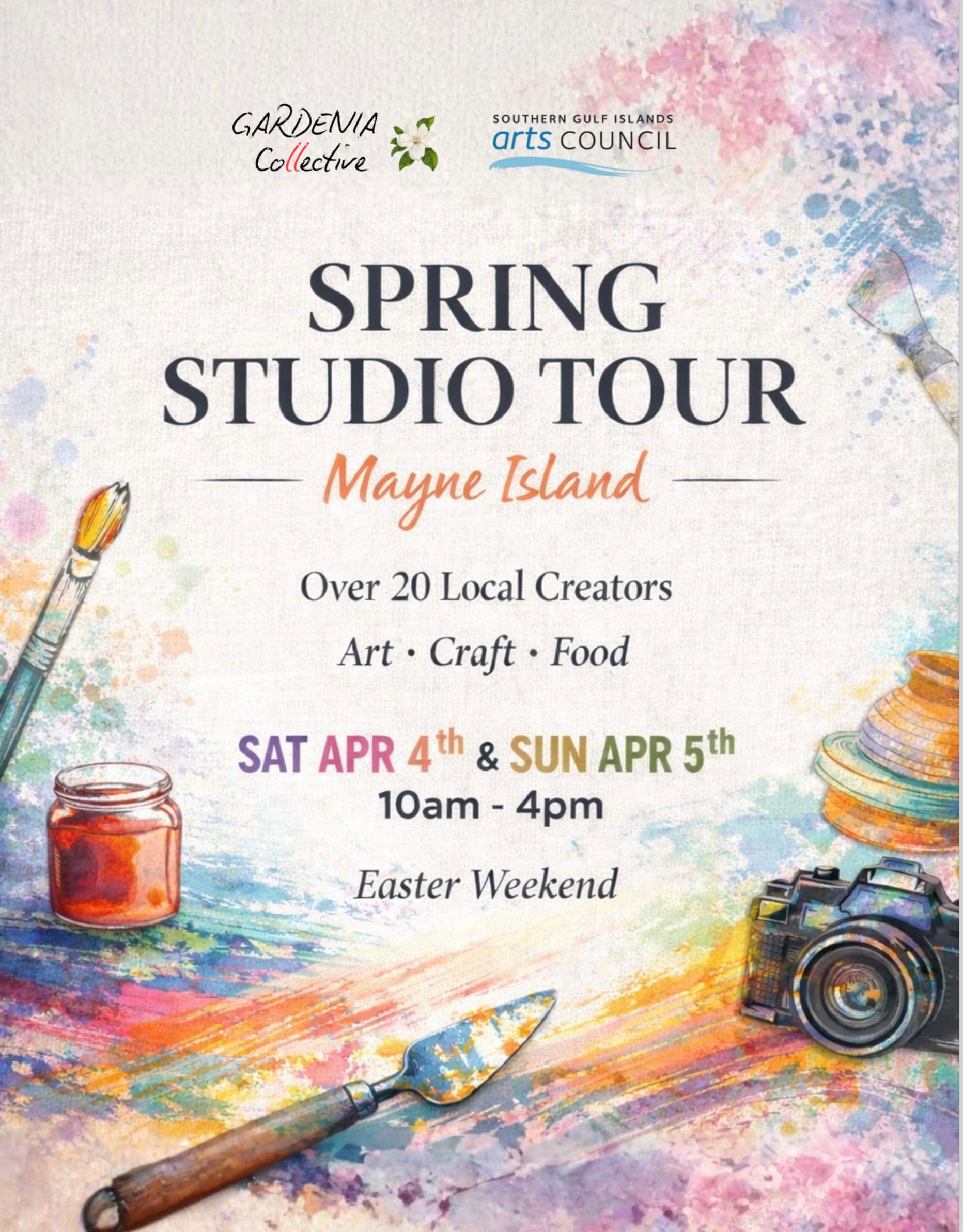
MAYNE ISLAND SPRING STUDIO TOUR
The poster below includes everything you need to know. I will have maps to hand out at the Terrill Welch Gallery Pod, 428 Luff Rd on Mayne Island, if you are coming from off island or happen to drop by here first. Feel free to contact me if you have any questions.
UNTIL NEXT TIME
I do hope you enjoyed this totally immersive experience into my painting practice and life as an artist. I am going to keep my closing remarks brief as this issue is already long enough!
Warm regards and I look forward to hearing from you by whatever means works best for you!
Terrill 👩🎨❤️🎨
 Terrill Welch
Member discussion