Terrill Welch by herself - issue #41 Finding Space and Making Meaning
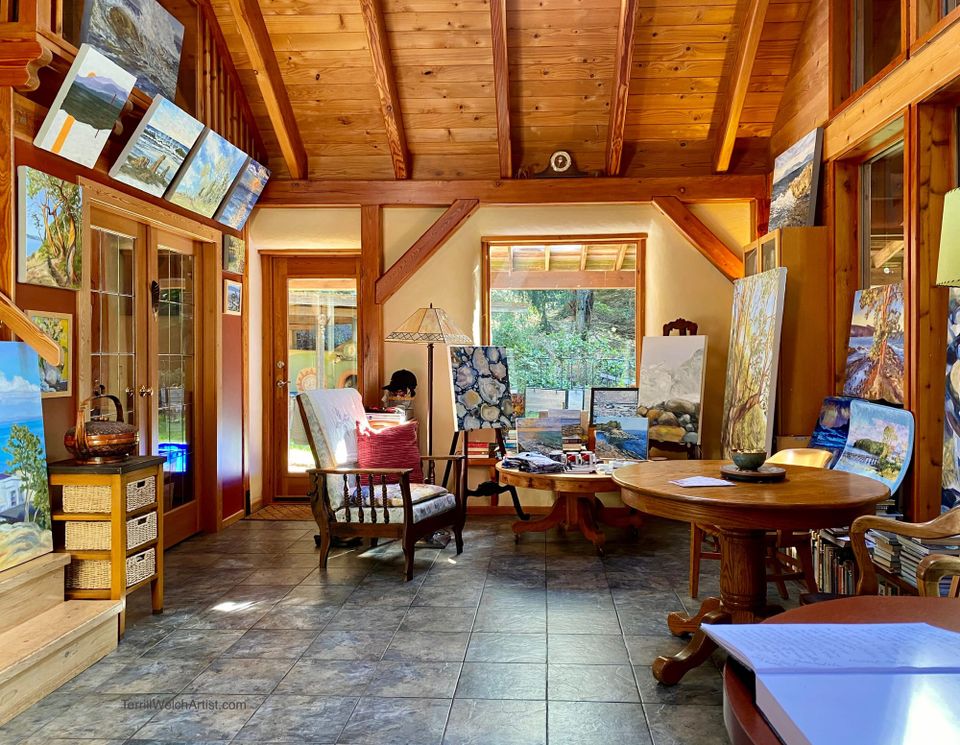
In my world, April showers bring plein air painting in the Japanese Memorial Garden and another art show for early May at the Sage Hayward Vineyard on Saturna Island. I have three new painting completed and several still to get into the inventory as I balance the many tasks for school, the studio, the gallery, the art business and our daily lives. However, the yearend and income tax paperwork did make it to the accountants office at the end of March. So not everything is off the rails! I also have my notes for you from my part of an interesting presentation that I did yesterday that I think you will find intriguing. Let’s start and see how we get on shall we!?
Please Note: Reminder if you are receiving this newsletter via email, it may be clipped short. For full and best viewing, click on the ‘view in browser’ link underneath the title and my name and the date.
PLEIN AIR PAINTING IN THE GARDEN
I am never disappointed by my time in our Mayne Island Japanese Memorial Garden. A few weeks ago, I made a short video capturing part of my experience.
This past weekend, my eldest grandson came to visit with his partner who is also an artist. We took advantage on one hazy midday to set up in the garden to paint.
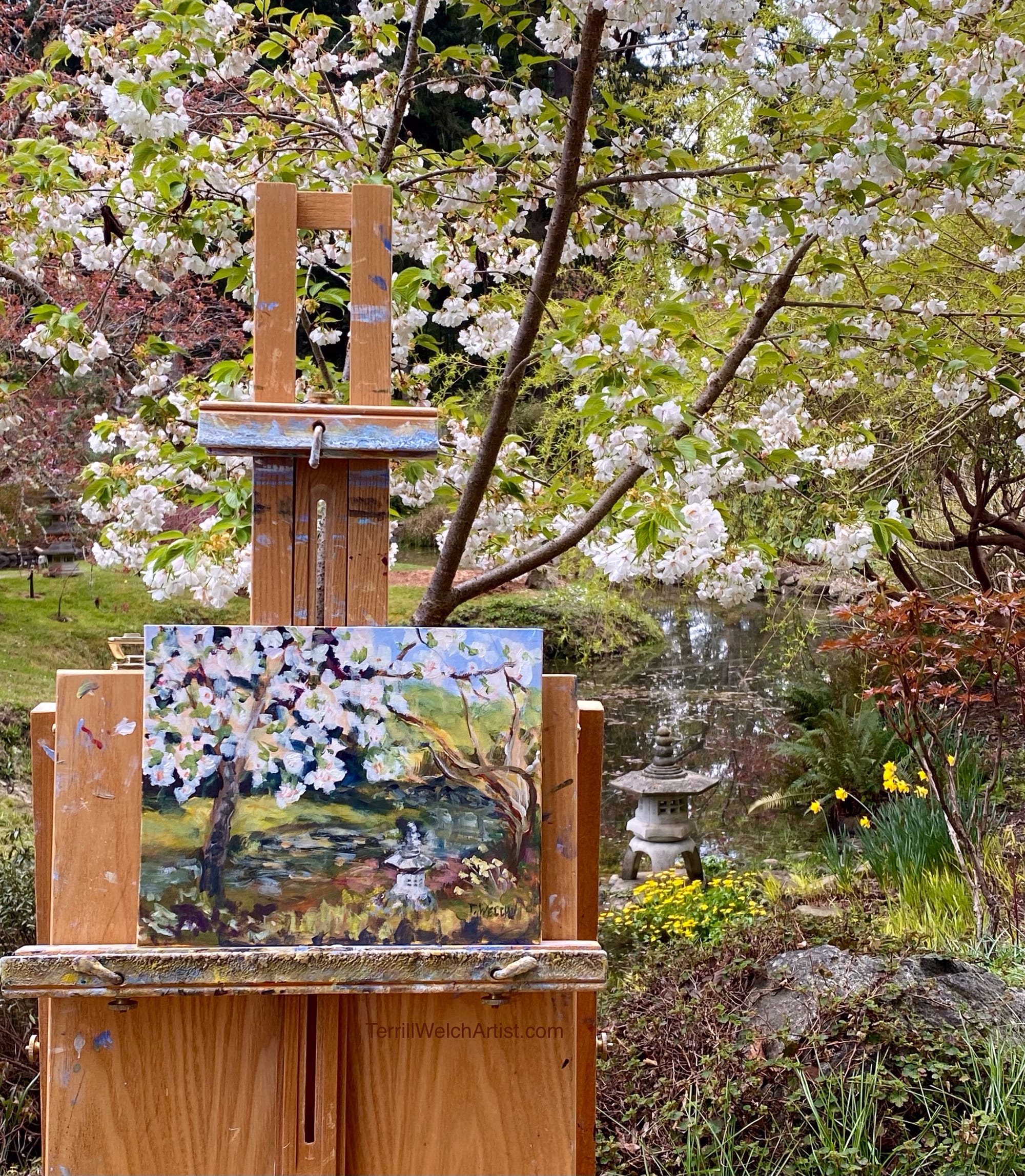
I didn’t get her permission to share her or her work so you will have to imagine us working quietly side by side while my grandson meandered the garden around us.
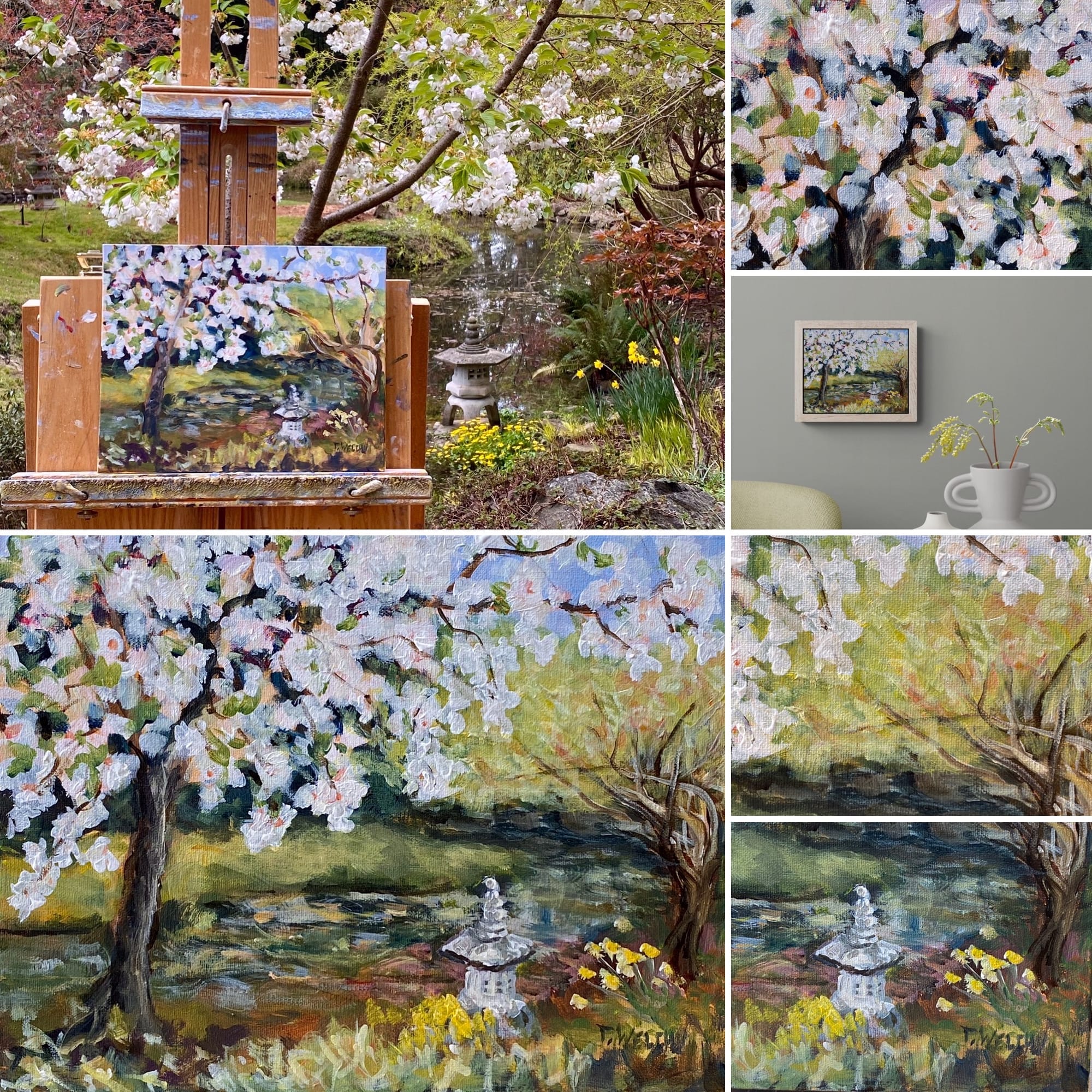
This painting isn’t for school and is just for me to taken in the moment through my brushes. It is available and will be listed as soon as I find a moment to do so.
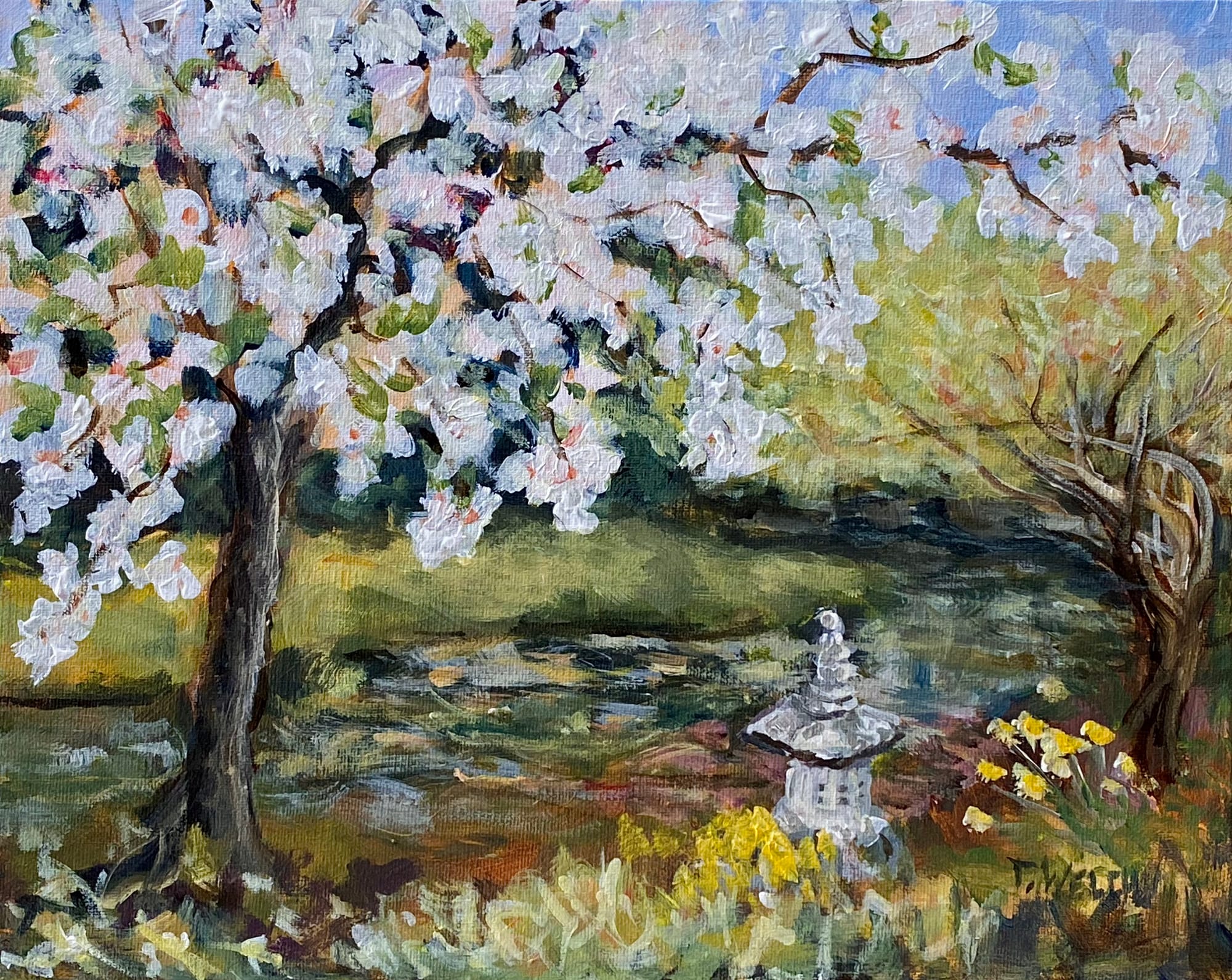
Artist notes: The spring air is warmer than expected inside the walls of the Mayne Island Japanese Memorial Garden. Filtered light sometimes escapes from the overhead haze and then settled quietly again as if the effort needed for brilliance is too much. I brush snatches of light and shadow onto the linen board with unhurried concentration and finished it later from memory in the studio.
VINES AND VISIONS EXHIBITION
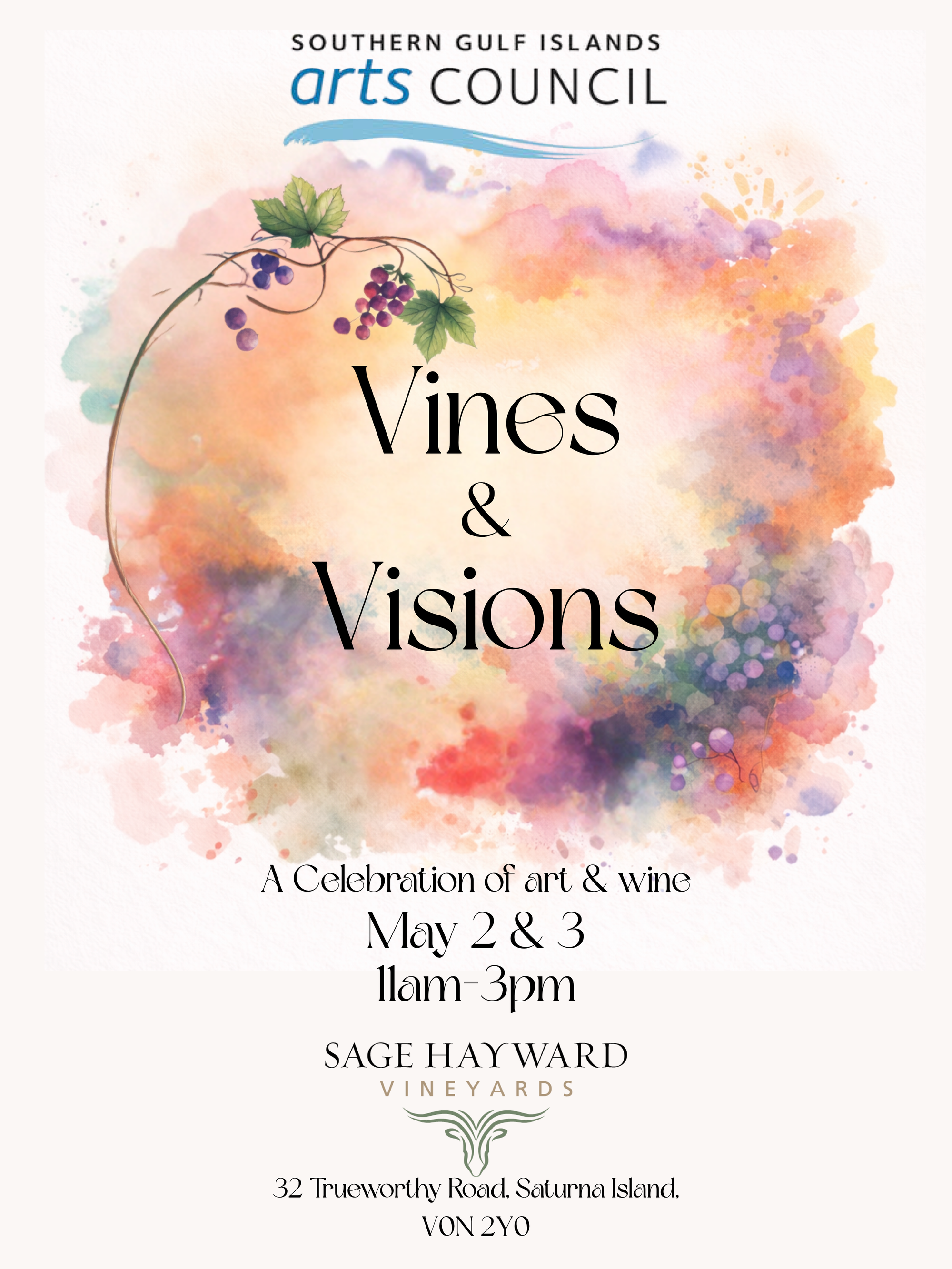
I think everything you need to know about the show is in the poster. I will have three paintings in this show along with the work of over 20 other artists from Saturna Island and Mayne Island. I am not able to attend but thanks to a fellow artist and one of the organizer, my paintings can make it. Unfortunately, as far as I know, the show doesn’t have an online accompaniment. But if you are up for a visit to Saturna Island, the exhibition will be worth taking in.
NEW PAINTINGS
TIDAL ARRANGEMENTS PAINTING DATA COLLECTION
Monday, 30 March 2026
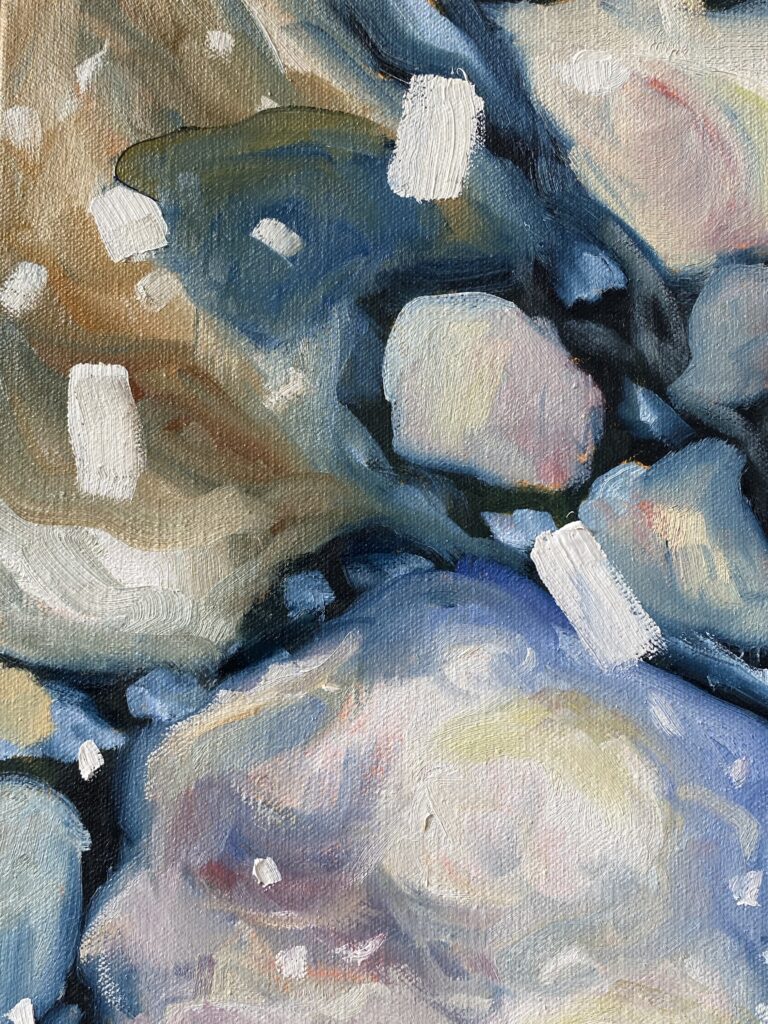
Figurative/Abstract Self Assessment Band-Scale Rating between 1-10:
The rating for a range of 7-9 on my mark making scale can be seen in the detail below with the floating rectangle over abstract shapes that loosely hint at the shapes of shells.
Reference Gathering:
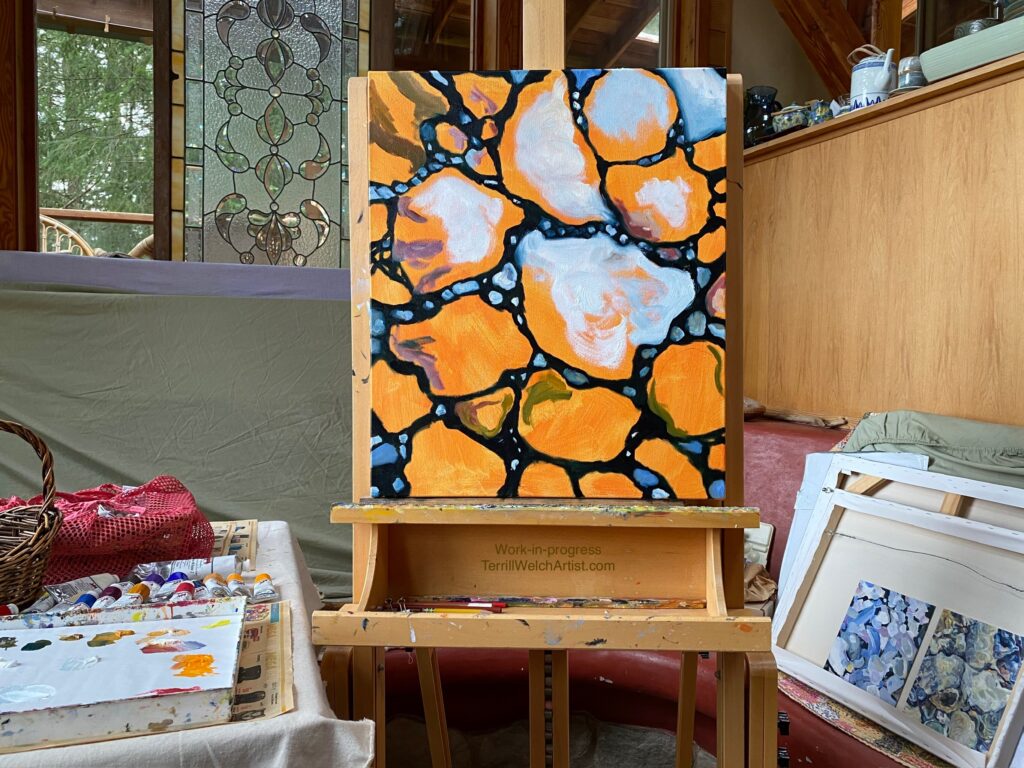
The references used for this painting are two earlier acrylic 10 x 8 inch studies of an abstract painting ‘Seafloor Fragments’ completed 8 March 2026 and a child’s view painting ‘Underwater Study’ completed 29 January 2026. They can be seen near the bottom right in this work-in-progress image.
Making Process:
There had been a big windstorm and we had lost power the evening before at 5:00 pm and it had still not come on in the morning. It was perfectly filtered light in the studio and our propane fireplace was keeping the house warm enough to work in the studio. I painted for 3.5 hours straight and shortly after that the power came back on after a 22 hour outage. I had charged my phone in the car before I started so I was able to take work-in-progress images as I went. The middle image is the finished painting with the progress running down the left side and then down the right side of the image collage.
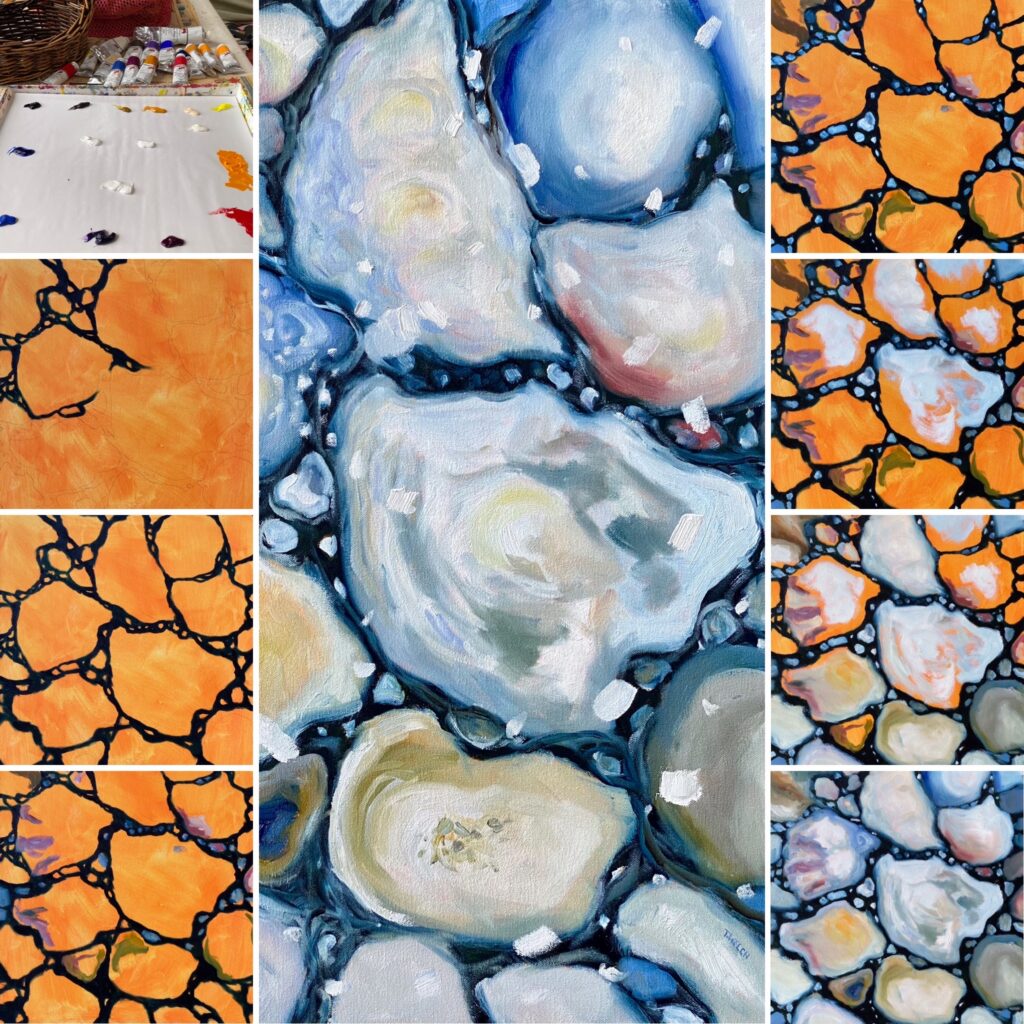
Finished Painting:
Here it is in a room view to scale in order to get a better feel for the work.
Making Notes:
A slow incoming Salish Sea tide, arranges the seafloor gently, shifting particulates by weight and volume, compassionate, sensual. Filling the depths beneath the sand and pebbles with icy coolness. Gathering small broken bits to float on the surfaces. Nudging larger worn shell shapes into place. The sea moves as if sharing intimate secrets that I recognize but cannot quite decipher. I stay. I watch. I listen for more clues.
Reflective Analysis:
I continue to explore the tension between abstract and figurative mark making with the intent to only offer the bare minimal of descriptive detail yet enough to spark some familiarity for the imagining. My comfort level with painting the Seafloor has strengthened to the point that I can work from memory and imagination rather than a few specific references. This offers additional freedom of expression.
Reflexive Analysis:
I consciously focused on being an incoming tide licking my salty wetness around each shape and texture as I shifted and arranged them into place. It was in this practice that the English language attached to each shape evaporated and only their essence was left behind. The house was extra still and quiet with the power being off. My thoughts drifted to painting in my childhood when we did not have electricity to go out. Now as then, my place in the world expanded with rhythmic purpose. I was using a new brand of oil paint that I had only used a few times before. This required consideration in mixing rather than using my muscle memory. But it wasn’t difficult. During this long painting session, there seemed to be a direct connection to my idea, my hand and the brush. I was a human critter but without age, gender, culture, class or geographic definitions or restrictions. My primary concern was the canvas on the easel and the paints on my palette.
I stopped here and left the rest for a short painting session the next morning.
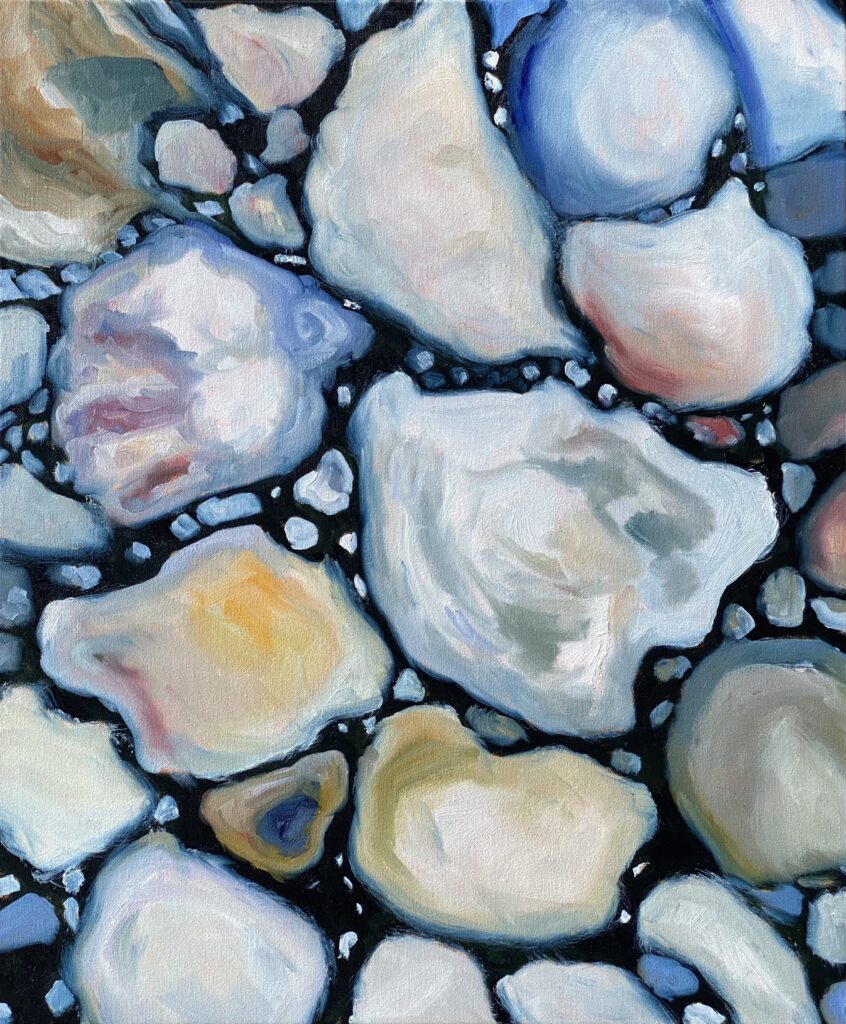
I knew I wanted to do another layer but I was tired enough that I didn’t trust my ability to make good decisions. I am glad I waited as I painted and repainted the final layer in my dreams during the night. The finishing work went quickly and smoothly.
Key Findings:
I thought I would put it in a room view to scale using the Canvy App for us and also pair it up with the previous painting ‘Web and Wash’ to see what kind of conversations they can have.
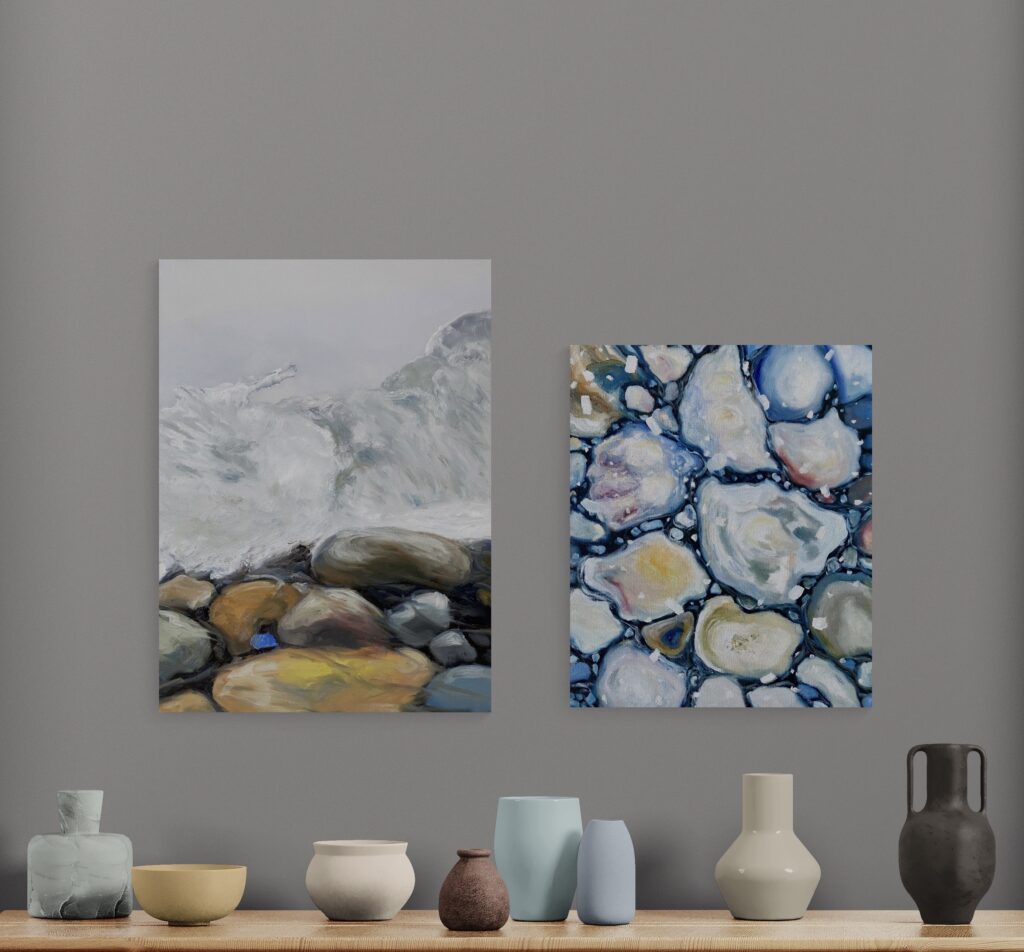
What I notice is that as I go closer to the seafloor and take in smaller areas the colour masses become larger and less defined. Yet, in feedback from viewers, they experience the rocks in ‘Web and Wash’ as boulders rather than pebble size and the wave as a large standing wave instead of one that is three inches high. In ‘Tidal Arrangements’ the shells become smooth stones to viewers instead of tiny bits of shell. The unfamiliar viewer seems to scale the elements up in the paintings to fit their human reference rather than become small in the environment. I am not sure this is anything that needs to be addressed but it has been interesting to observe.
Anything else:
The one thing that has remained consistent throughout the past eighteen months of painting the seafloor is that I find the same endless variation and options as I did painting the broader and grander views of our sea and landscapes. When other artists say they get bored with their work or their subject, I find it hard to understand what they are experiencing. If someone told me that I could only paint this one specific 20 square foot piece of the seafloor at the tideline for the next 10 years, I don’t think I would run out of new ideas for a unique painting. There are just never two moments that are the same and I always find something new to try. This, coupled with what life throws at me, gives me plenty of autoethnographic material to examine from a nature-centric perspective. In fact, after eighteen months, I feel like I am just getting started and just beginning to get my bearings on the seafloor.
SHIFTING SHAPES IN THE TIDES DATA COLLECTION
Monday, 13 April 2026
Figurative/Abstract Self Assessment Band-Scale Rating between 1-10: 4-9
I carefully scrutinized my personal band scale rating assessment tool to determine this rating that in my first viewer eyes handily holds this wide swath of mark making through time. I am going to place the scale here again so that it is easier to follow my observations.
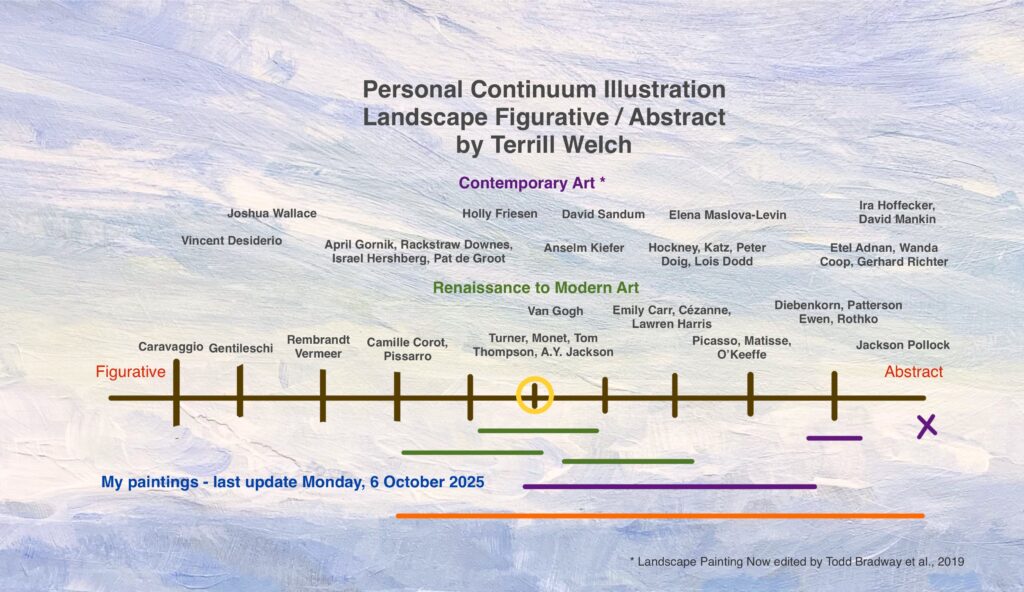
This painting needs to be assessed as a whole so let’s do this as well.
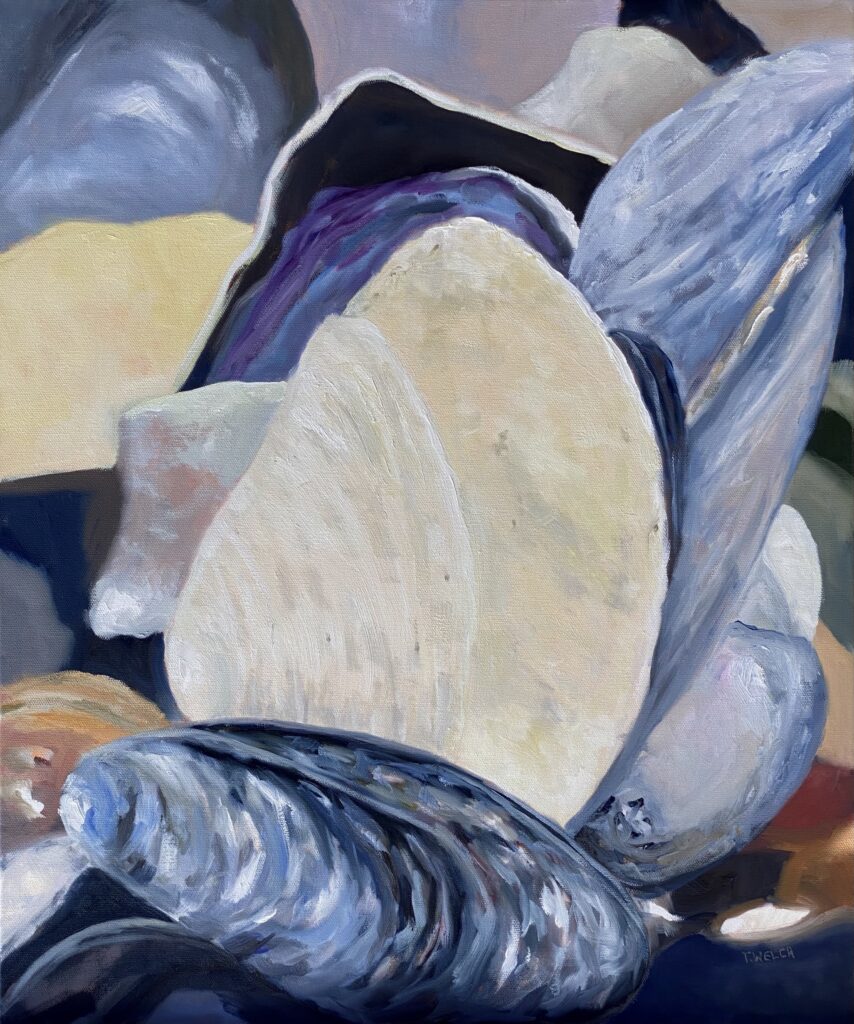
On the rating of 4 end of the continuum, Corot, Pissarro, Gornik, and de Groot came to mind with the realism of the central shells even though these artists did not paint such intimate close up ‘landscapes of the small’. It is the mark making itself that I am referencing. Then if we consider the mark making move out from the centre the work of Harris, O’Keeffe, Diebenkorn, Rothko, Dodd and Adnan influences are recognizable. All together, this is the most timeless painting I may have ever completed from within a continuum of recognizable genres while still being very much my own work.
Reference Gathering:
My reference gathering continues to have a softer presence in my work but is still significant. Here is a collage of field images that influenced the development of this painting.
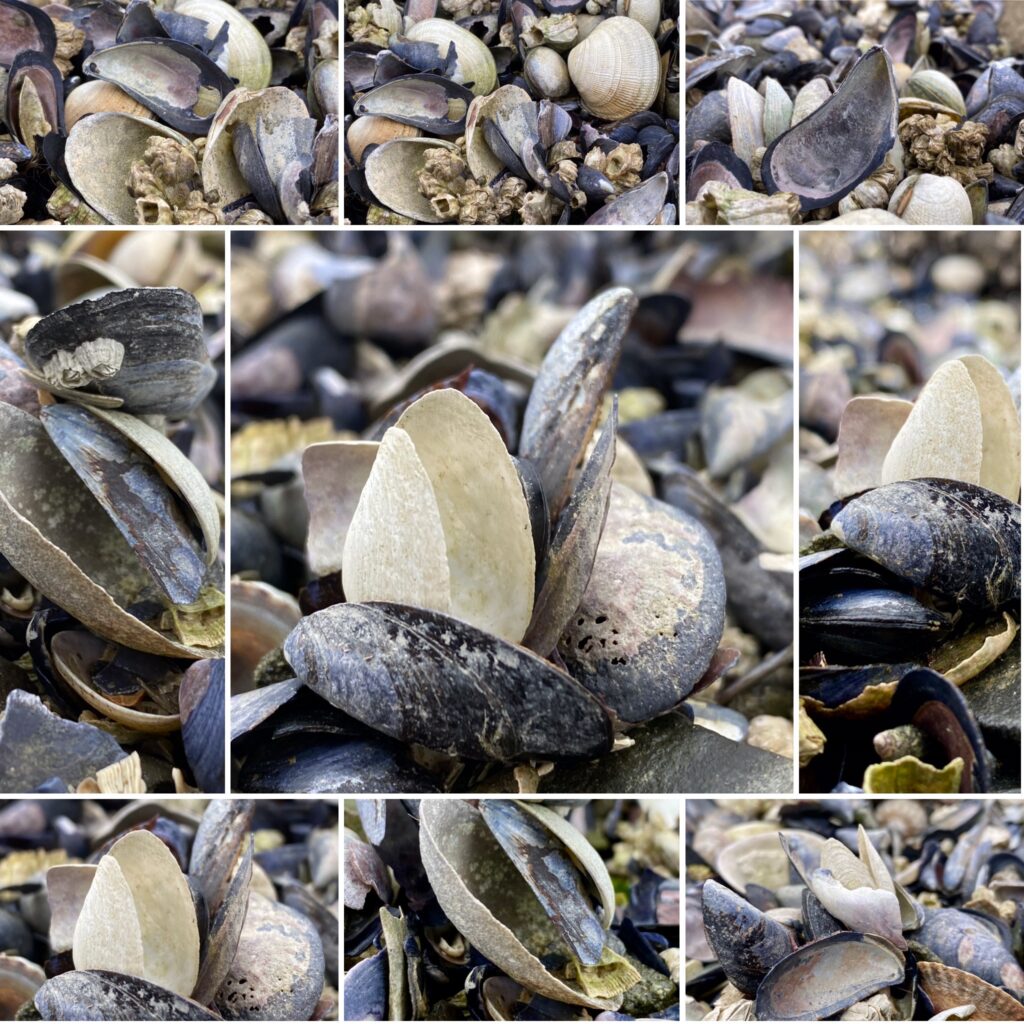
Making Process:
There was nothing unfamiliar about the first stages of my painting process for this work even though the painting delivered stronger results than other attempts to stretch this continuum of mark making. I knew from the beginning that I wanted some striking details for the central shells and strong abstract shapes that overflowed the edges of the painting.
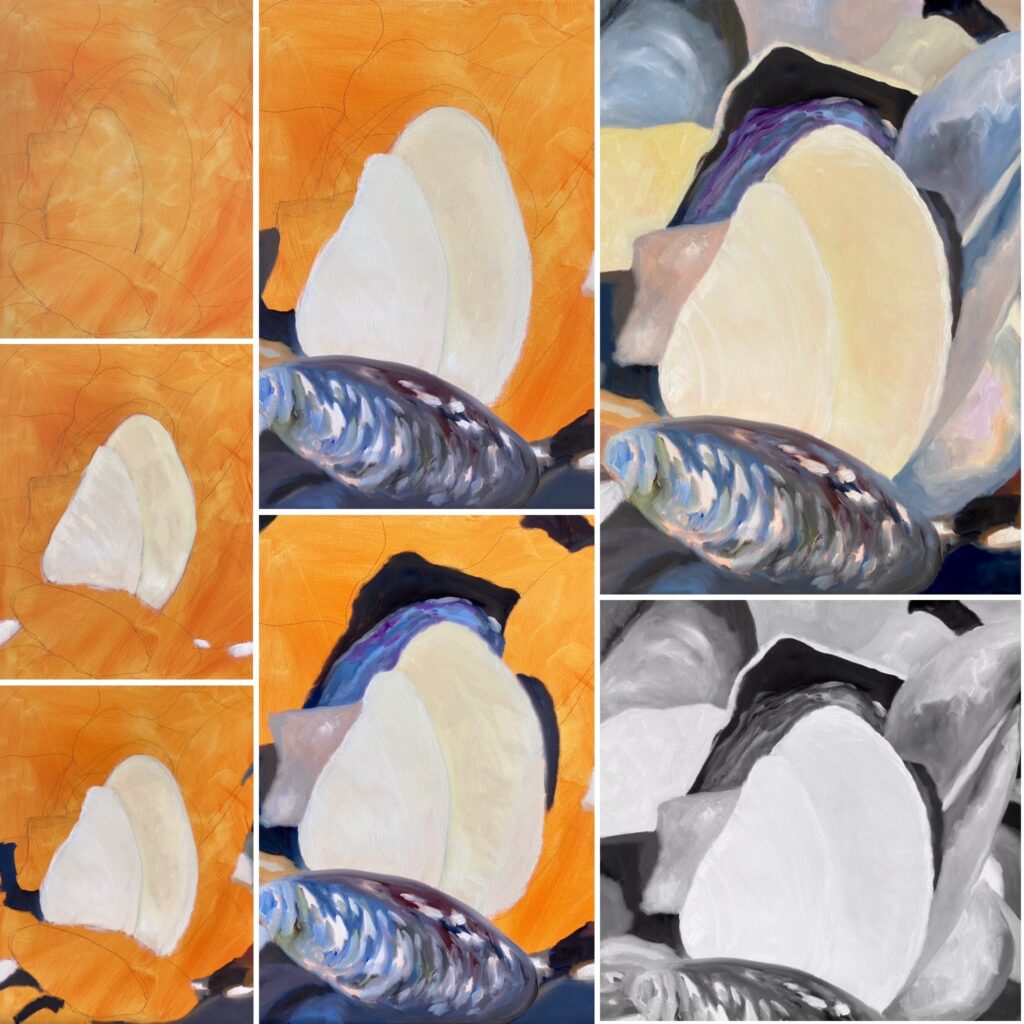
I stopped at the point of having the work blocked in and walked away with a grey scale image to contemplate how I was going to continue. I was going to leave it for a few days but when I woke up the next morning I knew exactly what I wanted to do and nothing else was going to get done until the last brushmark was laid to rest on the canvas.
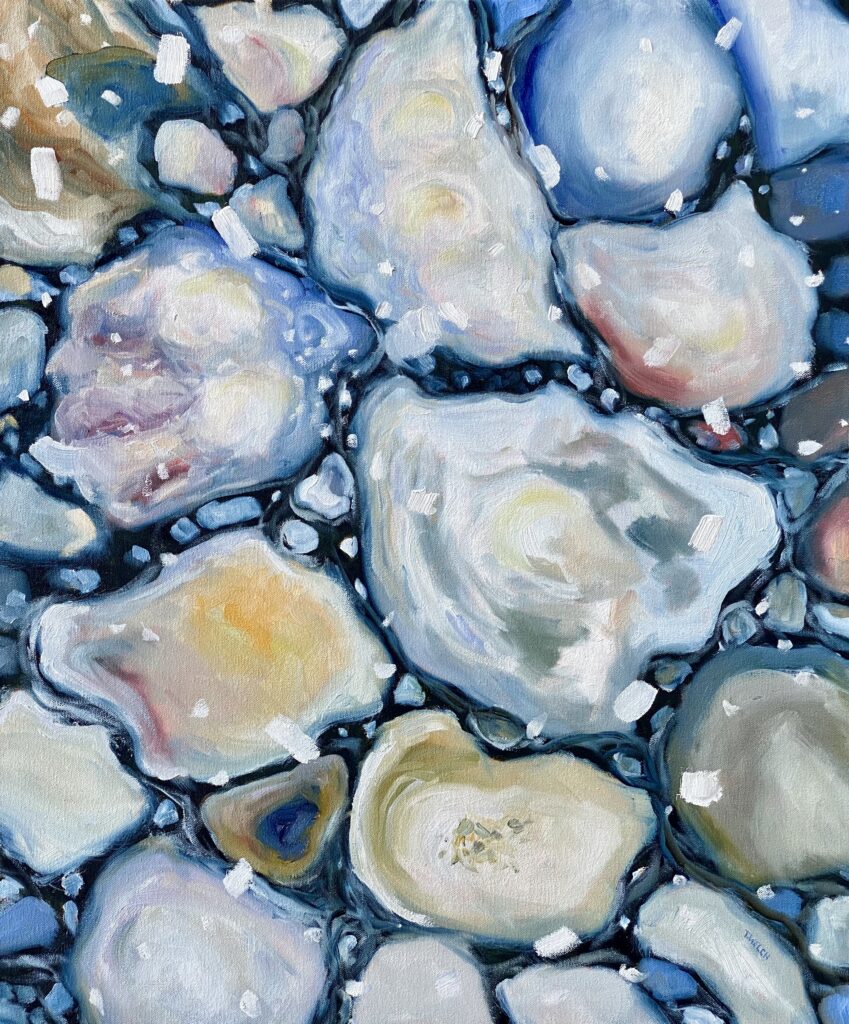
Finished Painting:
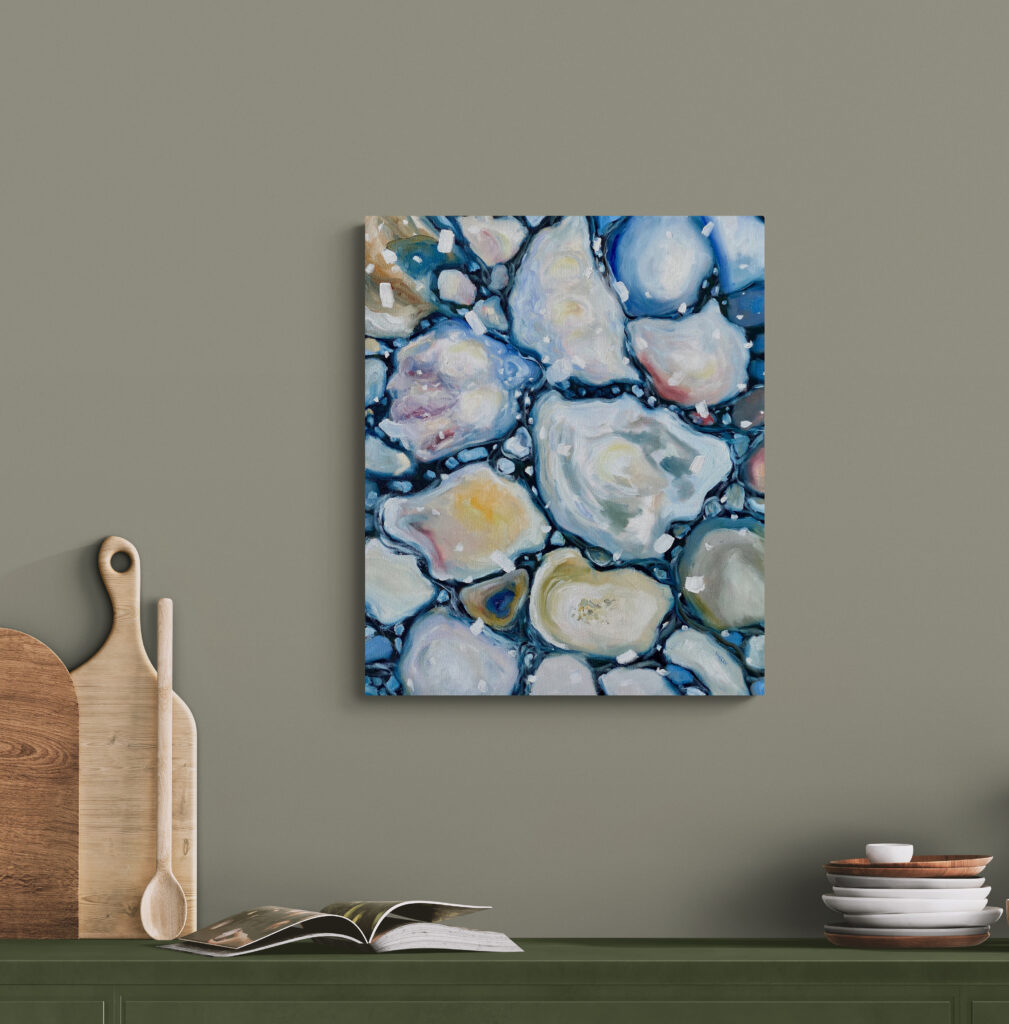
Let’s add a room view just to get a wee bit of distance…
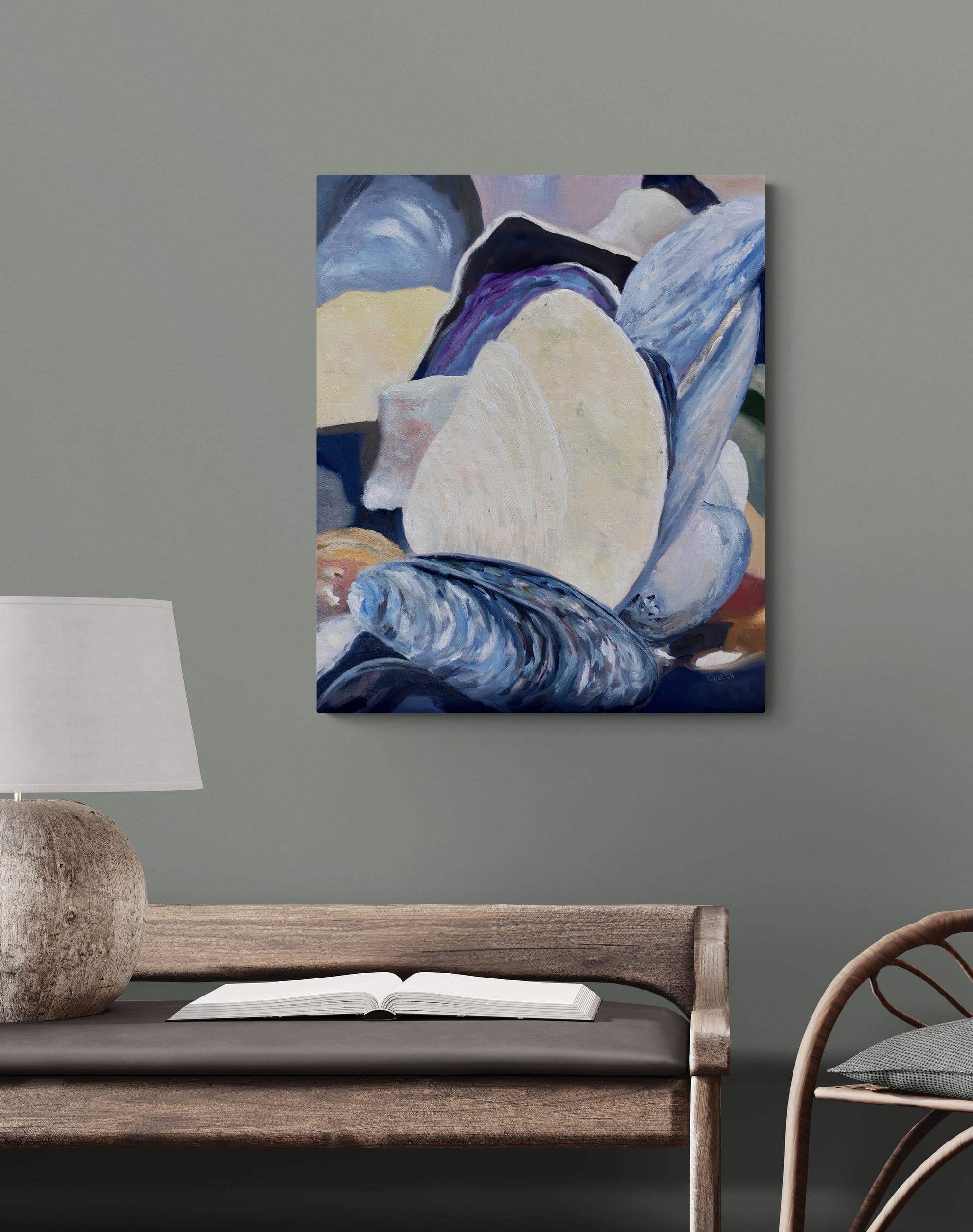
Making Notes:
Bunched along the bottom of the reefs, broken and whole empty seashells have been organized by the tides into abstract shapes and muted patches of colour. I never see the same combination twice. Each visit offers something new to discover as I get down close to the landscapes of the small on this pungent seafloor. My intention is to move rhythmically between figurative and abstract shapes offering a few identifiably seashells with more obscure abstract coloured shapes that anchor to the mystery of tides while letting paint be paint.
Reflective Analysis:
I admit that I am quietly excited about this work that from my perspective successfully combines mastery with expression in a considered, rigorous and robust manner. There is a tension that I recognize which holds throughout the canvas. Bold yet restrained when necessary as it braved the mystery of the seafloor without being prescription in its narrative details. Now my question is - can it hold? Can I repeat this breadth of expression in future exploration without it becoming a methodological crutch? Can I keep the brave freshness as I move forward? The truth is that there never seems to be a straight line forward. I often zigzag in ways that seem sporadic and divergent from my core intention. That said, this is the tension and the possibility that has kept me coming back to the field almost daily and returning to the easel for years. So we shall see.
Reflexive Analysis:
I easily recognize my first relationship to nature as my daily life is embedded in its expression. The more distant and less accessible references to art history and chosen mentors and colleagues are less tangible but not invisible to me as is noticeable in my assessment of mark making for this painting. However, I am at a point of wanting to evaluate my reflexive autoethnography tools. Based on a history of sociology and gender study education and my past employment theory and research practices, I developed a framework and this data collection method for my painting practice. I have been testing this tool and my thinking since the painting of ‘The Long Goodbye’ completed August 5, 2026. So far I have completed 14 data collection templates and posted them in my journal. I now want to reflect on what is working and not working. What should I keep doing, stop doing and start doing? Is there anything else I should be mindful about? To do this I am consulting not just the data I have collected but also the work of Heewon Chang in her book Autoethnography as Method (Chang, 2016). I have chosen Chang’s work as a way to assess my data collection beyond the framework I currently have in place because of the depth and clarity of her analysis that demystifies the strengths and pitfalls of this approach. I am not able to stop painting and gathering data due to my course requirements. Therefore this review will need to happen alongside my ongoing painting practice research.
Key Findings:
This painting’s data collection is a good place to pause and begin this review. However, I am not going to do this here but rather in a separate document. The reason I want to critically analyze my data collection is that I am fairly certain that my theory and research painting practice is going to outlive my MA in Fine Art. I am preparing to have this methodology follow me and become part of my ongoing way of working. Therefore, I want the critical analysis to be as strong as possible as I move forward beyond my formal degree requirements. I want it continued with my structured research and critical assessment because it is a meaningful way to move my practice forward.
Anything else:
This commitment to ongoing formally structured investigative nature-centric painting research practice has surprised me in some ways. I have always written up my artist notes for each painting since I started working full-time as an artist. However, upon reflection these notes have often stopped at the surface and immediate moment of the painting process. My data collection process has gone much deeper in its reflection and reflexive critical thinking and analysis. I want to keep this going forward, even if it doesn’t always end up in a newsletter post or immediately anywhere in the public domain (though this is highly unlikely simply because of my ingrained workflow).
Reference list:
Chang, H. (2016). Autoethnography as Method. Abingdon, Oxon: Routledge.
ENTANGLEMENTS THAT REQUIRE ART PRACTICE BRAVERY
Part 1 ‘Entanglements that require Art Practice Bravery’ presentation by Terrill Welch
Presented Thursday, 16 April 2026 OCA, Ma in Fine Art, Unit 3.
Introduction:
In our two part provocation the overarching title and topic are:
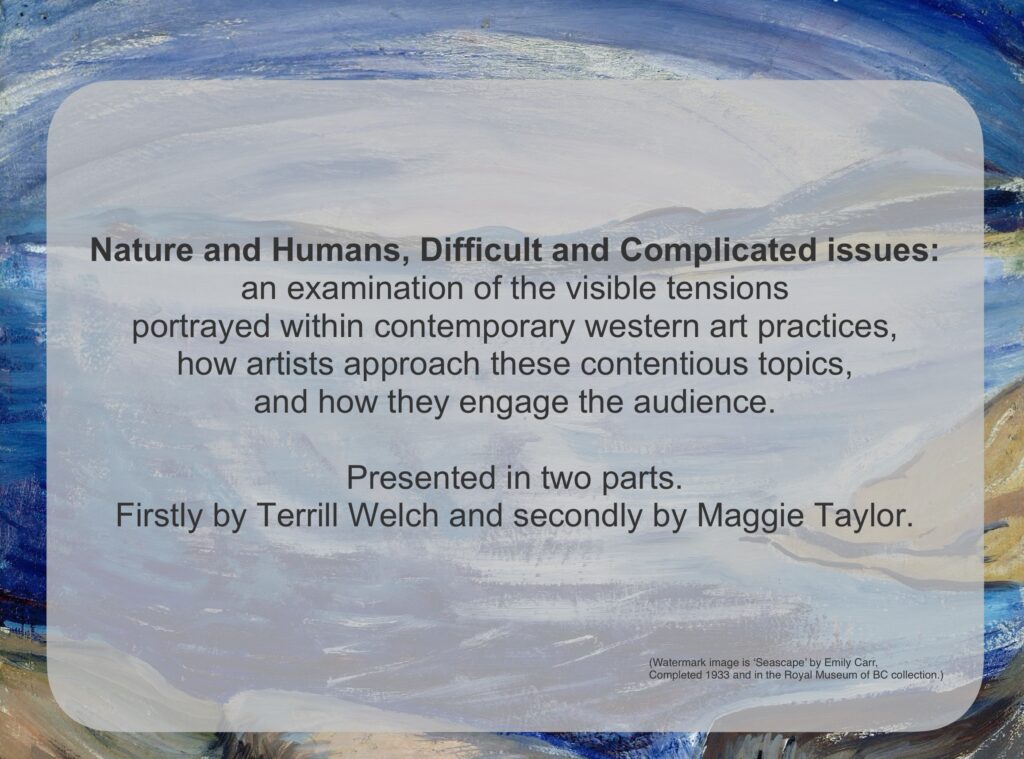
Nature and Humans, Difficult and Complicated issues: an examination of the visible tensions portrayed within contemporary western art practices, how artists approach these contentious topics, and how they engage the audience.
We are presenting separately. I will go first.
Part 1
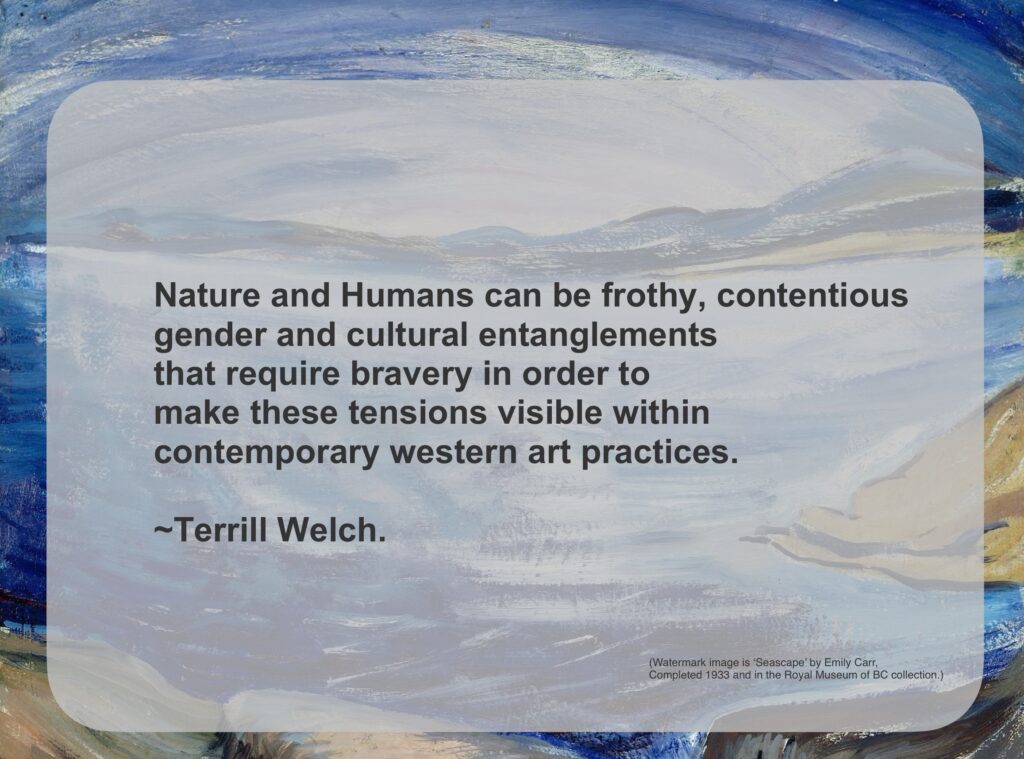
Nature and Humans can be frothy, contentious gender and cultural entanglements that require bravery in order to make these tensions visible within contemporary western art practices.
Using a nature-centric lens (Oliver, 2024), I am positioning this topic within a Canadian context. I will present issues relating to gender/gender fluidity, cultural/cultural appropriation and nature/environmental impacts. I will demonstrate the complexity within these entanglements and the value of bravery, boldness and overtly explicit exploration of these tensions in our creative work even when it is uncomfortable for the artist or viewer.
Philosopher Anthony Rudd claims that ‘good paintings in general are of value because they disclose essential aspects of reality’ (Rudd, 2022, p.9).
Reality comes with authenticity, vulnerability and honesty in an artwork. But there are cautions.
I am going to present examples from three different artists.
Trained in the United States, France and England, Emily Carr 1871-1945) is of English heritage and born in Victoria, British Columbia. I want to focus on her commitment to document Indigenous culture through her early to mid career.
This descriptive painting is from 1912 and early in her career.
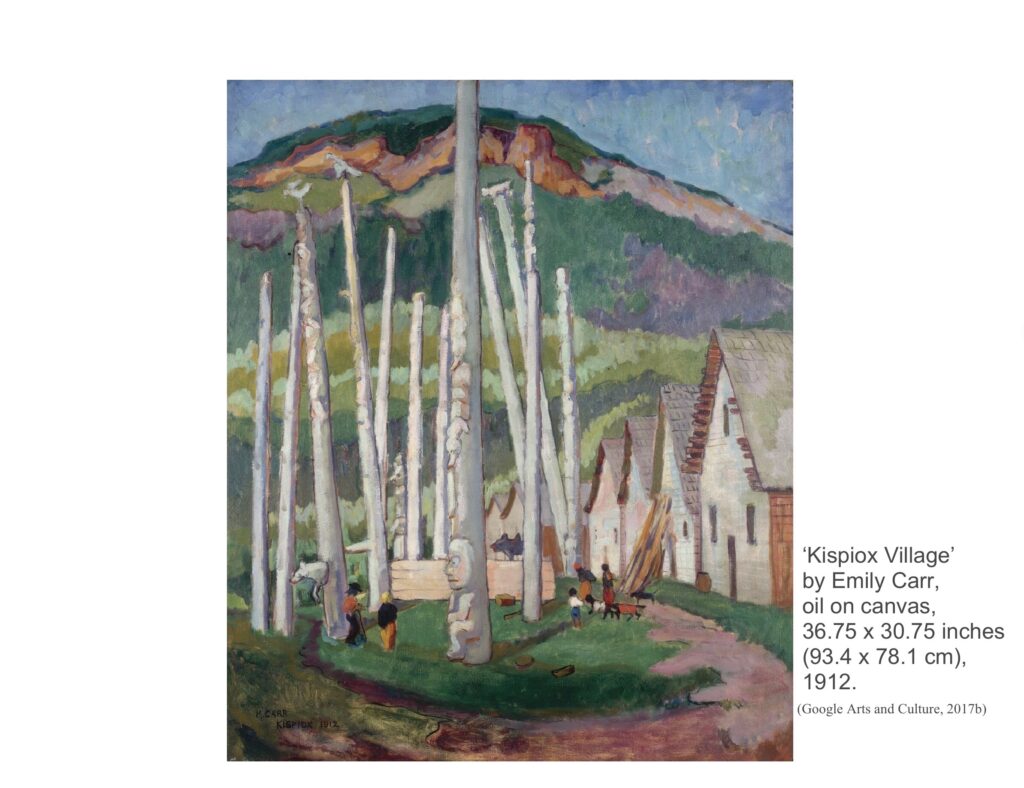
Image: ‘Kispiox Village’ by Emily Carr, oil on canvas, 36.75 x 30.75 inches (93.4 x 78.1 cm), 1912 (Google Arts and Culture, 2017b).
This next cubist influenced painting of the same subject is from later 1929.
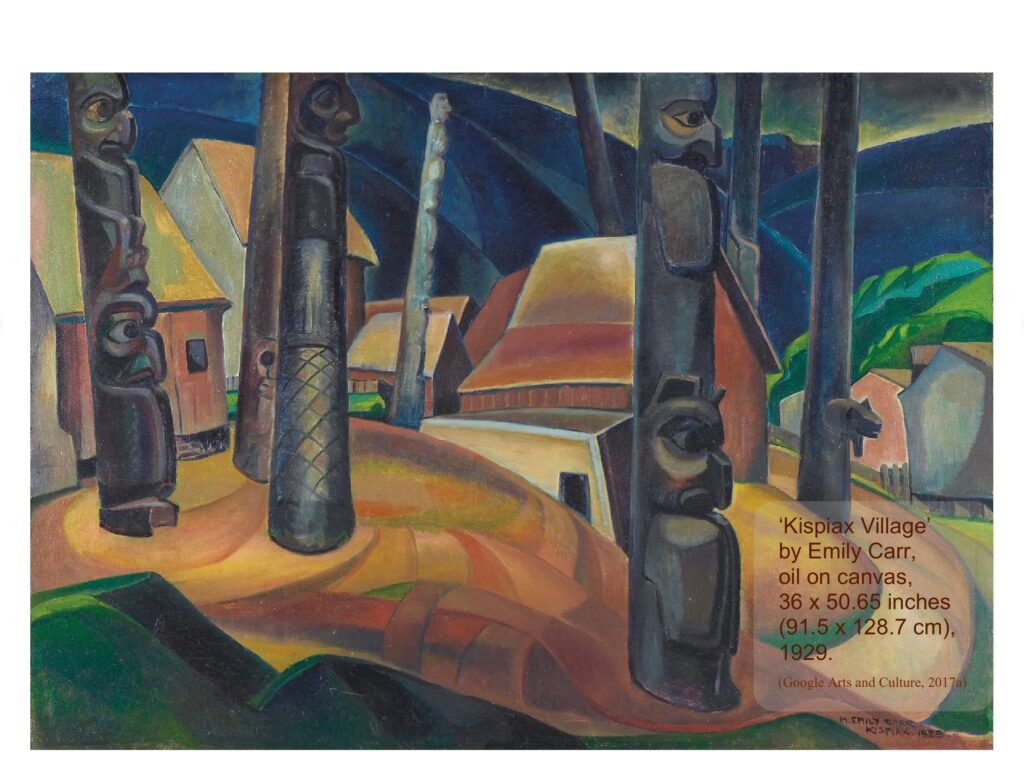
Image: ‘Kispiax Village’ by Emily Carr, oil on canvas 36 x 50.65 inches (91.5 x 128.7 cm),1929 (Google Arts and Culture, 2017a). [This is the same village. Carr spelt ‘Kispiox’ as ‘Kispiax’ in this second painting.]
Carr was one of the first significant artists out of Western Canada and considered one of the leading figures in Canadian modernism (Baldessera, 2015). But her complete body of work is not without its complications. Feeling alienated from her own family and culture, in her earlier career Carr pursued an almost romantic and idealized relationship to Indigenous culture that has elements of racism and overt appropriation and as Shirley Bear and Susan Crean point out ‘she had encountered the disapproval of elders to photographs and picture making, and more than once was accused of stealing the poles she was sketching’ (Carr et al., 2006 p7o).
Though much of her artwork during this period is brave in its subject matter and rendering, in hindsight, she fails to address the cultural appropriation of Indigenous culture which unfortunately today adds a caveat to her whole body of work.
The second artist, Bill Reid (1920-1998), was also born in Victoria to a Haida mother and an American Scottish, German father. Reid was a master goldsmith, carver, sculpture, broadcaster and community activist. He began exploring his Haida ancestry and artwork at the age of 23 and became an important figure both within and outside of the Haida community (Bill Reid Gallery, 2001).
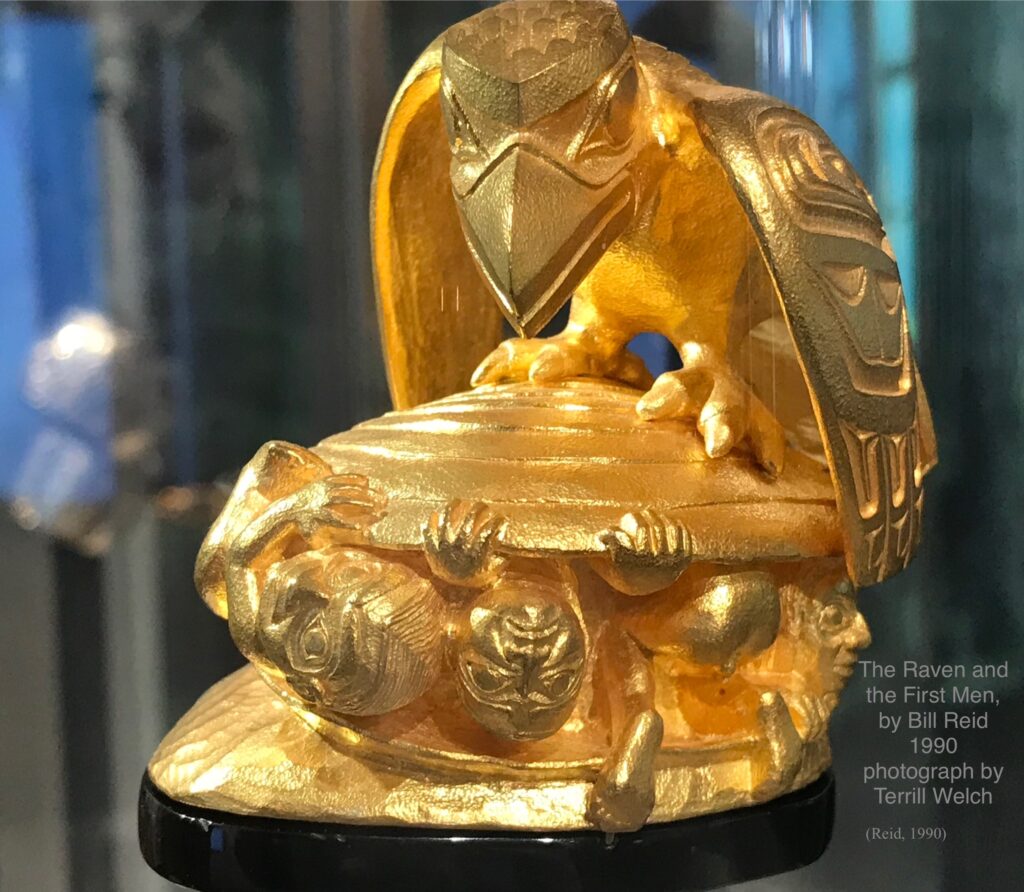
Image: ‘The Raven and the First Men’ by Bill Reid, 4 x 2 x 2.75 inch gold cast, 1990 (Reid, 1990).
The subject in this image of his work is one he created in many different forms.
Reid’s boldness and audacity comes from a different place than that of Carr. In his depiction of this creation story, the connection between nature and humans is inseparable. The intermixed use of goldsmith casting, Indigenous carving and sculpture techniques offers something that only Reid’s unique historically specific knowledge could provide.
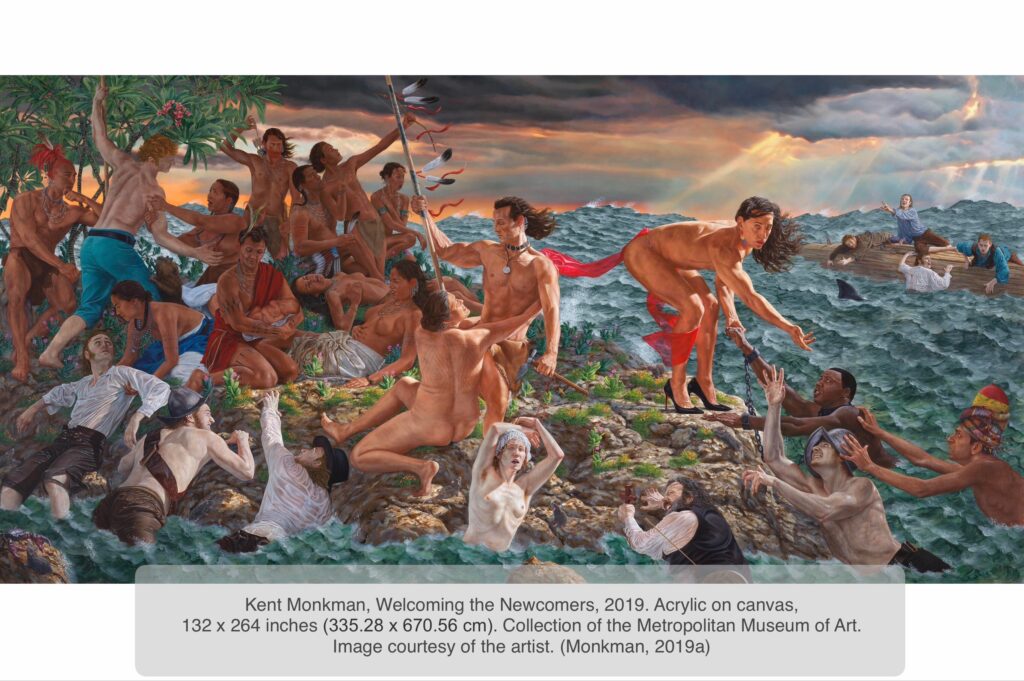
Image: diptych ‘Welcoming the Newcomers’ 132 x 264 inches or 11 x 22 feet or 335.28 x 670.56 cm (Monkman, 2019a).
Link to image:
https://www.kentmonkman.com/painting-2001-2019/welcoming-the-newcomers
Finally, Kent Monkman (1965- ), self identifies as an interdisciplinary Cree visual artist and member of the Fisher River Cree Nation of Manitoba, Canada. He lives and works between New York and Toronto cities and:
Monkman’s gender-fluid alter ego Miss Chief Eagle Testickle [whose looking directly at the viewer in this painting] often appears in his work as a time-travelling, shape-shifting, supernatural being who reverses the colonial gaze to challenge received notions of history and Indigenous peoples (Monkman, 2024).
Monkman’s appropriation of Western European and American history and grand narrative paintings to crack open dominant (white) colonial lenses and landscape/people exploitative assumptions is both uncomfortable and revealing to me. I immediately thought of ‘The Raft of the Medusa’.
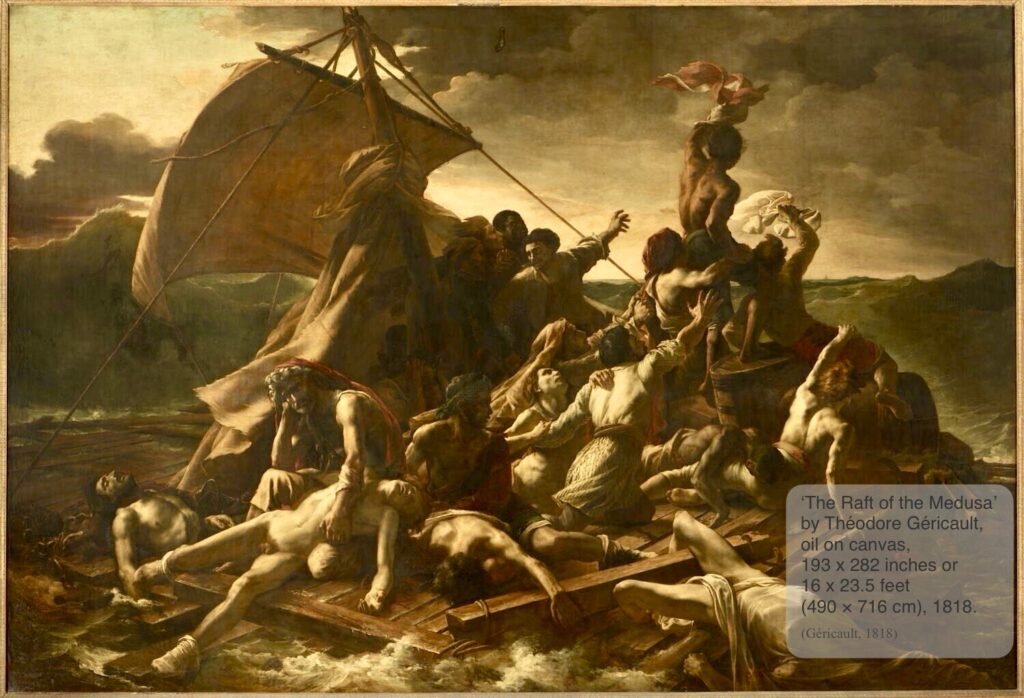
Image: ‘The Raft of the Medusa’ by Théodore Géricault, oil on canvas, 193 x 282 inches or 16 x 23.5 feet (490 × 716 cm), 1818 (Géricault, 1818).
What Monkman tells me is that this colonial encounter is important to consider from a Cree Indigenous perspective.
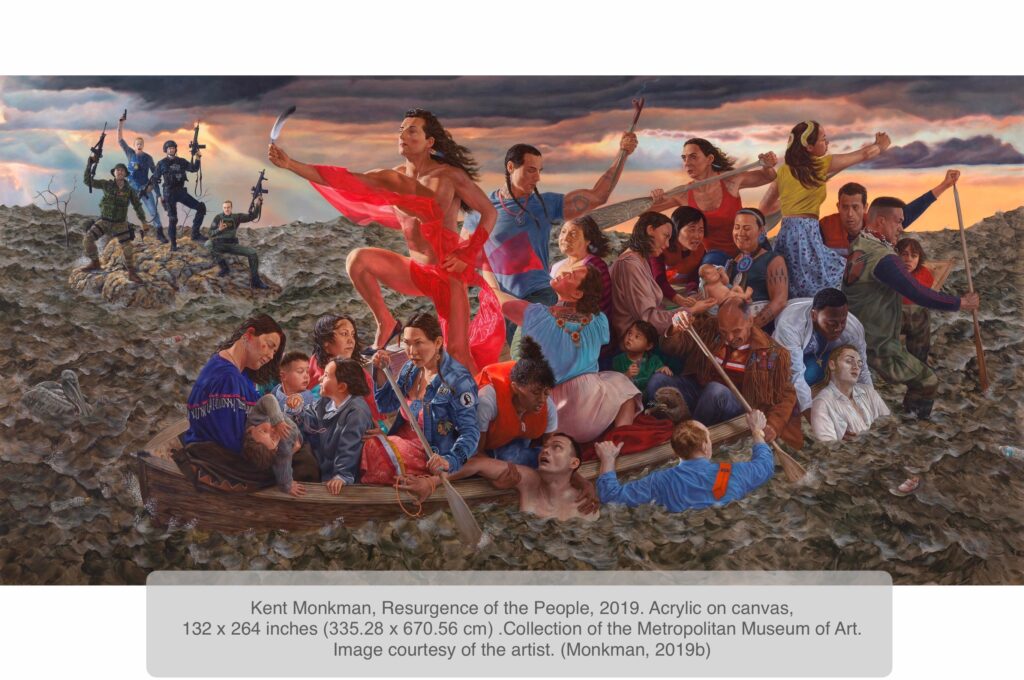
Image: ‘Resurgence of the People’ (Monkman, 2019b) by Kent Monkman) 132 x 264 inches or 11 x 22 feet (335.28 x 670.56 cm).
Link to image:
https://www.kentmonkman.com/painting-2001-2019/resurgence-of-the-people
In the Cree language there is no gender-distinct pronoun and gender has much more fluidity than female/male. The term ‘Two-Spirit’ came to Cree Elder Myra Laramee in a vision in 1990 and encompasses six different Cree words for Two Spirited people (Bannatyne, 2024).
Monkman’s work that is historically situated and specific to his experiences exposes my viewer’s internalized prejudices through his deliberate appropriation of colonial tropes and western grand narrative painting. I encourage us to take our time to unpack both of these paintings in relation to gender/gender fluidity, culture/cultural appropriation and nature/environmental impacts.
Conclusion:
In my presentation I argue that braveness and boldness are critical to good artwork even when they are uncomfortable for the artist and potentially shocking for the viewer. Yet, to appropriate art motifs from a non-dominant culture as a member of a dominating society is unacceptable and, in Canada at least, can discredit the artwork. That said, the reverse might not equally apply.
Bravery is important and essential but there are nature and human entanglements that must be considered.
A tool we can use to assess our own work is to ask ourselves- Is it my story to tell? Do I have the appropriate permissions? Is it ethical?
End Note: I was pleased to get permission to use Kent Monkman’s two painting images for my presentation and later for my newsletter. His assistant sent high resolution images and information about how he would like the work attributed in the presentation. The other historic painting images are in the public domain with the exception of the Bill Reid gold cast which I took when at the gallery with permission to use for personal and educational purposes.
Reference list:
Bannatyne, C. (2024). Indigenous 2S/LGBTQQIA+ Identities | Archives | The University of Winnipeg. [online] Uwinnipeg.ca. Available at: https://archives.uwinnipeg.ca/our-collections/indigenous-2slgbtqqia-identities.html [Accessed 9 Mar. 2026].
Bill Reid Gallery (2001). Bill Reid Gallery | About Bill Reid. [online] Bill Reid Gallery. Available at: https://www.billreidgallery.ca/pages/about-bill-reid [Accessed 10 Mar. 2026].
Carr, E., Hill, C.C., Lamoureux, J., Thom, I.M., National Gallery Of Canada and Vancouver Art Gallery (2006). Emily Carr : new perspectives on a Canadian icon. Ottawa: National Gallery Of Canada.
Géricault, T. (1818). Le radeau de la Méduse. [online] Musée du Louvre. Available at: https://collections.louvre.fr/en/ark:/53355/cl010059199 [Accessed 16 Mar. 2026].
Google Arts and Culture (2017a). Kispiax Village - Emily Carr - Google Arts & Culture. [online] Google Arts & Culture. Available at: https://artsandculture.google.com/asset/kispiax-village/HQHDIK0gtbn8ZQ [Accessed 12 Mar. 2026].
Google Arts and Culture (2017b). Kispiox Village - Emily Carr. [online] Google Arts & Culture. Available at: https://artsandculture.google.com/asset/kispiox-village-emily-carr/xwE6FX9PBzZrAA .
Monkman, K. (2019a). Kent Monkman. [online] Kent Monkman. Available at: https://www.kentmonkman.com/painting-2001-2019/welcoming-the-newcomers [Accessed 9 Mar. 2026].
Monkman, K. (2019b). Kent Monkman. [online] Kent Monkman. Available at: https://www.kentmonkman.com/painting-2001-2019/resurgence-of-the-people [Accessed 9 Mar. 2026].
Monkman, K. (2024). Biography. [online] Kent Monkman. Available at: https://www.kentmonkman.com/biography [Accessed 9 Mar. 2026].
Oliver, T. (2024). The Rethink | Awakening the nature-centric mindset. [online] ASRA Network. Available at: https://www.asranetwork.org/news/the-rethink-awakening-the-nature-centric-mindset
Rudd, A. (2022). Painting and Presence: Why Paintings Matter. Oxford University Press.
UNTIL NEXT TIME
As we each go boldly forward into the uncertainty of our everyday, I wish for us curiosity and the willingness to be pursued so that we can sway and rebound with the winds of change. A quiet Sunday mist lingered across the valley. Sleep slipped out from under my linen sheets just before dawn. I stretched into the soft light as an eagle broke the grey stillness across the valley. During moments like this, I know I am right where I need to be. Then the sun comes out with the most brilliant blues and I know that this too is perfect.
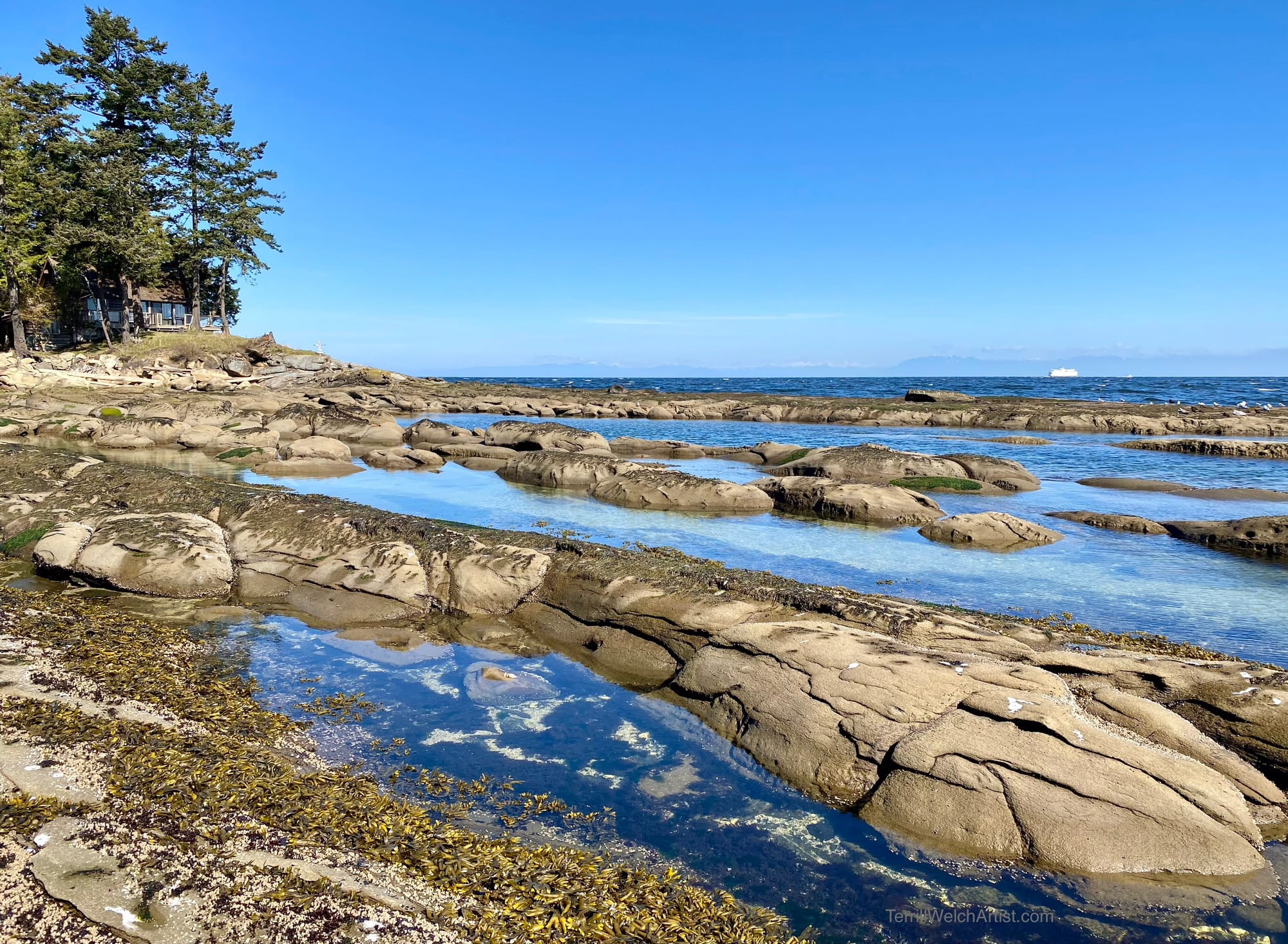
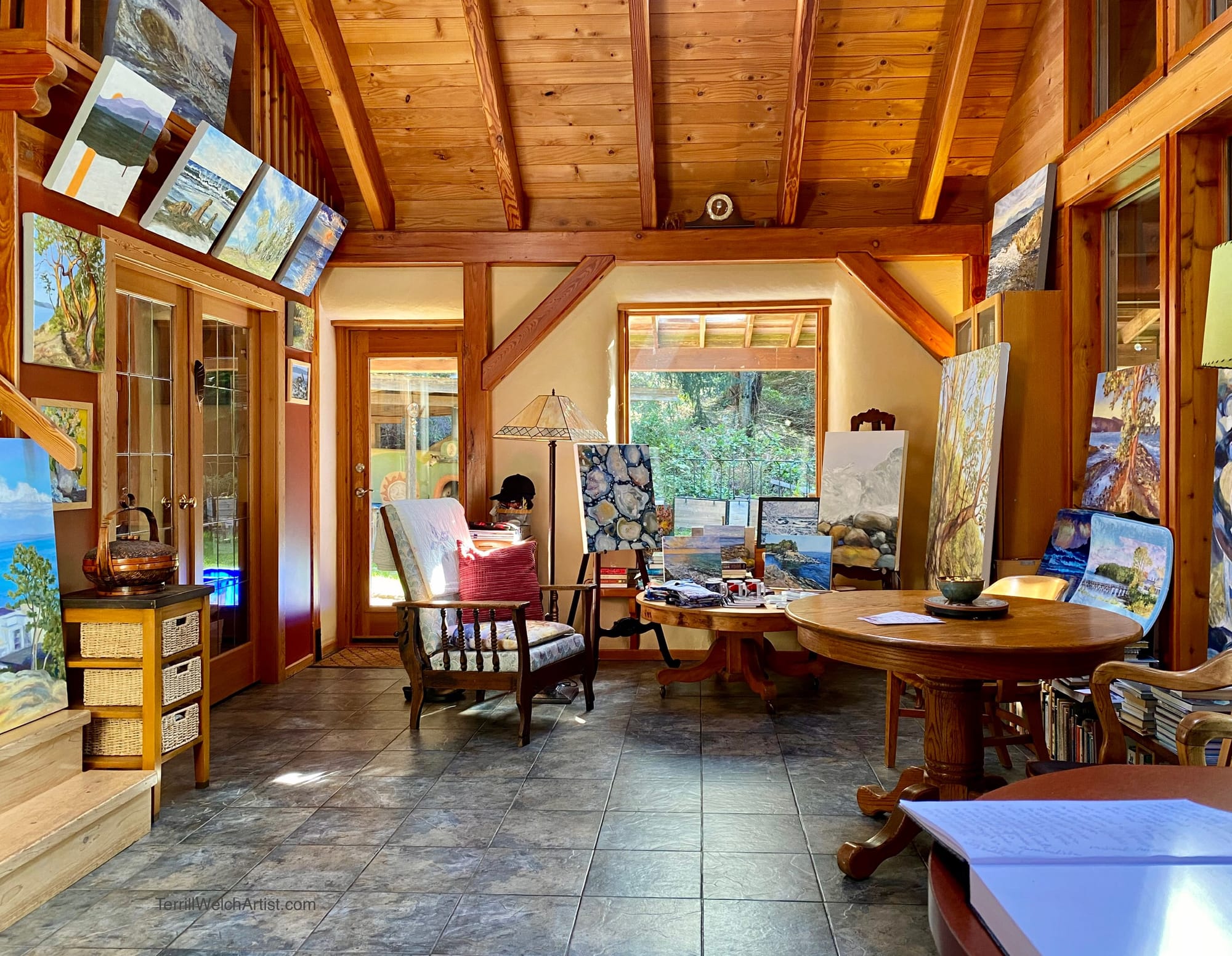
The studio tour was a success with many meaningful conversations and introductions and sales of a few smaller items. We enjoyed catching up with those we knew and meeting others for the first time.
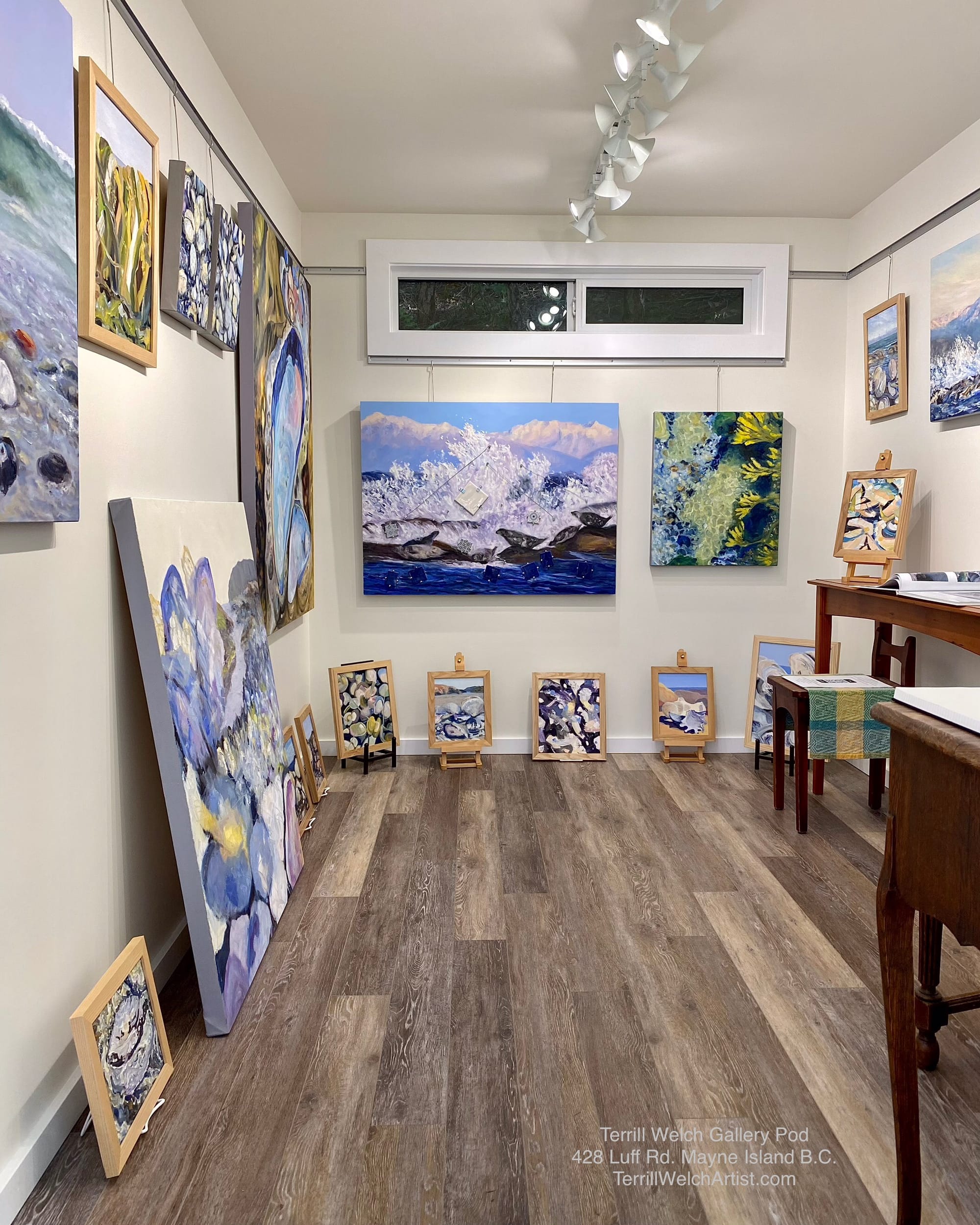
The Terrill Welch Gallery Pod received many accolades and continues to be open daily from 11-4 for walk in self-browsing at 428 Luff Rd.
I am at the point in my unit for school that I must lock in and keep my eye on the tasks that come up one after another at a good fast clip. Still, visiting with family and friends is something that must be worked into the mix even if it means pushing a little harder in and around these moments of connecting as I remind myself of the importance of living in community that is both near and far.
All the best and we shall catch up with you again next month. As always, I would love to hear from you with either comments or via private email to tawelch@shaw.ca
Terrill 👩🎨❤️🎨
 Terrill Welch
Member discussion